
How to recognize and identify minerals: a practical guide

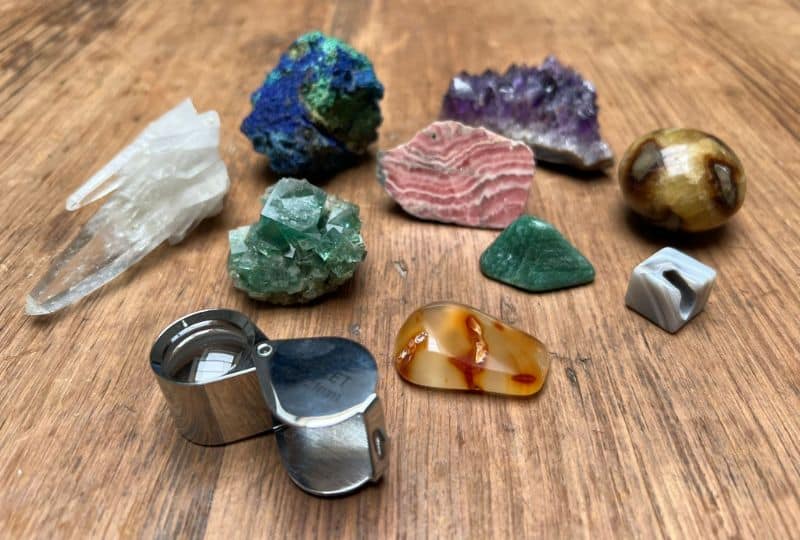
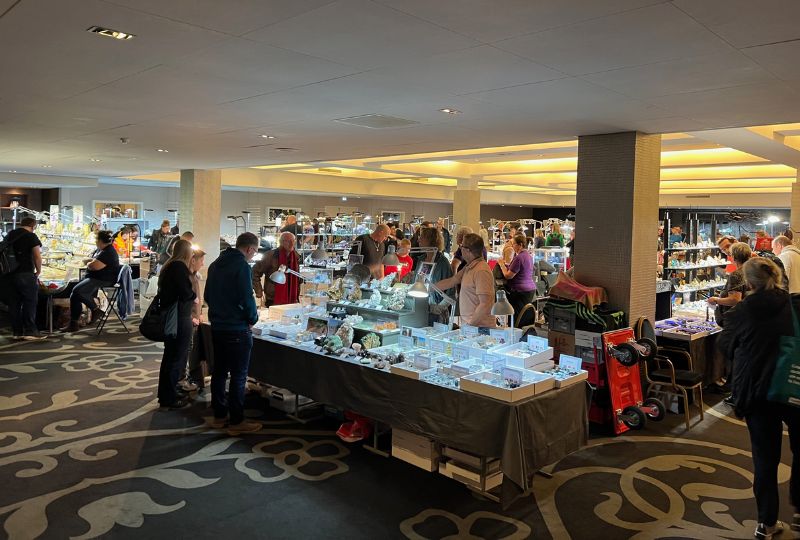
Minerals and gemstones are bought or collected for all sorts of reasons. Some people are drawn to a beautiful color or crystal shape, while others seek out a unique collector’s item or choose a stone with a specific personal intention. Some enthusiasts buy their stones at a mineral show or in a store, while others go out on their own to search for minerals.
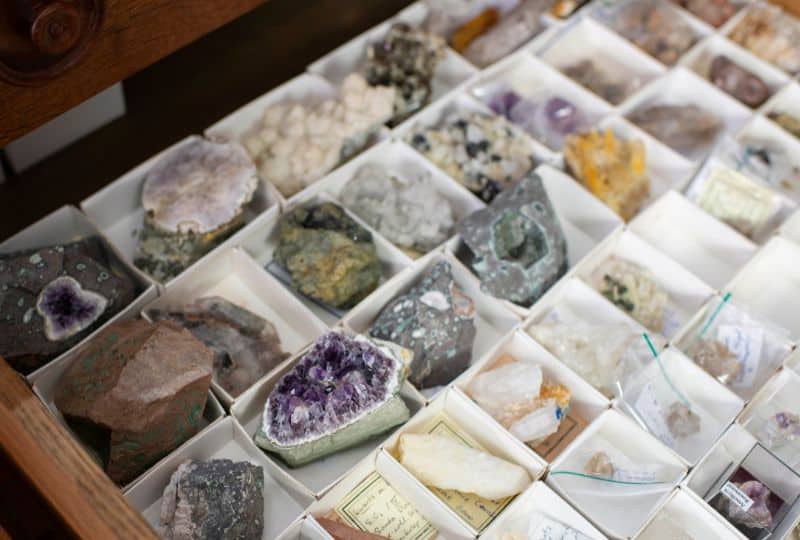
When you make a purchase, you sometimes receive the mineral’s name and exact location from the seller. But that’s not always the case. Sometimes the label only lists a trade name, the information is very general, or the note ends up getting lost over time. Maybe you received a stone as a gift with no further details, took over an old collection, or found something yourself that you’d like to know more about.
I know from experience that, over time, many people want to learn more about their minerals. What exactly do I have? Is the name under which I bought the crystal correct? Is it a natural mineral, has it been treated, or is it perhaps something else? That’s when the search for the correct name begins. And it often turns out to be less straightforward than initially thought.
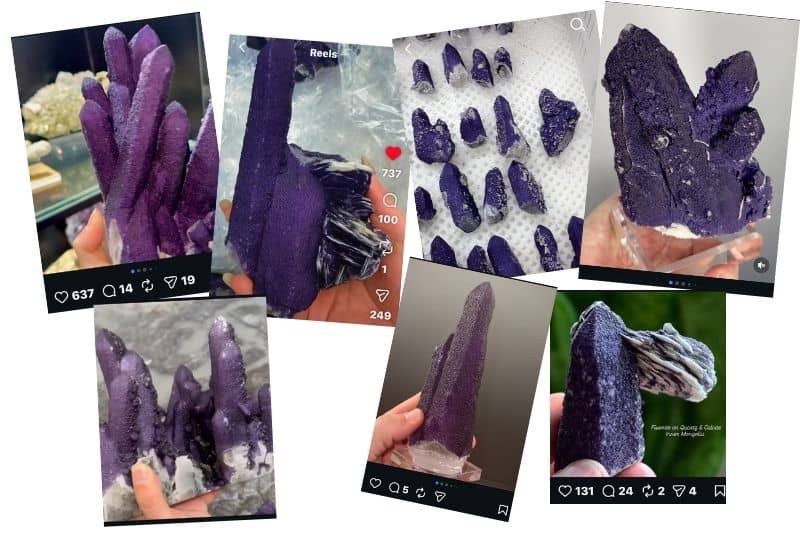
Many people, for example, post a photo on social media asking, “Does anyone know what this is?” Others ask a collector friend, a seller, or an expert. That can provide useful clues, but it’s not always possible to reliably identify a mineral from a photo. Moreover, it’s much more interesting when you learn for yourself what such identification is based on.
Learning to identify minerals therefore starts mainly with observing, comparing, and gaining experience. The more different specimens you examine, the better you’ll learn to spot both similarities and differences. You’ll discover that color alone usually isn’t enough and that crystal shape, luster, hardness, cleavage, fracture, associated minerals, and locality can also provide important clues. By combining that information step by step, you can gradually narrow down the possibilities. We call that process identification. In this article, I’ll show you how you can get started on your own and where the limits of identification at home lie.
Contents
Recognizing and identifying
The terms ” recognize,” ” determine,” and “identify” are often used interchangeably. There isn’t always a clear distinction between these concepts either. Still, they help describe different ways of looking at an unknown rock.
You can sometimes immediately recognize a mineral you’ve seen before. You’ll recognize a combination of, for example, color, crystal shape, luster, and cleavage. Think of the cubic crystals and good cleavage of fluorite or the purple hexagonal crystal points of amethyst. Such recognition is largely based on experience. The more different specimens you examine, the better you’ll learn which characteristics are typical of a particular mineral and how much variation can occur within a single mineral species.
When you “identify” a specimen, you conduct a more deliberate investigation. You examine and test various characteristics, compare multiple possibilities, and try, step by step, to determine which name best fits the stone. “Identifying” usually refers to the process by which an unknown material is ultimately given a name. In practice, these two terms are often used to describe the same process.
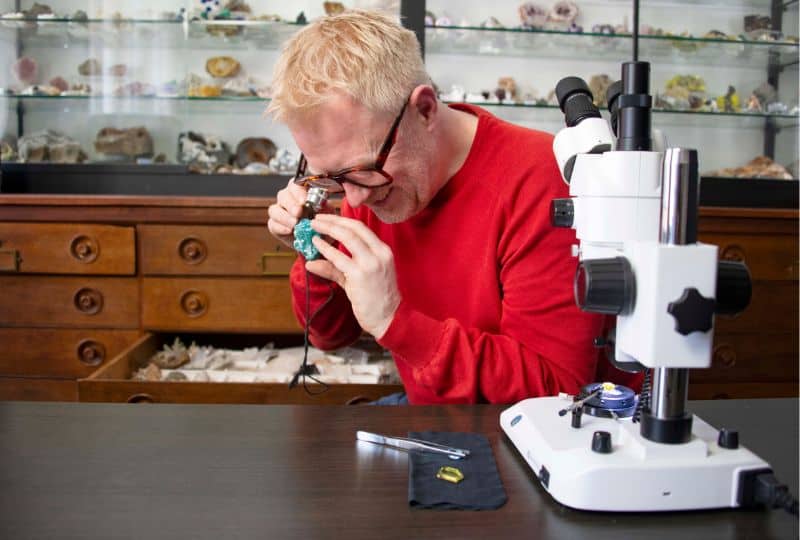
Just how precise that name needs to be also depends on what you personally want to know and how you’ll use the information. As an enthusiast, a well-known trade name or a broader group name is sometimes perfectly sufficient—as long as you understand what such a name does and doesn’t tell you. Perhaps it’s enough for you to know that a stone belongs to the garnet group, without identifying exactly which specific garnet variety it is.
If you want to catalog, study, or sell a mineral in your collection, it is important to use a correct and as accurate a name as possible. At the same time, the degree of certainty must remain clear. A probable identification is not the same as an identification that has been confirmed by targeted laboratory analysis.
Not every mineral can be identified with certainty down to the exact species at home. Sometimes you can only determine the mineral group or conclude that a certain name is likely. Different mineral species can closely resemble one another in appearance and in their easily measurable properties. For greater certainty, chemical analysis or an examination of the crystal structure may therefore be necessary. It is not a failure to temporarily label the stone with a group name or as “unknown.” Recognizing the limits of your own conclusions is an essential part of careful identification.
Why color alone is usually not enough
Color is usually the first thing you notice about a mineral. It’s therefore quite understandable that people rely on it first when they want to know what kind of stone they have. Yet color is also one of the characteristics that can most easily mislead you.
This is because a single type of mineral can occur in different colors. Fluorite is a good example of this. It can be colorless, purple, green, yellow, or blue, and sometimes even multiple colors can be found within a single crystal. Therefore, you cannot determine that a stone is fluorite based on color alone. The different colors can result from, among other things, small amounts of other elements, inclusions, or changes and defects in the crystal lattice.
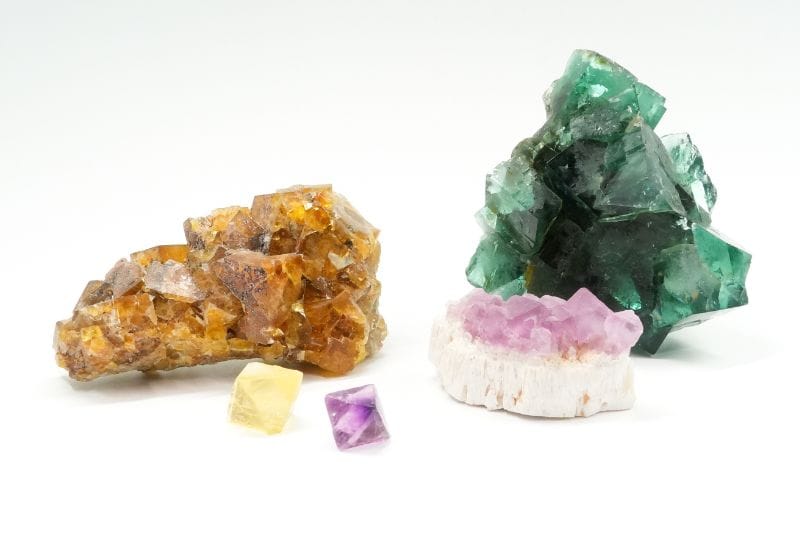
Conversely, different minerals can also have virtually the same color. For example, a green mineral could be fluorite, calcite, malachite, prehnite, serpentine, olivine, or amazonite. So while noting that a mineral is green does provide an initial clue, it doesn’t immediately lead you to the correct name.
That doesn’t mean color is useless when identifying minerals. For some types, a particular color is indeed a distinguishing feature. When combined with, for example, the crystal shape, luster, hardness, or streak color, color can be an important clue. Things go wrong when color is immediately taken as proof of a mineral’s name.
The same applies to identification using a photo, for example, via Google Lens or an AI app. Such tools can suggest names of minerals that resemble your specimen in appearance. However, they cannot determine hardness, streak color, cleavage, or specific gravity from a regular photo. Information about the location and associated minerals is also often missing. Furthermore, such apps do not always accurately distinguish between official mineral names, trade names, treated stones, and imitations. Therefore, treat the name suggested by Google or an AI app as a possibility that you must verify yourself using other characteristics and reliable sources.
What properties do you use to identify minerals?
As we saw with color, a single characteristic is usually not enough to identify a mineral. Combining different characteristics provides a more reliable picture. Which characteristics are most useful varies by mineral and by specimen.
Always start by examining the item carefully and conducting tests that won’t cause any damage. This is especially important for beautiful crystals, cut stones, jewelry, and other stone objects. Only perform tests that could cause scratches, cracks, or dull spots on an inconspicuous area or a small, loose piece.
Crystal form, habit, and aggregate form
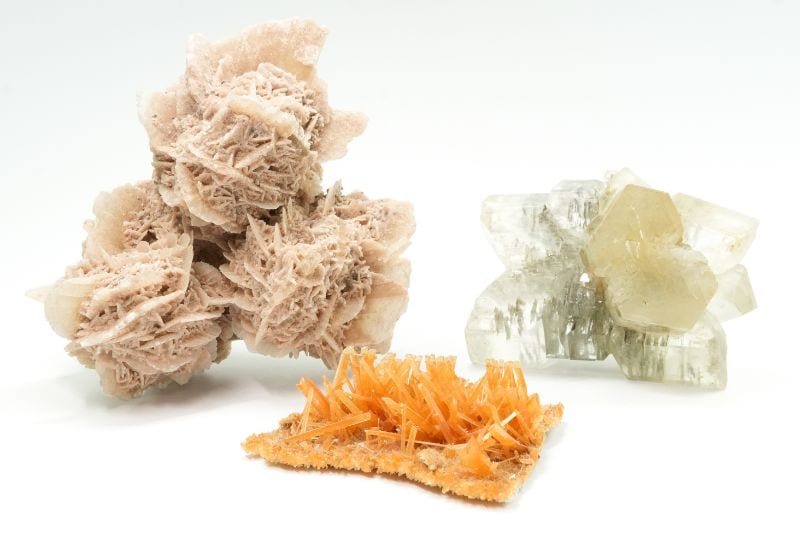
Well-formed crystals can provide important clues based on their shape and crystal faces. Think of cubes, prisms, plates, or needles. However, a mineral does not always form the perfect crystal shown in a mineral handbook.
The form in which a mineral appears in nature is called its habit. For example, the same mineral can form elongated, flat, or fibrous crystals. Minerals also often occur as groups of small crystals or grains. Such an aggregate can be, among other things, massive, granular, lamellar, radial, or grape-like.
Crystal shape, habit, and aggregate form can be very distinctive, but on their own they are usually not sufficient for a definitive identification. In addition, a mineral may sometimes have taken on the shape of another mineral that was present there earlier. We call this a pseudomorph. In such cases, the outer shape has been preserved, while the original mineral has been completely or partially replaced.
Luster and transparency
Luster describes how the surface of a mineral reflects light. An important initial distinction is that between metallic luster and non-metallic luster. For minerals without metallic luster, distinctions are made between, among others, vitreous luster, pearlescent luster, silky luster, resinous luster, and diamond luster.
It’s best to examine the luster on a clean, undamaged surface. A weathered, oxidized, or damaged crystal may appear much duller than a fresh surface. By gently moving the mineral under a lamp, you can often see more clearly how the light is reflected.
Also, check how much light the mineral transmits. It can be transparent, translucent, or opaque. Luster and transparency are different properties: a mineral can have a strong luster and still be opaque.
Hardness
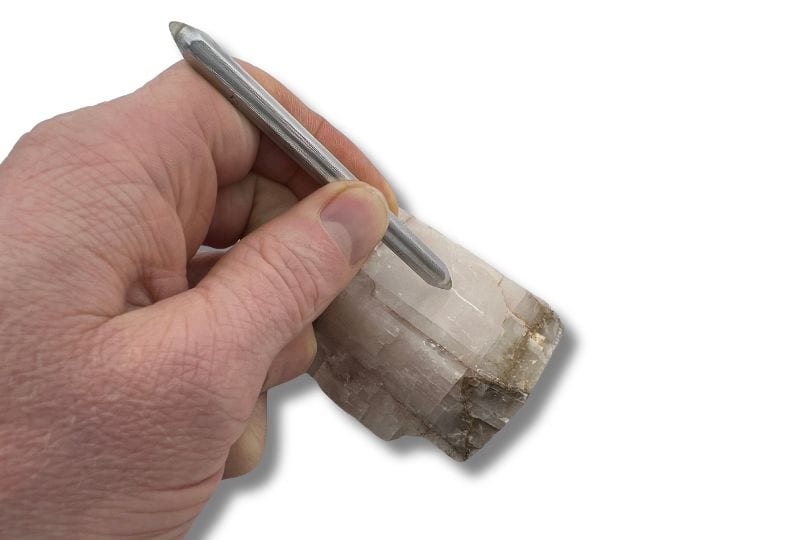
Hardness indicates how resistant a mineral is to scratches. We use the Mohs scale for this, ranging from talc (hardness 1) to diamond (hardness 10). A harder material can scratch a softer material.
Everyday materials are often used for an initial comparison. Glass typically has a hardness of around 5½, and a steel knife is about 5 to 5½. That’s why you often see the advice to scratch a stone with a knife or to test whether the stone scratches glass. However, such a test is harder to perform properly than it seems. The hardness of glass and steel can vary, and a knife can leave a metal mark without actually making a scratch.
Therefore, check to see if a permanent groove has formed and not just material left behind by the knife. A weathered surface, thin crystals, grainy fragments, and rocks composed of multiple minerals can also lead to misleading results.
A hardness test can cause damage. Therefore, never perform it on a well-defined crystal face, a cut stone, a piece of jewelry, a polished object, or a valuable collectible. If you don’t have a suitable, inconspicuous spot or a loose grain of sand, it’s best to skip this test.
Cleavage and fracture
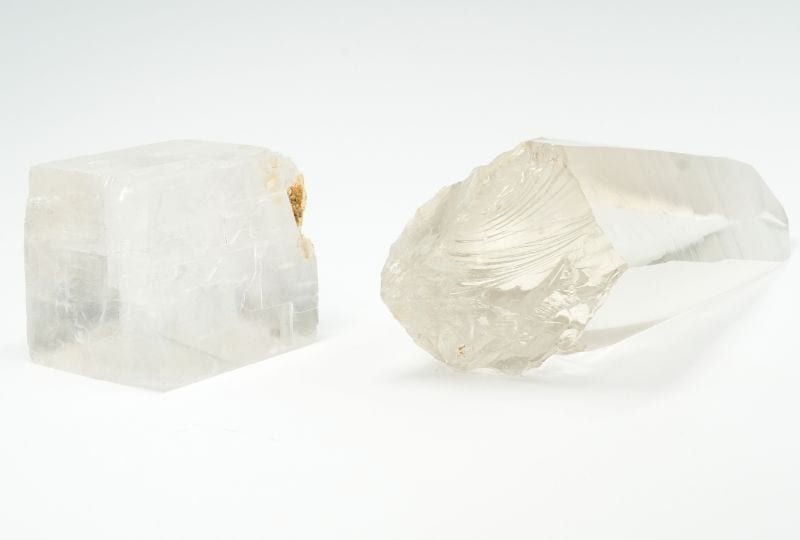
When a mineral cleaves, it breaks preferentially along weak planes in its internal crystal structure. Mica, for example, can be cleaved into thin sheets. Calcite has three good to perfect cleavage directions that are not perpendicular to one another, resulting in oblique cleavage fragments with rhomboidal faces.
Fracture describes how a mineral breaks when it does not split along cleavage planes. Quartz often has a conchoidal fracture, similar to broken glass. Other types of fracture can be, for example, irregular, fibrous, or splintery.
Cleavage planes are easily confused with original crystal faces. Both can be smooth and reflect light. Parallel planes and lines within the mineral may indicate cleavage, but learning to distinguish between them takes practice. Do not break a crystal to investigate this: existing damage and internal fracture lines often provide sufficient information.
Color and streak color
As discussed earlier, color is usually the first characteristic that stands out. It is a useful clue, but a single mineral can have different colors, and different minerals can have the same color.
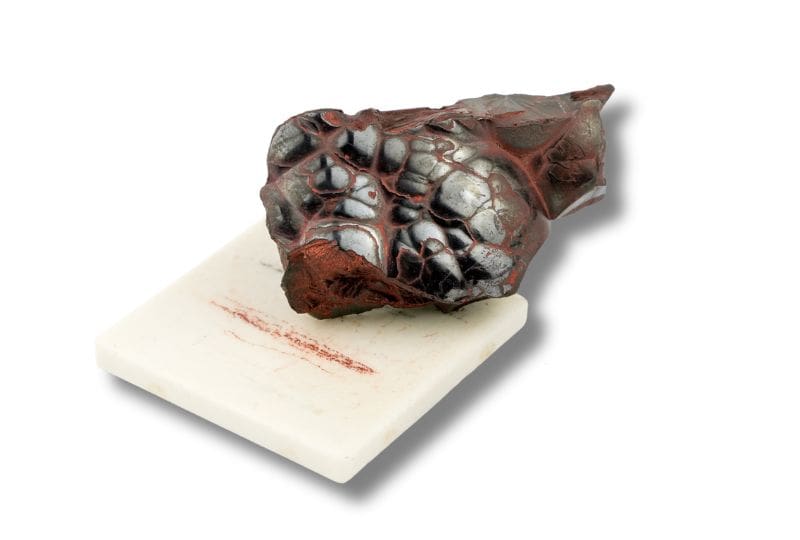
The streak color is the color of a mineral’s fine powder. It is often more consistent than the color of the entire mineral and is particularly useful for dark minerals and minerals with a metallic luster. Both hematite and magnetite can range in color from steel gray to nearly black. However, hematite has a reddish-brown streak, while magnetite has a black streak.
The test is usually performed on unglazed porcelain and can damage the mineral. Minerals that are harder than the test plate usually do not leave a usable powder streak but will scratch the porcelain. Therefore, the streak color is also a guide and not independent evidence of a mineral’s name.
Specific gravity
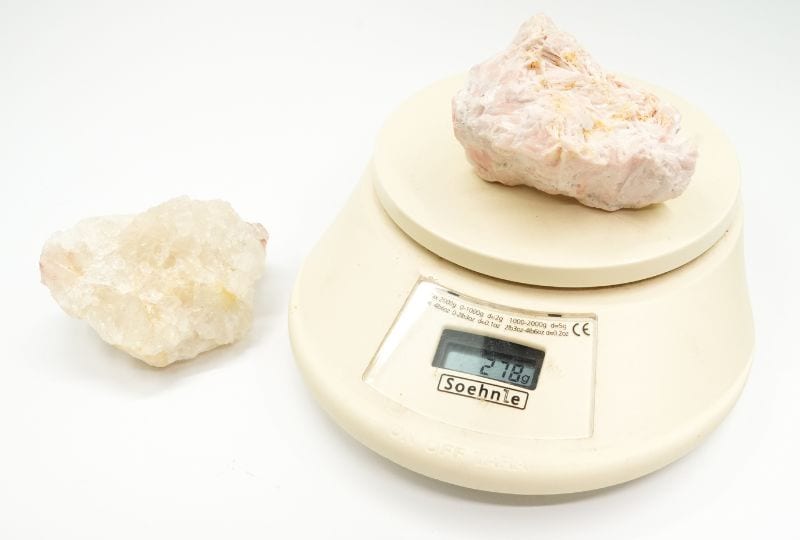
Some minerals feel noticeably heavy or light for their size. We express that difference in terms of specific gravity: the ratio of the mineral’s density to that of water.
Quartz has a specific gravity of approximately 2.65. Barite can sometimes resemble quartz in color and luster, but it has a specific gravity of approximately 4.5 and therefore feels much heavier. The names “barite” and “heavy spar” also refer to this strikingly high weight.
Weighing a rock in your hand does not provide an accurate measurement, but it can give you an initial indication. Using a precise scale, you can determine the specific gravity approximately by weighing the mineral both dry and submerged in water.
Cavities, porous material, air bubbles, and other minerals attached to the specimen can affect the results. A loose, uniform piece is therefore more suitable than a crystal cluster attached to its host rock. Furthermore, with a rock or composite object, you cannot always be certain that it consists entirely of the same material.
Special properties
Some minerals have properties that allow you to further narrow down the possibilities. Examples include magnetism, fluorescence under ultraviolet light, birefringence, electrical conductivity, and a reaction with dilute acid. Not every property is easy or safe to investigate at home.
Be careful when interpreting the results as well. Not every specimen of a particular mineral fluoresces in the same way. Therefore, the absence of fluorescence does not automatically rule out the presence of a mineral. Testing with acid requires knowledge and safe working practices. Furthermore, the acid can damage the surface.
Older books and online posts sometimes mention taste, smell, and heating as tests. I advise against licking unknown minerals, inhaling their dust or vapors, or heating the material. Some minerals contain harmful elements or can release hazardous substances.
Also, do not hold a lighter near an unknown stone to test whether it is real. This test is unreliable, can damage the material, and can release harmful fumes if the stone has been treated or contains synthetic materials or adhesives. The fact that a stone does not melt or change color does not prove that it is natural or correctly identified.
Associated minerals and locality: the geological context as a clue
Don’t just look at the unknown mineral; look at the rest of the specimen as well. Minerals often occur in recognizable combinations. We call such a combination a paragenesis. The rock on which or within which the mineral is found—the matrix or host rock—can also provide important clues.
Certain minerals form under similar conditions and are therefore often found together. An experienced collector can sometimes identify a possible origin based on the combination of minerals, the host rock, and the way the crystals have grown. For a novice collector, it is especially important to recognize that the material surrounding the unknown mineral is not an insignificant detail.
Even a reliable locality can greatly limit your options. In databases such as Mindat and Mineralienatlas, you can look up which minerals are known to occur at a particular location. When doing so, don’t just compare photos—also read the descriptions and see which associated minerals are mentioned.
Do remain critical, however. Labels may have been mixed up, and names or localities may have been recorded incorrectly. Databases are also not always complete. Therefore, use the locality and associated minerals to corroborate the other characteristics. A reported locality is not a reason to use a mineral name when the hardness, crystal shape, streak color, or other properties clearly do not match it.
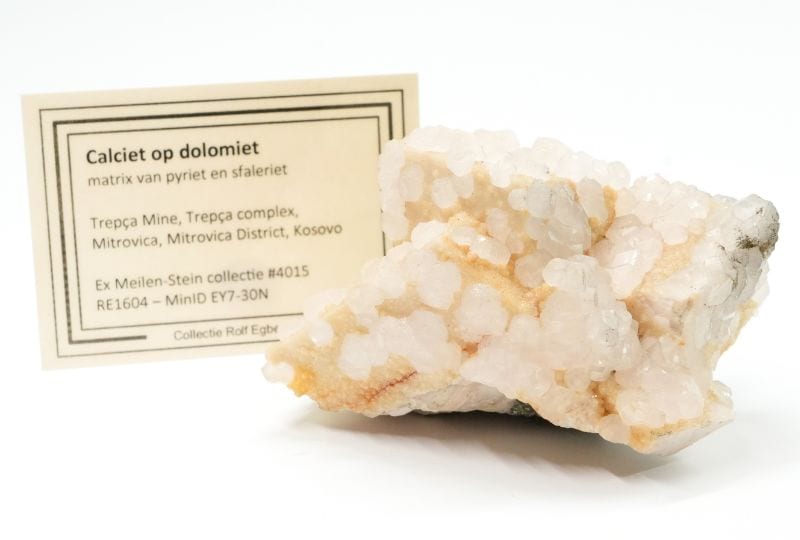
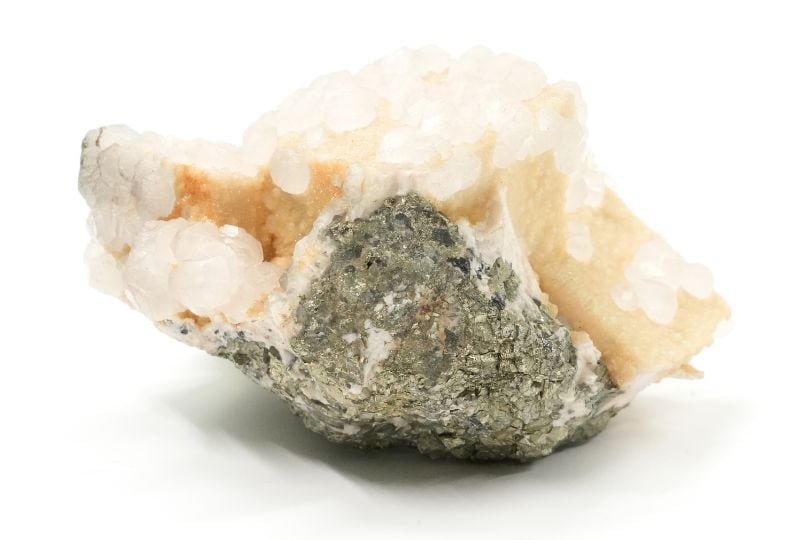
This specimen from the Trepča Mine in Kosovo consists of white calcite on cream-colored, rhombohedral dolomite crystals. The dark matrix, which includes pyrite, is visible on the back. The combination of minerals, the matrix, and the accompanying label together provide valuable information about the paragenesis and location.
Identifying minerals at home: a practical guide
A consistent approach helps prevent you from jumping to conclusions based on the first name that seems plausible. Not every mineral requires the same kind of investigation, but you can usually follow these steps.
- Write down what you know
Make a note of where the specimen comes from and how reliable that information is. Did you find it yourself, does it have an old label attached, or is only the country of origin or trade name known? Distinguish between what is certain and what you suspect. Information on a label can also be incorrect.
- Take a good look without choosing a name right away
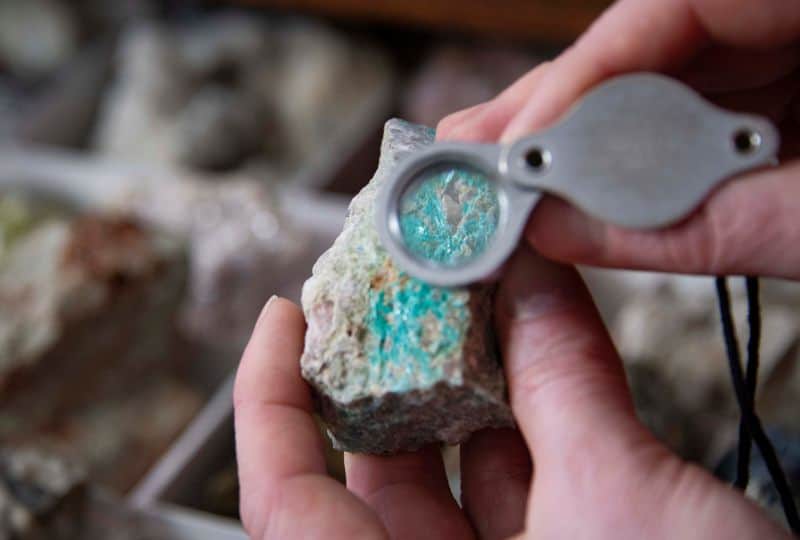
Examine the specimen under good, neutral lighting and use a magnifying glass if necessary. Pay attention to several useful characteristics, such as color, luster, crystal form, cleavage, associated minerals, and the host rock. You don’t have to examine everything, but never base your conclusion on just one characteristic.
First, describe what you see. Green, glassy, and grainy in dark volcanic rock is an observation. “Probably olivine” is already a conclusion.
- Choose the appropriate tests
Determine which simple tests can reveal differences between the possible minerals. Consider hardness, streak color, magnetism, or specific gravity. An acid test is only appropriate if you have sufficient knowledge and take the necessary safety precautions.
Start with tests that won’t cause any damage. Only scratch, streak, or use acid if the item allows it, preferably in an inconspicuous spot or on a loose grain. With cut gemstones, jewelry, and polished objects, it’s often best to skip these tests.
- Compare multiple options
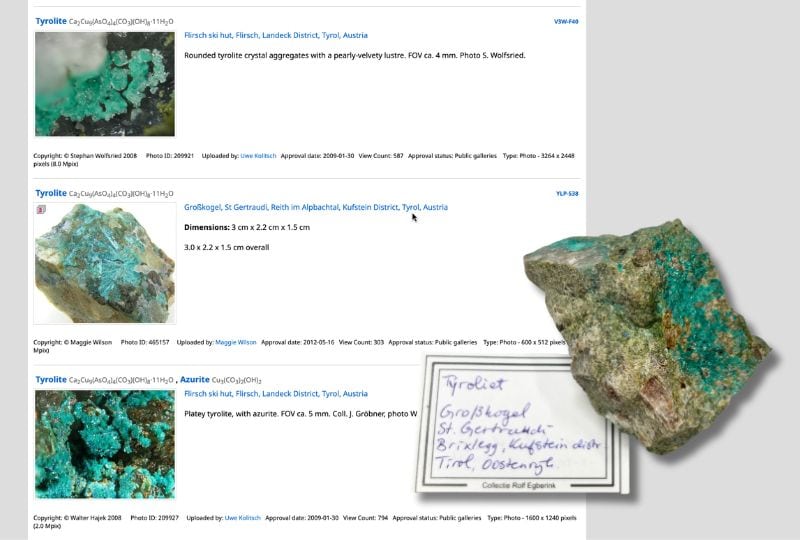
Don’t just look for a photo that resembles your specimen; compare it with various possible minerals. To do this, use a good mineral guide, specialized literature, and reliable databases such as Mindat. If the location is known, check which minerals have been described there and which other minerals they occur with.
- Also take a look at what doesn’t fit
For every possible name, check not only the similarities but also the differences. A mineral may seem to fit well in terms of color and shape, but it may still be ruled out due to a different hardness, cleavage, or streak color. Also pay attention to characteristics you would expect but that are missing.
- Draw a well-considered conclusion
Does the name correspond to all the examined characteristics, the host rock, the associated minerals, and the location, if any? Also, honestly indicate how certain the result is. A confirmed name is different from a probable or possible identification.
Sometimes, the best conclusion for now is to classify it as a broader mineral group or simply as “unknown.” That’s better than assigning a name that isn’t supported by the available information.
Common mistakes in mineral identification
One of the most common mistakes is choosing a name too quickly. As soon as you think a stone is, for example, fluorite or olivine, you tend to focus primarily on the characteristics that fit that name. Characteristics that actually contradict that name then receive less attention. Therefore, always try to explore several possibilities and ask yourself why a particular name might actually be incorrect.
Other common pitfalls include:
- based solely on the color or one other distinctive feature;
- blindly trusting the results of an app, search engine, or AI application;
- just compare photos and not read the accompanying descriptions;
- assume that the name and location listed on a label are always correct;
- mistaking a metal streak left behind during a hardness test for an actual scratch;
- confusing a cleavage plane with a primary crystal face, or vice versa;
- accidentally testing the host rock instead of the unknown mineral;
- treat a trade name as if it were an official mineral name;
- do not take into account treatments, coatings, imitations, or counterfeits;
- looking only at the outward appearance, even though it could be a pseudomorph.
Trade names require extra attention
A trade name is not automatically incorrect or misleading. Some trade names have been in use for a long time and are widely understood by everyone. An enthusiast or seller may also consciously choose to use such a well-known name. It is important to note, however, that a trade name does not always make it clear exactly which mineral or material is actually being referred to.
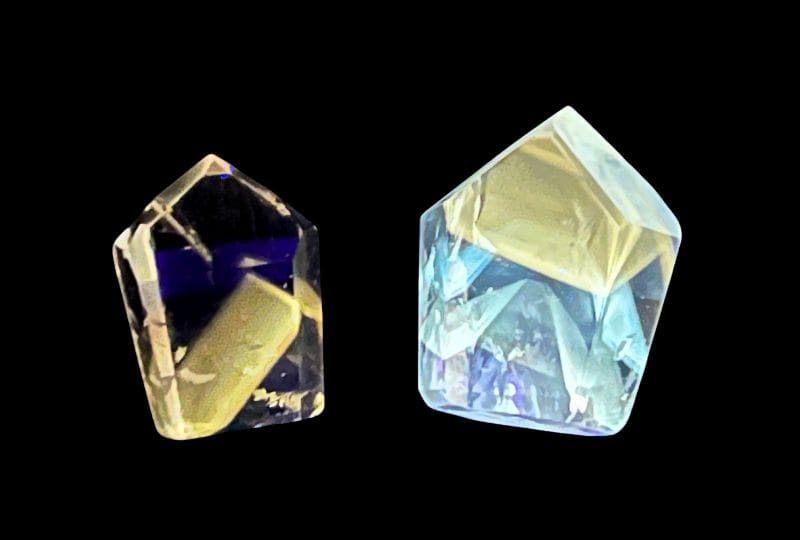
Other trade names are primarily coined to make a stone sound more attractive, rarer, or more valuable. Furthermore, the same name is sometimes used for different materials. Treated stones, imitations, and composite products are also not always clearly identified as such.
This is especially important for sellers. A customer must be able to trust that a stone is identified as accurately as possible and that any known treatments, imitations, or uncertainties are clearly stated. When the exact mineral species has not been determined, it is better to state this honestly than to use a definitive name that is not sufficiently substantiated.
In the Gem or Scam Library, I discuss examples of misleading trade names, treated stones, imitations, and other materials that frequently cause confusion in the market.
When do you need an expert or additional testing?
By looking closely, comparing specimens, and performing a few simple tests, you can identify many common minerals. However, there are limits to what you can determine at home. Very small crystals, such as those found in micromounts, fine-grained mixtures, rare minerals, and species that closely resemble one another can sometimes not be reliably distinguished from one another.
An expert can then help evaluate the observations and determine what additional research would be useful. Even an expert usually cannot identify the mineral with complete certainty based on a photo alone. Sometimes, therefore, the conclusion is limited to a mineral group, a probable name, or a short list of possibilities. This is not a shortcoming, but an honest conclusion based on the available information.
For greater certainty, investigative techniques such as polarizing microscopy, refractometry, Raman spectroscopy, X-ray diffraction (XRD), or chemical analysis may be necessary. Not every technique provides an answer to the same question. A chemical analysis reveals which elements are present, but this does not always determine the mineral species. Minerals can have similar chemical compositions yet differ in the way the atoms are arranged in their crystal structures. Therefore, multiple types of analysis are sometimes necessary before a reliable conclusion can be reached.
These earlier observations remain important even during laboratory analysis. Do the results match the color, hardness, crystal shape, associated minerals, and reported location? Is the examined area representative of the entire specimen, or might the material consist of multiple minerals? A measurement result must always be considered in conjunction with what has been observed on the entire specimen. A device provides data; correctly interpreting that data still requires knowledge and critical judgment.
Extensive research can also be costly, especially when multiple techniques are required. It is therefore wise to consider in advance exactly what question you want to answer and whether the costs are justified by the financial, scientific, or personal value of the mineral or object. In the case of a cherished stone, analysis may be worthwhile, even if its monetary value is limited. For a common and inexpensive specimen, it may be more reasonable to settle for a probable name or a broader group name.
Individual enthusiasts or collectors will not be willing to pay such costs for every specimen. That is why I believe that wholesalers, sellers, and industry professionals also have a role to play in having materials about which there is uncertainty examined. By making the research question, methods used, results, and limitations public, the entire mineral community can learn from such an analysis. However, it must remain clear exactly which specimen or batch was examined. A result from a single stone cannot automatically be applied to all material that looks the same or is offered under the same trade name. In the Gem or Scam Library, I therefore not only collect and discuss conclusions but, where possible, also the studies on which those conclusions are based. This makes analysis results useful for both enthusiasts and sellers and ensures that the degree of certainty in an identification remains transparent.
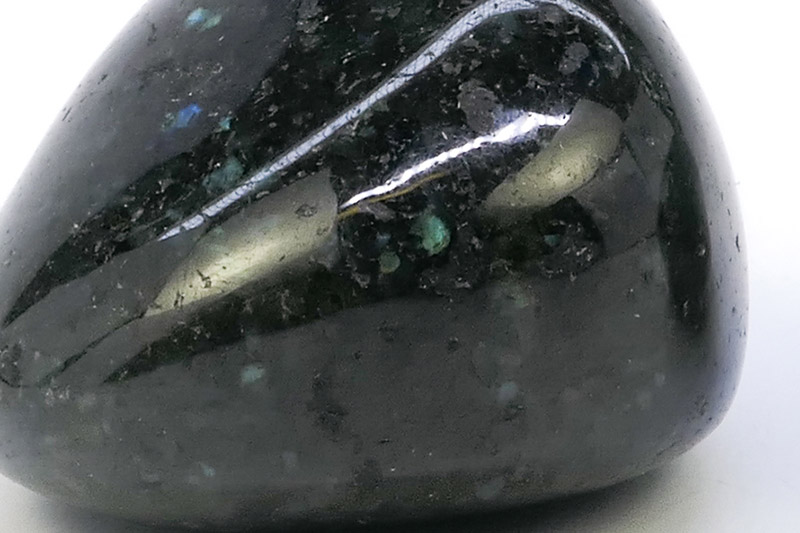
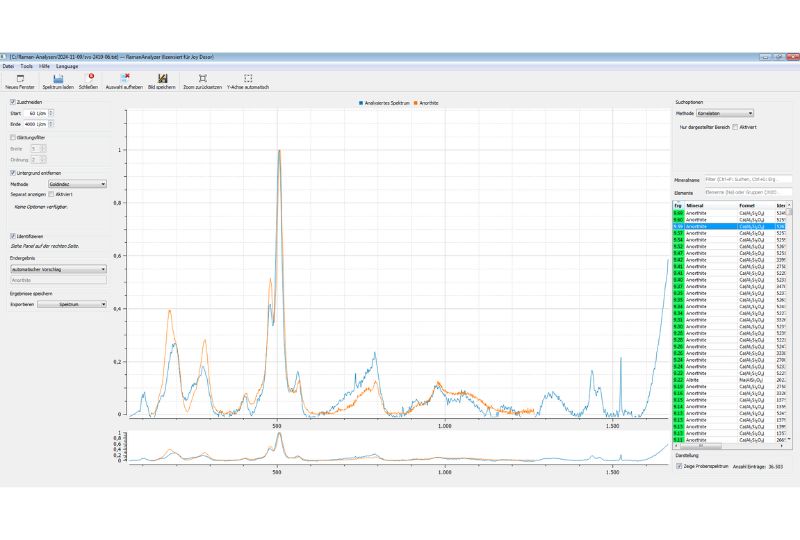
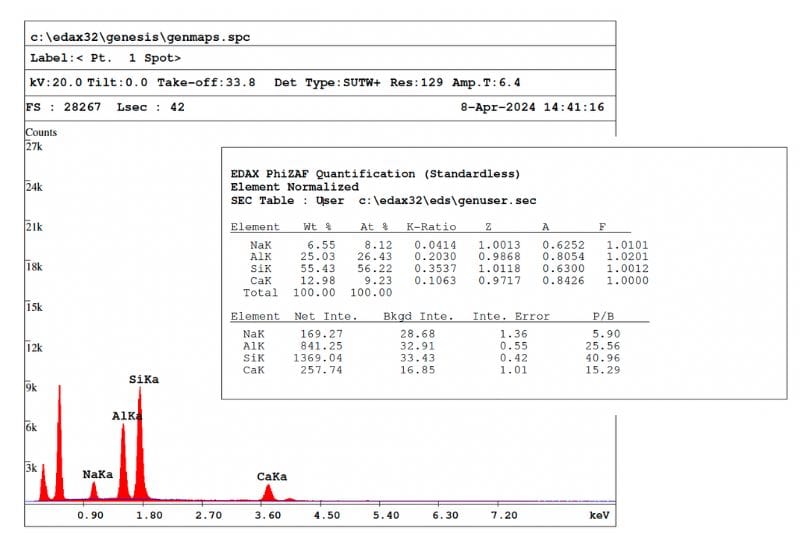
The Raman spectrum (left) showed the best match with anorthite, the calcium-rich end member of the plagioclase series. Because labradorite is an intermediate composition within the plagioclase series, information about its chemical composition was also needed. The EDX analysis (right) shows not only aluminum and silicon but also calcium and sodium. The calculated ratios between the end members anorthite (calcium) and albite (sodium) indicate that the stone examined falls within the composition range of labradorite. By combining Raman spectroscopy and chemical analysis, we were able to determine that this tumbled stone, sold as “Galaxyite,” consists of fine-grained labradorite.
Learning to identify minerals yourself
In this article, you’ve learned which characteristics are important and how to combine different clues. But learning to identify minerals is mainly a matter of learning to look closely, testing for yourself, comparing, and gaining experience with real specimens. Reading a description is different from actually determining whether you’re looking at a scratch, a cleavage plane, a crystal face, or a specific luster.
In the Basic Course on Identifying Minerals (Dutch), you ’ll learn , step by step, how to examine minerals and how to use the data you gather to compare and rule out possibilities. The goal is not to memorize as many mineral names as possible, but to learn to look at an unknown rock in a different way and to be able to support your conclusions more and more effectively.
Would you like to learn how to identify and classify minerals on your own? Then check out the Basic Course in Mineral Identification and discover how you can get started with classification at home in a practical and structured way.
Identifying cut gemstones
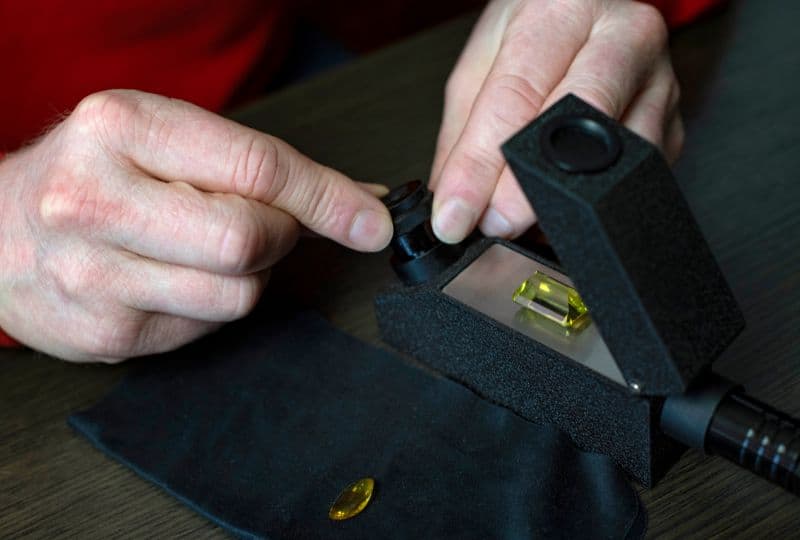
A slightly different approach is required for cut gemstones. Because of the cutting process, characteristics such as the original crystal shape, the host rock, and the associated minerals are usually no longer visible. For this reason, gemstone identification relies on other properties and measurement methods.
In the course “How to Identify Gemstones,” (Dutch) you will learn which instruments and data sets are used to examine cut gemstones and distinguish them from one another.
Frequently asked questions about identifying minerals
How can I identify a mineral myself?
Start by examining the specimen closely and describing its various visible characteristics, such as color, luster, transparency, crystal shape, and host rock. Then, perform only those tests that are appropriate for the specimen, such as tests for hardness, streak color, magnetism, or specific gravity. Compare several possible minerals and determine which name best matches all your observations.
Can you identify a mineral by its color?
Sometimes color is an important clue, but most of the time, color alone isn’t enough. A single mineral species can have different colors, and different minerals can, in fact, appear to be almost the same color. Therefore, always combine color with other characteristics.
What characteristics are most important when identifying minerals?
This varies by mineral and by specimen. Commonly used characteristics include crystal shape, habit, luster, transparency, hardness, cleavage, fracture, color, streak color, and specific gravity. Special properties, the host rock, associated minerals, and the location of discovery can also provide important clues. The combination of multiple characteristics almost always reveals more than a single test on its own.
How do you determine the hardness of a mineral?
You compare the scratch resistance of the mineral with that of a mineral or material whose hardness is approximately known. The harder material leaves a permanent scratch on the softer one. Check carefully to make sure a groove has actually formed and that it is not just a mark left behind by, for example, metal or the test mineral. Because this test causes damage, perform it only on an inconspicuous spot or a small loose grain. For a cut stone, piece of jewelry, or valuable specimen, it is best to skip this test.
Can you identify a mineral using a photo or an AI app?
A photo, search engine, or AI app can suggest a few possible names, especially when a mineral has a recognizable shape or color. However, this usually does not result in a reliable identification. Important properties such as hardness, streak color, cleavage, and specific gravity cannot be determined from a regular photo. Therefore, treat the suggested names as possibilities that you should verify using other observations, tests, and reliable sources.
What materials do you need at home?
With good lighting, a magnifying glass, and reliable reference materials, you can already observe and compare a great deal. For further investigation, you can use, among other things, a precision scale, a streak plate, and appropriate tools for a hardness test. Which tools are useful depends on the material and the question you want to answer. Learning to observe carefully and knowing which test can actually demonstrate a difference are more important than immediately purchasing an extensive test kit or expensive instruments.
What is paragenesis in minerals?
Paragenesis refers to minerals that occur together and were formed under similar conditions. The associated minerals, the host rock, and the way in which minerals have grown on or over one another can help narrow down the possibilities. A recognizable paragenesis is an important clue, but does not in itself constitute proof of a mineral’s name or locality.
Can you identify the mineral based on where it was found?
A reliable locality can help narrow down your options, since not every mineral is found everywhere. You can look up which species are known to occur at a particular location in mineral guides and databases. Be sure to remain critical, though: labels can be mixed up or incorrect, and databases aren’t always complete. The properties of the mineral itself must still match the chosen name.
Do you always have to identify a mineral down to the exact species?
No. For an enthusiast, a broader group name or a well-known trade name may sometimes suffice, as long as it is clear what that name does and does not mean. Without specialized research, it is not possible to reliably identify some minerals down to the exact species. In such cases, it is better to use a broader or probable name rather than suggest a higher degree of certainty than actually exists.
When is further testing necessary?
Additional testing may be necessary for very small crystals, fine-grained mixtures, rare minerals, or species that cannot be distinguished from one another using simple tests. Depending on the specific question, techniques such as refractometry, Raman spectroscopy, X-ray diffraction, or chemical analysis may be used. Sometimes multiple techniques are required. These results must also be combined with earlier observations of the mineral and the entire specimen.



Responses