
Yellow-fluorescent phantoms in amethyst: Is it really powellite?

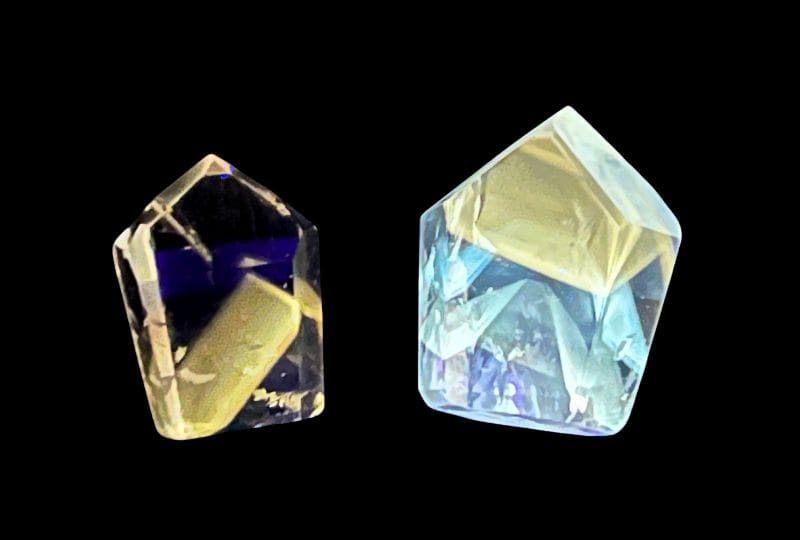
For several years now, the mineral trade has been offering light-colored amethyst crystals from Brazil that show striking yellow to yellow-orange phantoms under UV light. The material is sold under various names, usually with a reference to powellite or UV-reactive ametrine (such as Powellite Quartz, Powellite Phantom Amethyst, and Powerlite).
Soul Body Gems presented the material in June 2025 as “ametrine with powellite inclusions.” That identification was based on a 2019 analysis and later prompted further research and discussion (Soul Body Gems, June 5, 2025) 1.
According to an American seller, the material was discovered in the early 2010s in Cordeiros, Bahia, Brazil (Soul Body Gems, July 29, 2025)2. An initial analysis followed in 2019. Starting in the spring of 2025, a debate flared up following a second investigation that yielded a different result. The material is now widely available in the Netherlands and Belgium; in June 2026, we also saw it at several dealers’ booths at the trade fair in Sainte-Marie-aux-Mines.
I first came across such a crystal in March 2026, when a seller from my Sellers Community asked me how best to describe the material. I quickly came across conflicting analyses: one source mentioned submicroscopic powellite particles, another mentioned hydrocarbons, after which that interpretation was also criticized. Since the material is now being offered more widely, I’ll compare the available analyses and arguments in this article. Do the fluorescent phantoms actually contain powellite, or is the effect caused by something else?
Preliminary Note
This article is not intended to criticize laboratories, researchers, or vendors. In fact, parties that commission analyses and publicly share the results provide valuable information to the mineral community. My goal, therefore, is not to determine whether any one party is right or wrong, but to compare the available information chronologically and to discuss both the strengths and limitations of the various interpretations.
Update (August 6, 2026)
After this article was first published on August 2, 2026, I contacted Soul Body Gems, and they drew my attention to a supplementary analysis report from October 2025, in which ten additional fluorescent specimens from the same site were examined. These results had not previously been included in my overview. Thanks to the original reports being made available, I was able to update the article in a few areas. The most significant changes concern the description of the supplementary study, the conclusion, and the interpretation of the available data. The general thrust of the article remains unchanged; the new data primarily strengthen the rationale behind the conclusion. My thanks go to Kasia Bitner of Soul Body Gems for providing this documentation.
What are we actually seeing?
The crystals consist of colorless to light purple quartz. In many specimens, zones are visible that follow the outline of a former crystal surface: so-called phantoms. These formed when, during crystal growth, a different material was temporarily deposited on the surface, after which the quartz continued to grow. Because many specimens have been cut, the shape of the phantom does not always match the outer shape of the crystal; sometimes the phantom is barely visible in daylight.
Under UV light, these growth zones fluoresce intensely yellow to yellow-green; orange fluorescence has also been observed in some specimens. The effect is visible under long-, medium-, and short-wave UV light, but is strongest under long-wave UV light.
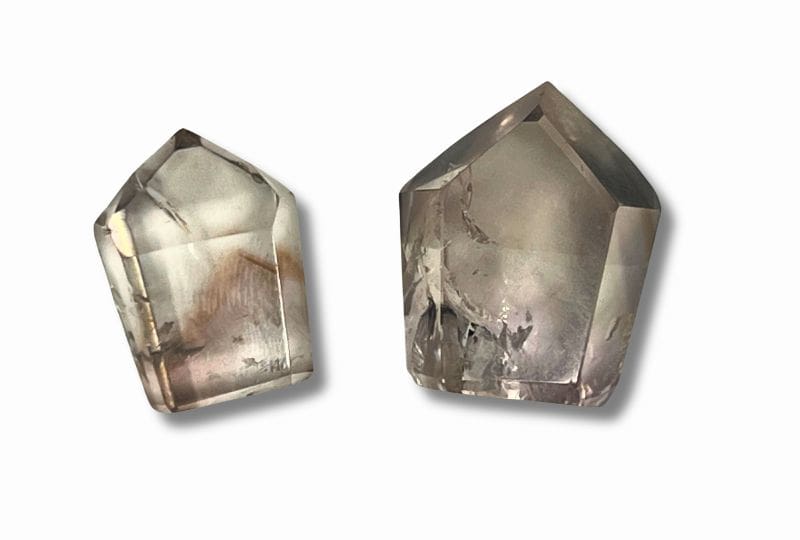
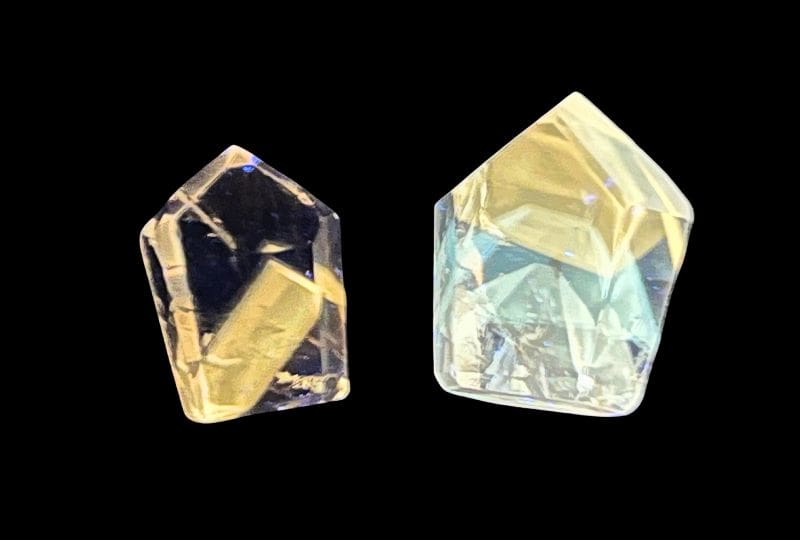
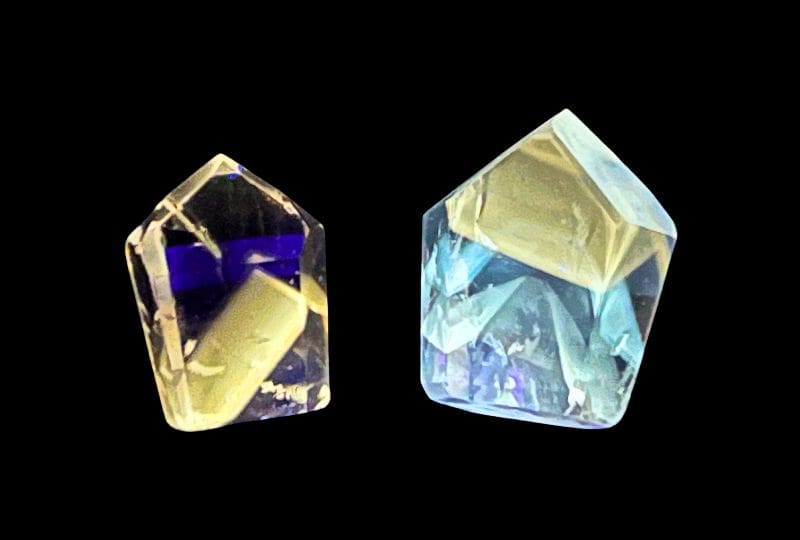
Two cut crystals (25 and 30 mm) of light amethyst with phantoms from Bahia, Brazil. Top left in daylight, where the crystals appear colorless to light purple, and a phantom is visible, particularly in the left crystal. The striking yellow effect only appears under UV light. Top right under long-wave UV (365 nm), bottom left under mid-wave UV (310 nm), and bottom right under short-wave UV (255 nm). Crystals donated by Palms and Seas.
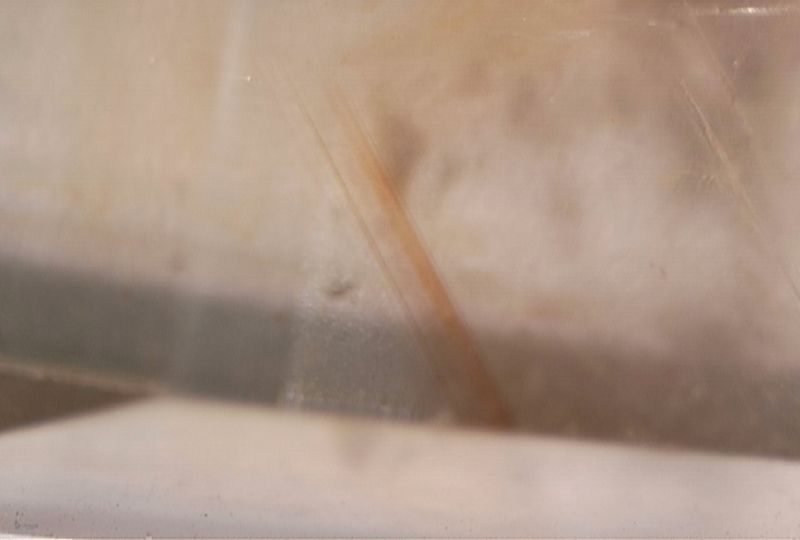
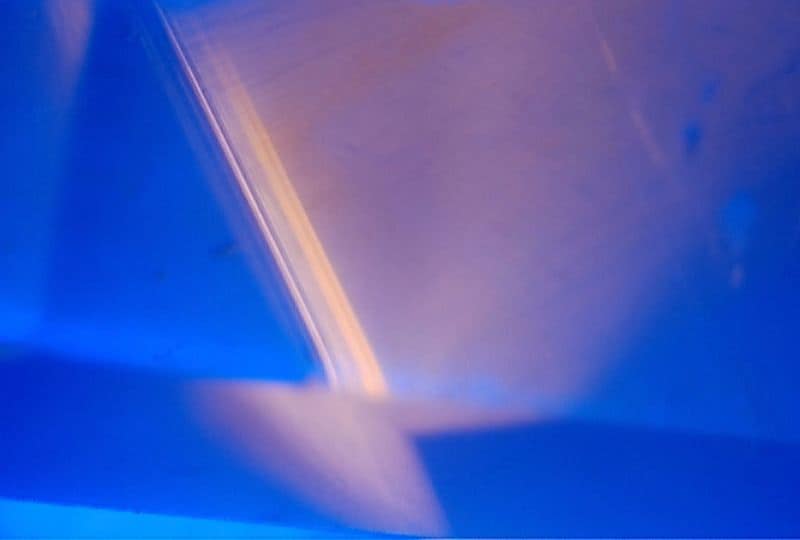
Close-up images (FOV 8 mm) of a section of a phantom in the left crystal in the photos above. On the left in daylight and on the right under long-wave UV (365 nm). No individual particles are visible at this magnification.
It is striking that there is hardly any information available about the site. On Mindat.org, Cordeiros is described as a site yielding quartz and amethyst in white sandstone, with no other mineralization. As far as I have been able to determine, there are also no substantive discussions or additional analyses regarding these fluorescent phantoms on the Mindat discussion forum. As a result, there is currently no broader geological context from which to deduce whether the formation of powellite at this location is plausible.
The first analysis from 2019: evidence for powellite
In 2019, a specimen was examined by Alexander Falster of the Maine Mineral and Gem Museum at the request of Jessica Nowlin of Sugar Studio Crystals (Falster, 2019)4. Using a portable XRF spectrometer, the elemental composition of a fluorescent zone and a non-fluorescent zone was compared. The measurements taken in both zones included, among other things:
| Element | Fluorescent zone | Non-fluorescent zone |
| Calcium | 178 ppm | 8 ppm |
| Molybdenum | 221 ppm | 5 ppm |
| Zircon | 7 ppm | 12 ppm |
| Titanium | 77 ppm | 89 ppm |
| Iron | 134 ppm | 145 ppm |
* ppm stands for parts per million; 221 ppm is equivalent to 0.0221%.
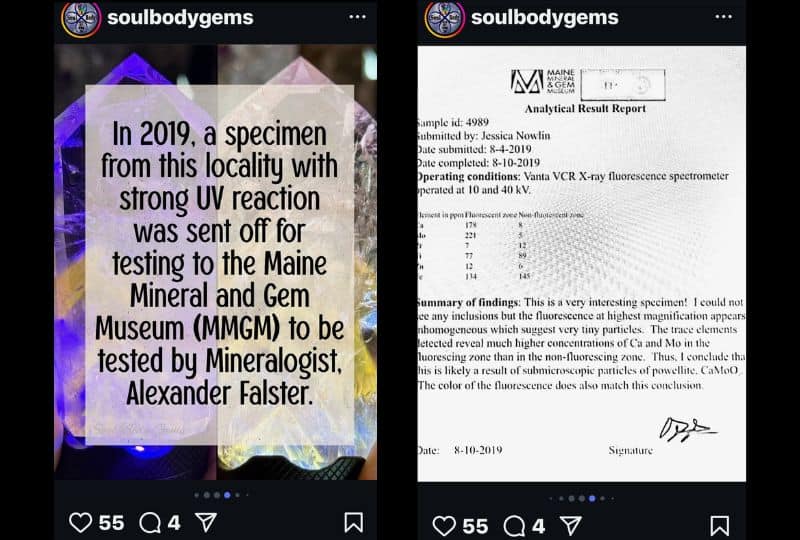
Significantly higher concentrations of calcium and molybdenum were measured in the fluorescent zone than in the non-fluorescent part. Since powellite has the formula CaMoO₄ and can fluoresce yellowish, Falster concluded that very small powellite particles were the most likely cause. That interpretation later formed the basis for the trade name “powellite in amethyst.”
The line of reasoning was logical: when both calcium and molybdenum are detected in a fluorescent growth zone, a calcium molybdate such as powellite is the obvious first hypothesis. Accidental surface contamination with molybdenum seems less likely, because the fluorescent growth zone specifically showed significantly higher concentrations of both calcium and molybdenum than the non-fluorescent part of the same crystal. This makes a natural relationship between the two elements plausible, although XRF analysis can only determine which elements are present and not in which mineral phase they occur. The analysis therefore did not prove that calcium and molybdenum were present together as crystalline powellite. That would require a mineral-specific technique, such as Raman spectroscopy or X-ray diffraction (XRD). The correct statement is therefore: the measurement provided an indication of powellite, but not a definitive identification.
From the Lab to the Trade name
After 2019, the material gradually appeared on the international market under names such as Powellite Quartz, Powellite in Amethyst, and UV-Reactive Ametrine. As a result, the original nuance in the analysis report quickly disappeared. In 2019, Falster still referred to “likely” present powellite particles, but in many product descriptions, that hypothesis evolved into an apparently definitive identification. This is a well-known phenomenon in the mineral trade: words like “likely” and “possible” are easily replaced by a short, recognizable trade name. This is understandable, since certainty simply sells better than uncertainty, but from a scientific perspective, that is a significant difference.
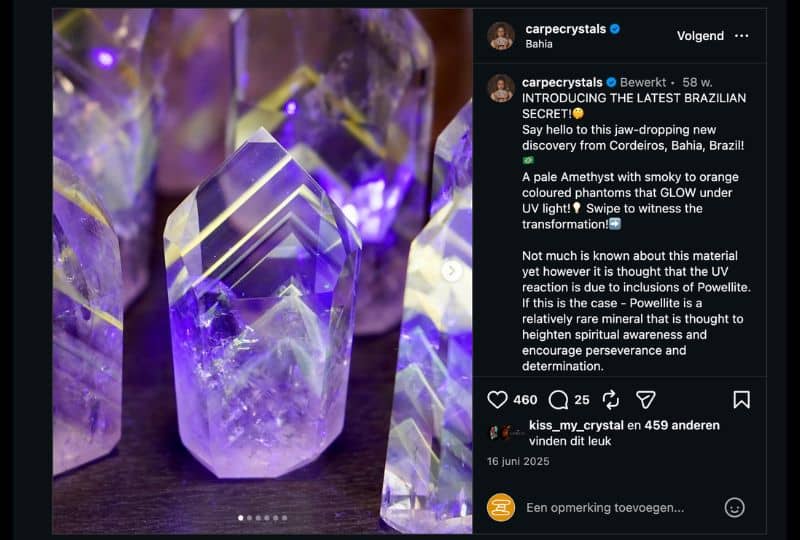
A good example of this can be seen in two consecutive Instagram posts by CarpeCrystals. On June 16, 2025, the material was presented as a remarkable new find from Cordeiros (Bahia, Brazil). In their post, they explicitly stated that little was yet known about the material and that the UV reaction was presumably caused by inclusions of powellite (“it is thought that the UV reaction is due to inclusions of Powellite”). It was also noted that the material did not yet have an official name and was circulating under various trade names.5
Just two days later, on June 18, 2025, however, a second post followed with the much more definitive title: “CONFIRMED: POWELLITE INCLUSIONS IN BRAZILIAN AMETHYST”6. It stated that recent analyses had confirmed that the crystals contained traces of powellite and that these micro-inclusions were responsible for the striking UV fluorescence. A geological explanation was also proposed, suggesting that the crystals had formed in a molybdenum-rich hydrothermal system. However, based on the available information, this “recent analysis” appears to stem from the 2019 study shared by Soul Body Gems on June 5, 2025. It is likely that CarpeCrystals only saw this analysis between the two posts or were made aware of it, although this cannot be determined with certainty.
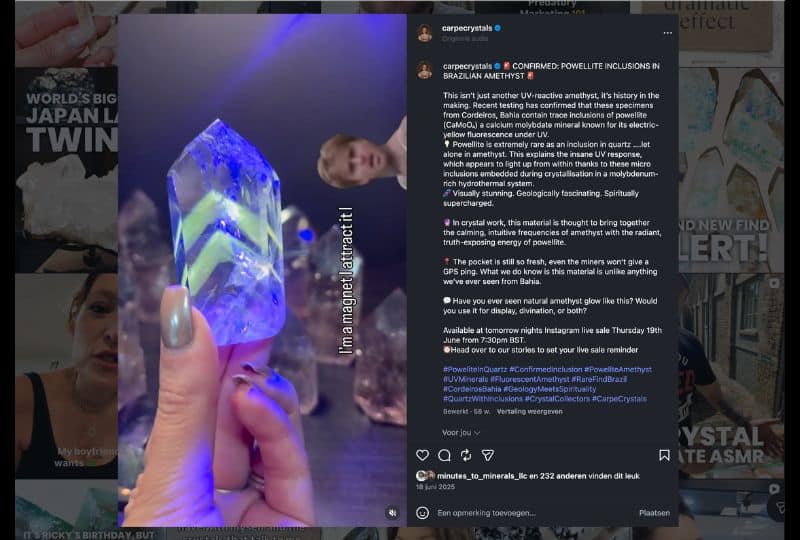
These two posts clearly illustrate how quickly a preliminary scientific interpretation can turn into what appears to be a definitive identification in the trade. Within two days, the communication shifted from “suspected powellite inclusions” to “powellite confirmed.” This case thus illustrates how a working hypothesis can quickly evolve into a trade name.
A second analysis in 2025 leads to a different explanation
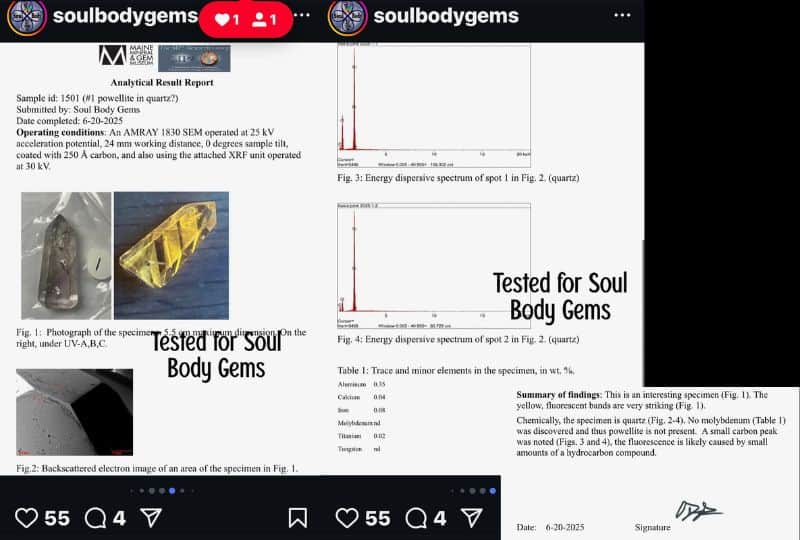
In June 2025, Soul Body Gems had a second crystal analyzed, taken from more recently mined material from the same reported site in Cordeiros, Bahia. The analysis was again conducted by the same mineralogist as in 2019. First, two fluorescent zones on the surface were examined using a scanning electron microscope (SEM) and energy-dispersive spectroscopy (EDS). The crystal was then ground for a separate trace element analysis. This analysis detected small amounts of aluminum (0.35 wt%), calcium (0.04 wt%), iron (0.08 wt%), and titanium (0.02 wt%), but no molybdenum. The report’s conclusion was therefore unequivocal:“No molybdenum (Table 1) was detected, and thus powellite is not present.” In addition, based on a small carbon peak observed with SEM-EDS, the researcher concluded that the striking fluorescence is likely caused by small amounts of a hydrocarbon compound7. This marked the first time an alternative to the now-established powellite hypothesis had been proposed.
It is noteworthy that the current version of the shared analysis report (screenshot from August 2, 2026) is more detailed than a screenshot I had previously saved from July 2025. In the later version, the researcher explains that MicroRaman and X-ray diffraction (XRD) identified only quartz and were unable to detect any individual inclusions, likely because they were too small. He also noted that the XRF analysis used has a detection limit of approximately 5 ppm. The absence of a detection therefore means that any molybdenum present is below that detection limit, not that it is absent with absolute certainty. However, the researcher stood by his conclusion that powellite could not be confirmed in the sample under investigation.
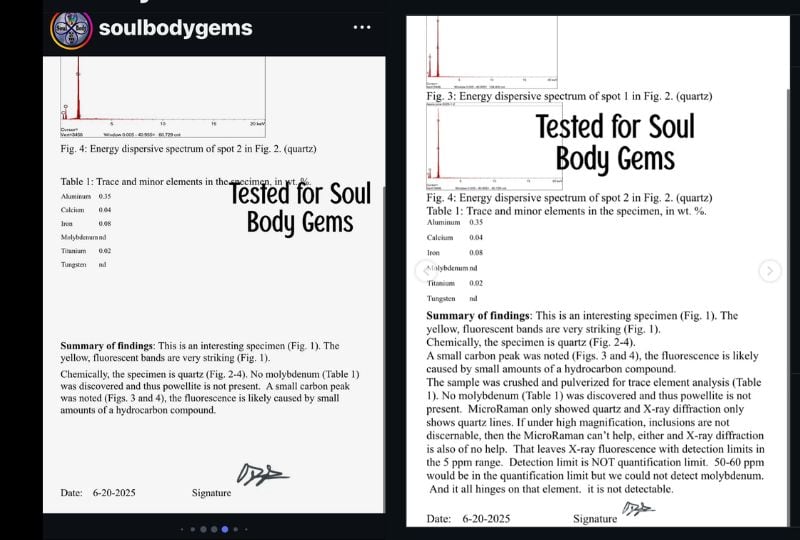
It was precisely that conclusion that sparked a vigorous substantive debate within the minerals industry. It was not so much the measurement results themselves that were in question, but rather the extent to which one could rely on the findings of this analysis.
Discussion on the Interpretation of the Second Analysis
The conclusion of the June 2025 report sparked debate almost immediately. Among others, CarpeCrystals responded on July 25, 2025, with a detailed Instagram post in which they questioned the interpretation of the research findings8. According to CarpeCrystals, the absence of detectable molybdenum does not automatically mean that powellite is absent. They compared that conclusion to examining a drop of ocean water and then concluding that there are no whales in the ocean. Their central message was that a local surface analysis cannot provide information about the entire composition of a crystal.
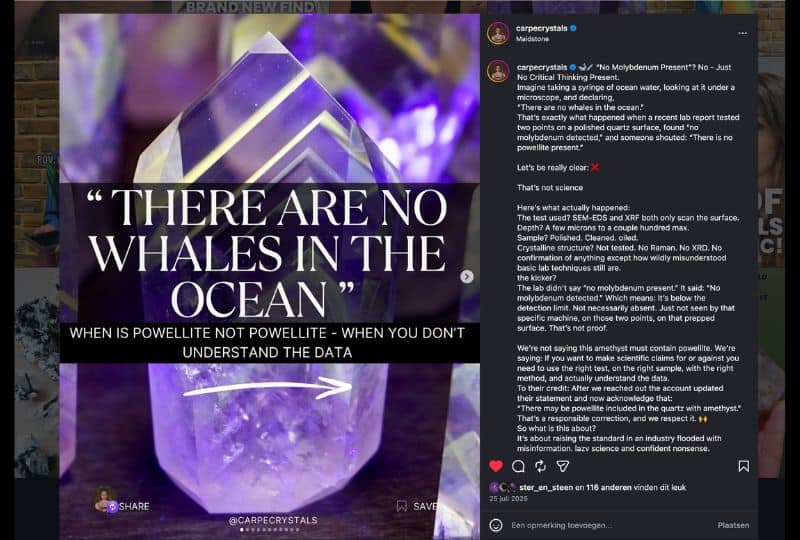
That criticism raises an important point. The fact that no molybdenum was found in the 2025 sample examined does not, in fact, automatically mean that powellite is absent elsewhere in the same crystal or in other specimens. The researcher himself pointed this out in the later-published version of the report by explaining in greater detail the limitations of the analytical techniques used and the detection limit of the XRF.
The proposed explanation involving hydrocarbons also warrants some caution. Prior to SEM analysis, the sample under investigation was coated with a thin layer of carbon to make it electrically conductive—a common preparation method for non-conductive minerals such as quartz. In addition, residues from sawing, polishing, or other surface contaminants may also contribute to a carbon signal. Based on the published data, it is therefore not possible to determine with certainty to what extent the measured carbon originated from natural inclusions. This analysis does not definitively support the explanation that natural hydrocarbons are the cause of the fluorescence.
At the same time, this criticism also raises an interesting question. If the same standard is applied to the 2019 analysis, it does not follow from that either that powellite has been definitively identified or is responsible for the fluorescence. After all, that interpretation was also based on an indirect XRF analysis that measured elevated levels of calcium and molybdenum, but in which powellite itself was not directly identified as a mineral species. The 2019 analysis made powellite a well-substantiated hypothesis, but it did not provide definitive proof either.
Remarkably, the 2019 analysis was, in fact, accepted by the trade almost immediately as confirmation of powellite. On June 16, 2025, CarpeCrystals still presented the material as an amethyst suspected of containing powellite and, two days later, even referred to it as “Powellite confirmed.” When Soul Body Gems released the results of a much more comprehensive study in June 2025—which included not only SEM-EDS but also trace element analysis, Raman spectroscopy, and X-ray diffraction (XRD)—the limitations of the techniques used were strongly emphasized. Following this criticism, Soul Body Gems’ original Instagram post was removed, and on July 29, 2025, a new, more thoroughly explained version was published in which the analyses from 2019 and 2025 were discussed side by side.
Soul Body Gems deserves credit for the way it handled that criticism. The company had the material tested at its own expense, made the results public, and revised its original wording after substantive objections were raised. This did not mean the conclusion was retracted, but rather that it was phrased more carefully. Whereas the initial communication had stated that powellite was not present, it was now acknowledged that other specimens or untested areas might still contain powellite.
Expansion of the study: ten additional specimens
While the online discussion was still in full swing, Soul Body Gems didn’t stop there. To further verify the earlier results, they had not just one additional crystal tested, but a batch of ten fluorescent specimens from the same reported locality. The results from the October 7, 2025, report were publicly shared on December 17, 2025, via Soul Body Gems’ Instagram and Facebook accounts (Falster, 2025; shared by Soul Body Gems, December 17, 2025)9. The additional analysis provided a much broader picture of the material than the individual specimens from 2019 and June 2025.
As in the previous analysis, the fluorescent zones were first examined microscopically using a scanning electron microscope (SEM) and energy-dispersive spectroscopy (EDS). In addition, all ten crystals were individually ground for a trace element analysis of the total sample. It was notable that all specimens exhibited similar fluorescence, while molybdenum was detected in only two of the ten specimens. Calcium was also measured only in low concentrations (Falster, 2025; shared by Soul Body Gems, December 17, 2025).
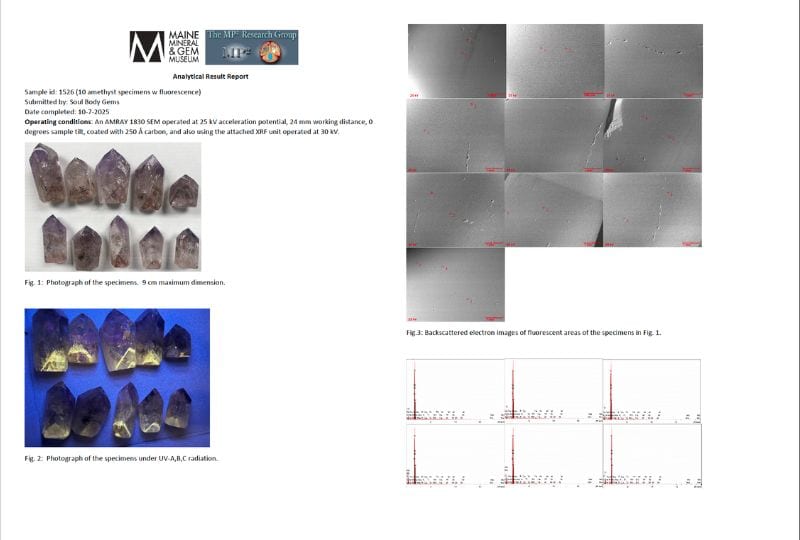
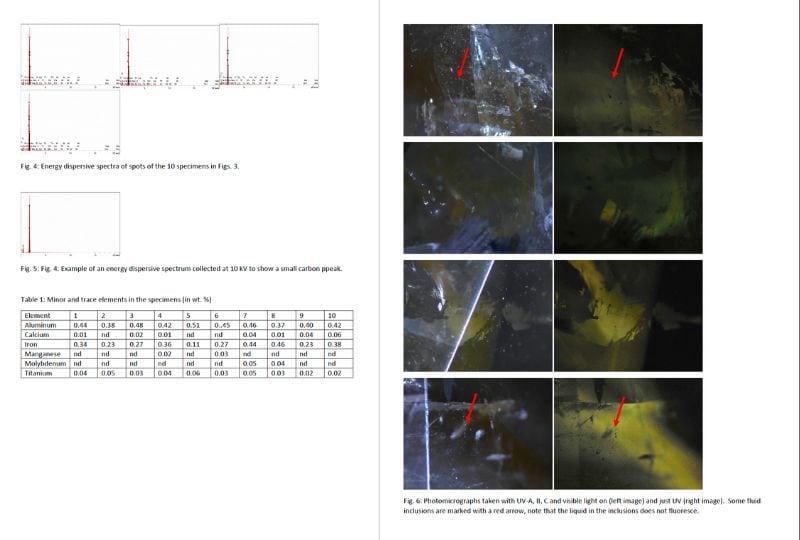
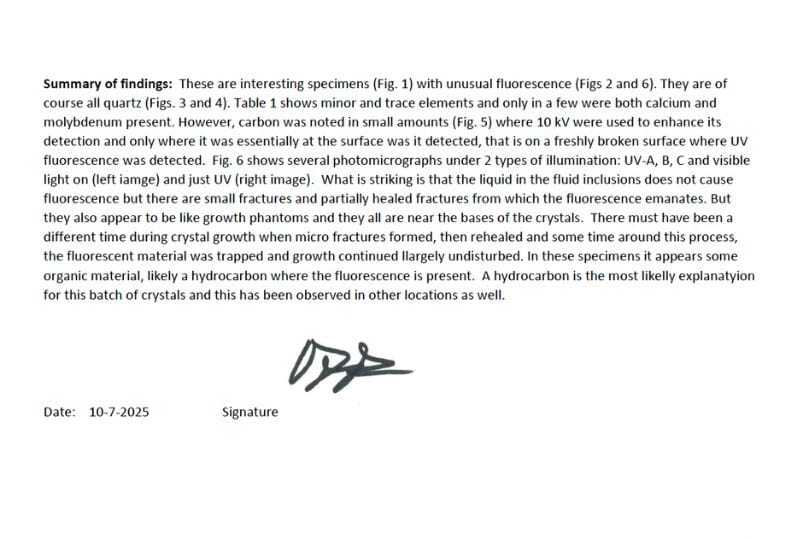
Screenshots from the follow-up study (pp. 1–5) on ten fluorescent amethyst crystals, dated October 7, 2025. (Falster, 2025; shared by Soul Body Gems, December 17, 2025).
In the report’s summary, Falster concludes that only a few crystals contain both calcium and molybdenum. Furthermore, a small amount of carbon was again observed during the microscopic analysis of several fluorescent zones. Microscopic examination also showed that the fluorescence does not appear to originate from liquid inclusions, but rather from small fractures, partially healed fractures, and growth phantoms near the base of the crystals. The researcher concludes that a hydrocarbon compound is the most likely explanation for the fluorescence in this batch of crystals.
Incidentally, during the discussion in July 2025, CarpeCrystals also announced that it would have five untreated raw crystals analyzed using Raman spectroscopy. More than a year later, these results still had not been made public. In a response on Instagram (July 2026), CarpeCrystals stated that additional analyses were desirable, but that the costs for these turned out to be significantly higher than expected. However, they did indicate that they now suspect that both organic material and molybdenum play a role in the various fluorescence colors. However, as long as the results of that study are not available, these statements cannot be independently assessed or taken into account in this article.
Soul Body Gems’ follow-up study of ten additional specimens has significantly altered the picture. Although not all questions have been definitively answered, it became clear that virtually all of the crystals examined fluoresce, while molybdenum was found in only a small fraction of the specimens. This makes it increasingly unlikely that powellite is the general cause of the fluorescence, although it cannot be ruled out that some crystals from this locality do contain small amounts of powellite. The question thus shifts from “Is powellite present?” to “Does powellite actually cause the fluorescence?”
A third line of research: What does the fluorescence itself tell us?
While the discussion on social media focused primarily on the question of whether or not powellite was actually present, the additional research on the ten specimens made the organic hypothesis considerably more likely. Almost simultaneously, at the end of 2025, a third, entirely independent study was published that approached the discussion from a completely different angle. Instead of focusing primarily on the chemical composition of the material, Michael Crawford, working for the Fluorescent Mineral Database of the Fluorescent Mineral Society, examined the behavior of the fluorescence itself. He examined three crystals from Cordeiros under long-, mid-, and short-wavelength UV light and compared their emission spectra with those of a reference sample of powellite (Crawford, 2025)10.
The phantoms fluoresced most strongly under long-wavelength UV (365 nm) and noticeably weaker under mid- and short-wavelength UV. In addition, one of the three crystals examined exhibited a distinct orange fluorescence. Both this behavior and the measured emission spectra differed markedly from those of the powellite reference sample under investigation, which, in contrast, exhibited a stronger response under short-wavelength UV. Crawford therefore concluded that an organic fluorescent substance is more likely than powellite.
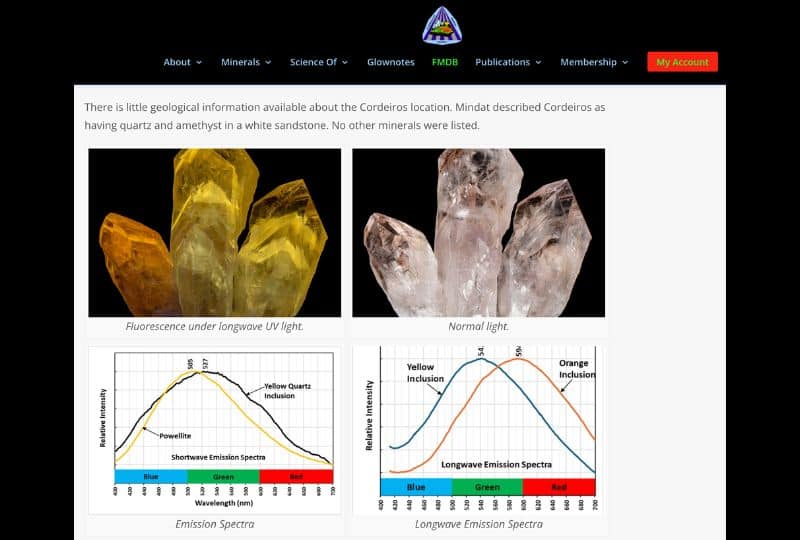
* Technical background (for those interested): The yellow fluorescence exhibited maxima around 542 nm under long-wavelength UV and 527 nm under short-wavelength UV. The powellite reference sample had a narrower peak around 505 nm. In addition, a broad orange emission peak around 594 nm was measured in one specimen.
The study does not identify which organic compound is responsible for the fluorescence, but it does convincingly demonstrate that the fluorescence behavior does not match that of the powellite reference sample examined. Thus, this study provides independent and relatively strong evidence that an organic compound is likely the cause of the fluorescent phantoms, and not powellite.
This study therefore addresses a different question than the earlier analyses, which focused primarily on whether powellite was present in the crystals examined. Crawford, on the other hand, investigated whether the observed fluorescence behavior corresponds to that of powellite. It is precisely for this reason that this study constitutes an important, independent supplement to the earlier analyses.
What do we actually know—and what don’t we know?
Reasonably well-supported:
- The material consists of colorless to light purple quartz with fluorescent growth zones or phantoms.
- The specimens are believed to have been found at the Cordeiros region in Bahia, Brazil.
- In one specimen from 2019, elevated levels of calcium and molybdenum were measured in the fluorescent zone. In another specimen from 2025, no molybdenum was detected despite the use of multiple analytical techniques.
- In a follow-up study of ten fluorescent specimens from 2025, molybdenum was detected in only two specimens, even though all ten crystals exhibited the same UV phenomenon.
- In three other crystals, the fluorescence behavior differed markedly from that of a powellite reference sample and was more consistent with that of an organic fluorescent compound.
Not proven:
- That all samples contain powellite, or, conversely, are completely free of powellite.
- That the calcium and molybdenum from the 2019 analysis occurred together as crystalline powellite.
- That the carbon from the 2025 analyses came from a natural organic inclusion.
- That powellite is responsible for the yellow fluorescence, if it is indeed present in some specimens.
- That the presence of small amounts of molybdenum is related to differences in fluorescence color.
- Which specific organic compound causes the fluorescence, and whether all the material in question comes from exactly the same find or growth phase.
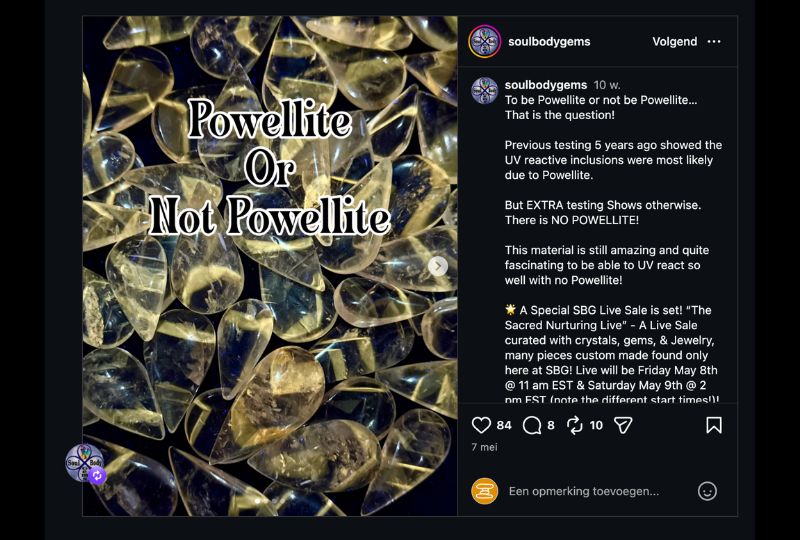
In May 2026, Soul Body Gems once again presented a collection of cabochons under the title “To be Powellite or not to be Powellite… That is the question!”. This suggests that the trade is now focusing less on definitive identification and more on the unique UV effect itself. Furthermore, the comments under the post show that many collectors primarily appreciate this visual phenomenon and are less concerned with its exact cause.
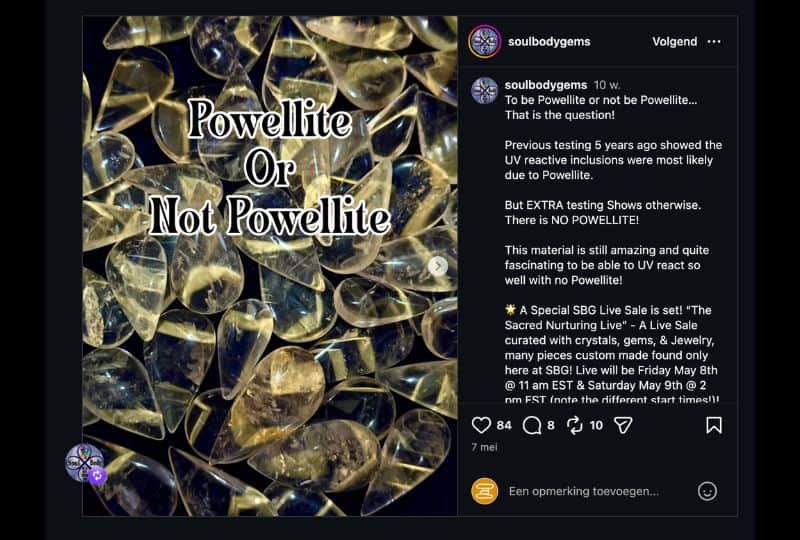
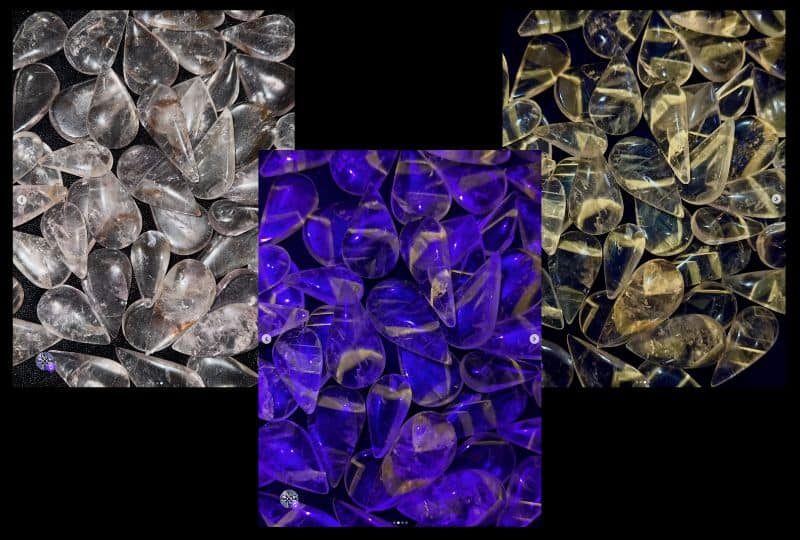
In May 2026, Soul Body Gems chose the fitting title: “To be Powellite or not to be Powellite… That is the question!” (screenshot of Soul Body Gems’ Instagram post, May 7, 2026).
Conclusion: likely organic, but not yet fully identified
The available studies do not provide definitive proof that powellite is the cause of the yellow fluorescent phantoms. The 2019 XRF analysis did make powellite a plausible hypothesis, as elevated levels of calcium and molybdenum were measured in a fluorescent zone. However, that analysis could not demonstrate that both elements actually occurred together as crystalline powellite.
Follow-up research on a single specimen in June 2025 and an additional analysis of ten fluorescent specimens from the same site in October 2025 paint a different picture. Despite similar fluorescent behavior, molybdenum was detected only sporadically, while the presence of carbon led to the hypothesis that an organic compound is the most likely explanation for the fluorescence. However, the presence of carbon alone does not constitute conclusive evidence of a natural organic compound, because the measured carbon signal may also (partially) originate from the applied carbon coating or other contaminants, but this does make it increasingly unlikely that powellite is the cause of the UV reaction.
Crawford’s fluorescence study thus provides an important independent corroboration of these findings. The response at different UV wavelengths and the measured emission spectra clearly differed from those of the powellite reference sample under investigation and were more consistent with an organic fluorescent compound. This further strengthens the organic hypothesis, even though the specific substance responsible has not yet been identified. Based on all available data, an organic compound therefore appears to be the most likely general explanation for the yellow fluorescence. At the same time, it cannot be completely ruled out that some specimens or individual growth zones contain small amounts of powellite. If that is the case, however, based on the current data, powellite does not appear to be the general cause of the UV effect.
Perhaps the most important finding of this study is that two different questions have often become conflated:
Does powellite occur in some specimens? And does powellite cause the yellow fluorescence?
Based on the current data, the first question cannot yet be definitively answered, while the second question seems to point more and more strongly toward an organic fluorescent compound.
For commercial purposes, therefore, a neutral and transparent description is the safest option:
Light-colored amethyst (quartz) with yellow-fluorescent inclusions. Based on current research, an organic compound appears to be the most likely cause of the fluorescence. Origin: Cordeiros, Bahia, Brazil.
Optionally, the following can be added:
In the trade, this material is also marketed as “amethyst with powellite” or “Powellite Quartz.” Powellite may be present in some instances, but the available data do not support the notion that powellite is the primary cause of the yellow fluorescent phantoms.
Reflection: How much certainty do we really need?
After four studies, various analytical techniques, and an extensive online discussion, the exact cause of the fluorescence has still not been definitively identified. However, current research results increasingly point toward an organic fluorescent compound as the general explanation. This raises a broader question: how much certainty can we reasonably expect before new material appears on the market under a specific name? It is not realistic to examine every new discovery in advance using multiple costly techniques. However, it is important not to present a working hypothesis as a proven identification.
This case study illustrates how mineralogical knowledge evolves. The 2019 interpretation was logical based on the measurements available at the time. The additional studies from 2025 proposed an alternative explanation, and the subsequent fluorescence analysis made that organic explanation more plausible. That does not automatically mean that the earlier research was “wrong.” Every analysis adds information, refines existing insights, or clarifies which questions remain open. That is precisely why observations, interpretations, and proven facts must be carefully distinguished from one another. Scientific discussions often focus not only on the measurement results themselves, but primarily on the question of how much certainty can be derived from different analytical techniques.
This case also shows that science and commerce do not always share the same starting point. While research focuses on carefully testing hypotheses, the commercial sector needs a recognizable name under which a new material can be marketed. A rare mineral like powellite naturally appeals more to the imagination than an organic compound that has not yet been identified.
That is precisely why it is important to continue to distinguish between a practical trade name, a working hypothesis, and a scientifically substantiated identification. This distinction helps prevent misunderstandings while also leaving room for new insights as additional research becomes available.
For many collectors and enthusiasts, the beautiful UV effect remains particularly important. For sellers, researchers, and museums, the responsibility is different: they must indicate as clearly as possible which information is certain and which is still tentative. As an independent knowledge center, Stapel van Stenen aims to play a role in this by collecting, comparing, and contextualizing available information. Not to determine who is “right,” but to clearly distinguish what has actually been observed, which interpretations are based on those observations, and which questions remain unanswered.
Perhaps that is the most important lesson from this case study: not that we now know for certain what the fluorescent phantoms are, but that dealing carefully with uncertainty is at least as important as finding an answer.
- Soul Body Gems. (June 5, 2025). Rare ametrine with powellite inclusions [Instagram Reel]. https://www.instagram.com/reel/DKidyScxa6n/ ↩︎
- Soul Body Gems. (July 29, 2025). An update on the 2019 & 2025 UV-Reactive Amethyst. [Instagram carousel]. https://www.instagram.com/p/DMskWkquDCN/ ↩︎
- Soul Body Gems. (May 7, 2026). To be a Powellite or not to be a Powellite… That is the question! [Instagram carousel]. https://www.instagram.com/p/DYA3Iy4lvXZ/ ↩︎
- Falster, A. (August 10, 2019). Analytical Results Report: Sample 4989 [Unpublished analysis report]. William B. “Skip” Simmons Research Laboratory, Maine Mineral & Gem Museum . Cited in Soul Body Gems. (July 29, 2025). An update on the 2019 & 2025 UV-Reactive Amethyst. [Instagram carousel]. https://www.instagram.com/p/DMskWkquDCN/ ↩︎
- CarpeCrystals. (June 16, 2025). Introducing the latest Brazilian secret! [Instagram post]. https://www.instagram.com/p/DK9Xa8ooK8p/ ↩︎
- CarpeCrystals. (June 18, 2025). Powellite confirmed. [Instagram Reel]. https://www.instagram.com/reels/DLCsdtoIaRj/ ↩︎
- Falster, A. (June 20, 2025). Analytical Results Report: Sample 1501 [Unpublished analysis report]. William B. “Skip” Simmons Research Laboratory, Maine Mineral & Gem Museum . Cited in Soul Body Gems. (July 29, 2025). An update on the 2019 & 2025 UV-Reactive Amethyst. [Instagram carousel]. https://www.instagram.com/p/DMskWkquDCN/ ↩︎
- CarpeCrystals. (July 25, 2025). “There are no whales in the ocean.” When is “powellite” not “powellite”?—When you don’t understand the data. [Instagram carousel]. https://www.instagram.com/p/DMiKaDTordx/ ↩︎
- Falster, A. (October 7, 2025). Analytical Results Report: Sample 1526 (10 amethyst specimens with fluorescence) [Unpublished analysis report]. William B. “Skip” Simmons Research Laboratory, Maine Mineral & Gem Museum . Cited in Soul Body Gems. (December 17, 2025). UV amethyst from Brazil: Powellite or not Powellite? [Instagram carousel]. https://www.instagram.com/p/DSYJ-Nvkcg7/ ↩︎
- Crawford, M. (November 25, 2025). Quartz with fluorescent phantom zones from Cordeiros, Bahia, Brazil. Fluorescent Mineral Database, Fluorescent Mineral Society. https://uvminerals.org/fmdb/specimen/344/ ↩︎


Responses