
Sphalerite or not? Part I

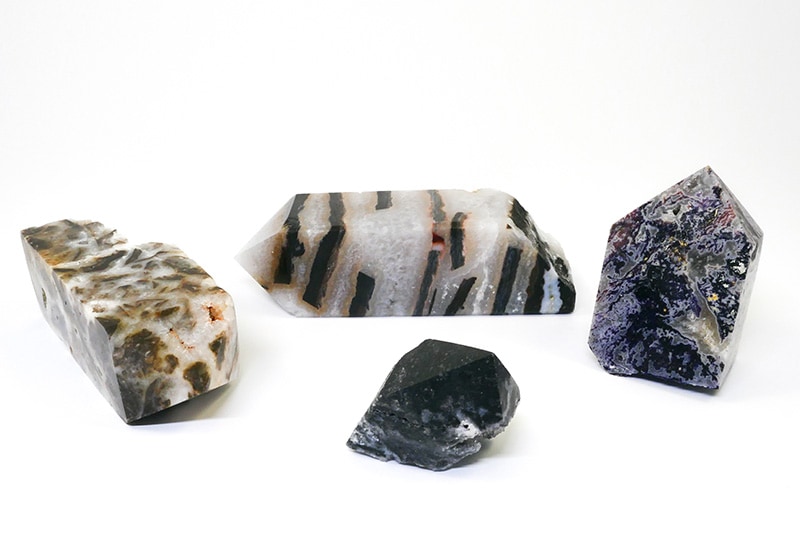
Quite some time ago I received from one of my students who also sells stones a number of polished towers of “sphalerite.” At least under that name the material was sold by the wholesaler. Partly as a result of taking the course, the discerning saleswoman had questions about the designation, also because the towers look quite different and do not show clear characteristics of sphalerite. Unfortunately, it is not known exactly where the different towers came from. This material is also still widely offered over the Internet at this time, both from Indonesia and China. Hence, here I share my analyses of 2 of the 4 turrets, the rest you can read in Part II. Of course, this information is also included as an article in the Gem or Scam Library.
Left tower 1, bottom center tower 2, top center tower 3 and right tower 4
No sphalerite but goethite in quartz
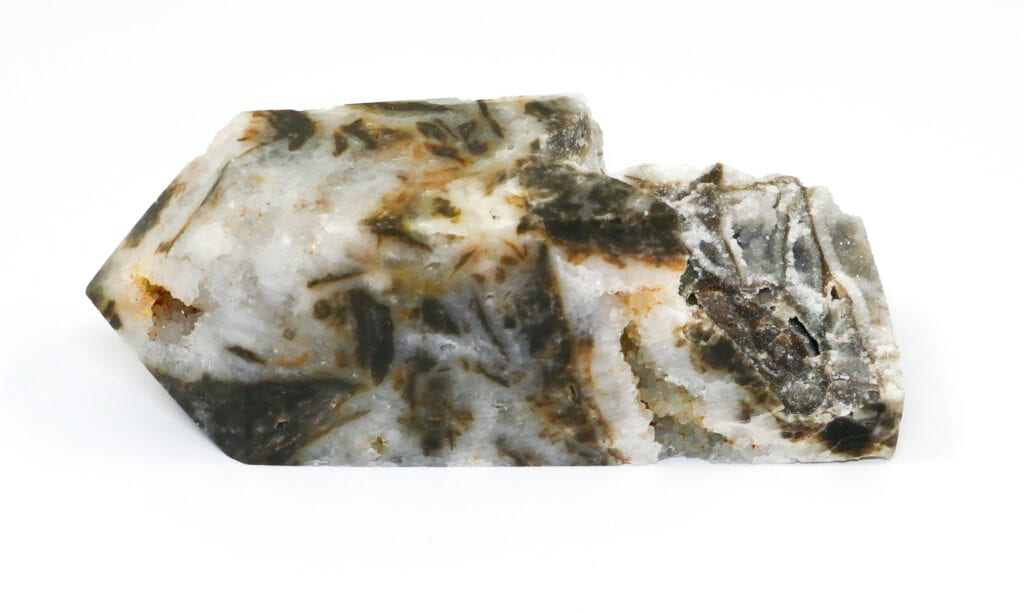
In the first tower, the brown spots are referred to as “sphalerite,” but I measured a Mohs hardness of about 6 – 7, much harder than sphalerite (Mohs 3 1/2 – 4). The white in this tower is quartz, possibly the sphalerite is in the quartz then, but that cannot be determined without additional examination. However, chemical analysis in a lab shows no zinc and/or sulfur (the constituents of sphalerite) are present in the brown mass. The brown mineral has been identified as goethite, an iron oxide, often a weathering product of other iron minerals.
Purple sphalerite? by no means
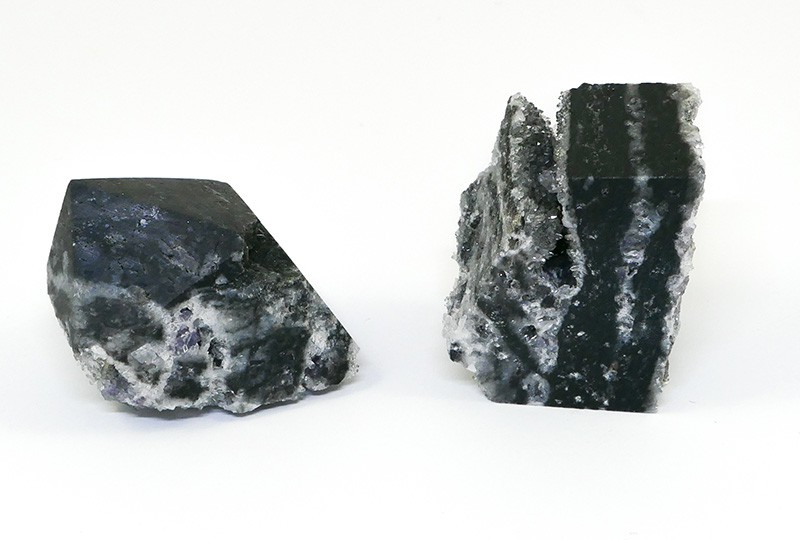
Tower 2 has gray-black bands that have a Mohs hardness of 5 – 6, making them harder than sphalerite (Mohs 3 1/2 – 4). Furthermore, white/clear quartz crystals are clearly visible and small purple crystals here and there under the microscope. Since there is also a purple-blue reaction with longe wave UV (UVA) this could be fluorite. The yellow spots effervesce with acid and give a red fluorescence with short wave UV (UVC), probably calcite. Additional examination in the lab shows that there is indeed quartz and fluorite in the tower. Unfortunately, no sphalerite was detected in the gray-black material. It was not possible to determine what mineral it is, probably manganese oxides.
Conclusion
Sphalerite or not? Not so. Unfortunately, I have had to find that sphalerite has not been demonstrated in any of the towers despite being sold under that name. Unfortunately, much, and perhaps more and more, material is still being offered whose designation is geologically incorrect. When a wholesaler sells it that way the incorrect name quickly spreads like an oil slick among all sellers and enthusiasts. It is good that there are more and more critical sellers like my student, who do like to sell their stones with the correct data.
Read the Gem or Scam Library article here.
Would you like to learn to recognize or identify minerals based on their characteristics? Perhaps the online basic course in mineral identification is for you!
Of course, you can also come to Stack of Stones for mineral advice or analysis.



Responses