
Thomsonite with mesolite

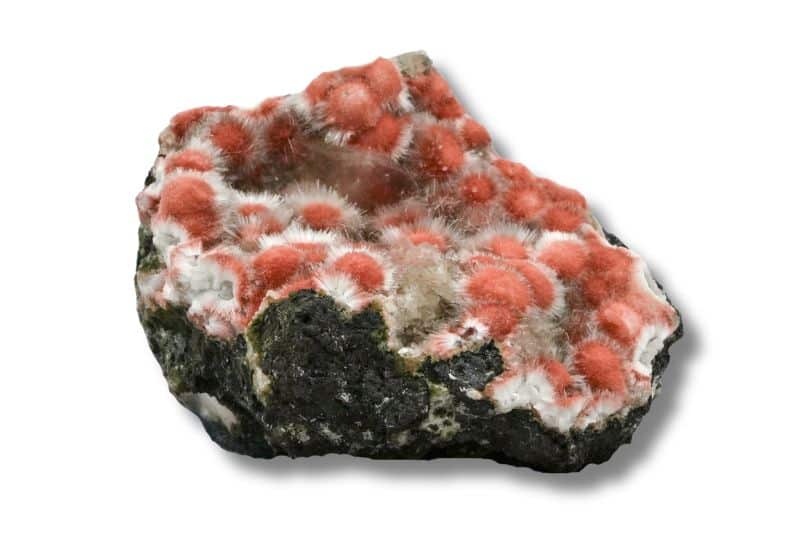
Both mesolite and thomsonite are natural minerals belonging to the zeolite group. They are known for their fine, needle-shaped crystals that often form spherical aggregates. For several years, orange-brown to orange-red spheres with bright white needles on top have been offered in the trade. These combinations are often incorrectly referred to as thomsonite with mesolite. In addition, imitation specimens made by humans are offered.
Most appear to be mesolite only
From geological and mineralogical research, described among others by Ottens (2024)1, show that most specimens consist entirely of mesolite – i.e., the clear crystal ends including the orange-red globular part that was referred to as thomsonite. The color appears to be caused by a thin iron-containing zone.
One of the sites where the first “thomsonite” with mesolite spheres came from is at Kannad, Aurangabad, India. Specimens from that location have bare, orange-brown spheres up to several cm in diameter. Due to the fragility of the mesolite crystals, they break off quickly when collected, causing an unattractive appearance. Miners therefore often brush away the outer layer of mesolite needles and sometimes treat the remaining spherical surface with oil to better sell the pieces.
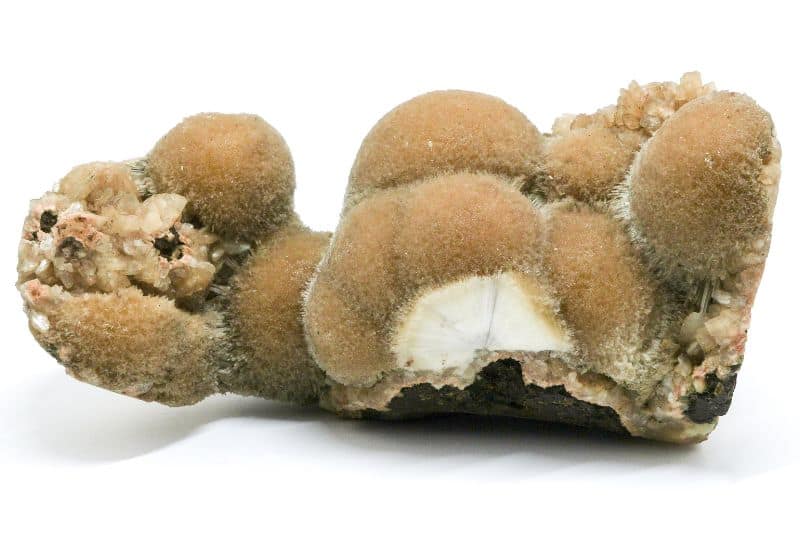
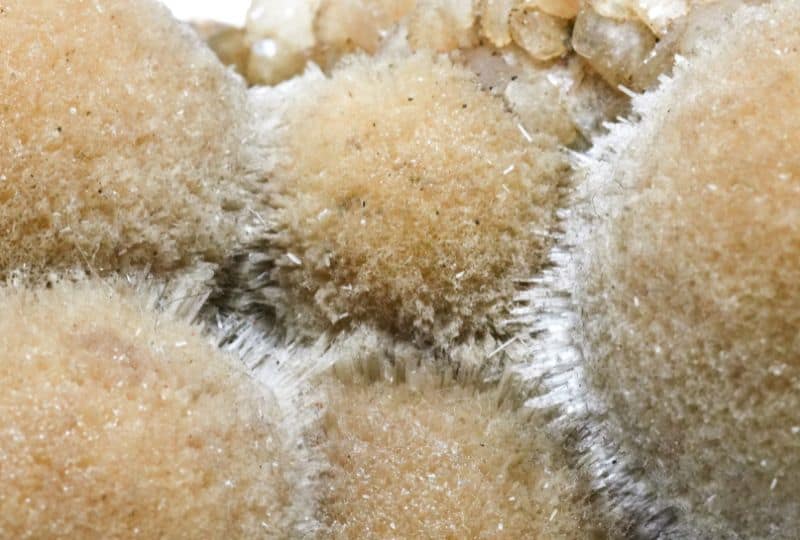
spherical aggregates of mesolite (12.5 cm x 6 cm; largest sphere 3.5 cm diameter) on a matrix of heulandite; most of the mesolite needles have been removed, a few are still visible in the seams between the spheres, the piece has been treated with oil; from Kannad, Aurangabad, India
In late 2021, new finds of mesolite on “thomsonite” were offered by Indian traders. It soon became known that they came from near the village of Dehgaon in Khandwa district of Madhya Pradesh province, India. The radially arranged crystal ends are colorless and emerge from a reddish sphere with a maximum diameter of 2 cm. Also from this location, analyses showed that the crystals are composed entirely of mesolite, with only a thin colored zone about 2 mm thick. The spherical aggregates grow on shiny heulandite crystals, which also sometimes have a wafer-thin reddish layer. There seems to be some resemblance to the mesolite formations from Kannad, but they are considerably larger and are less red in color.
Imitation specimens
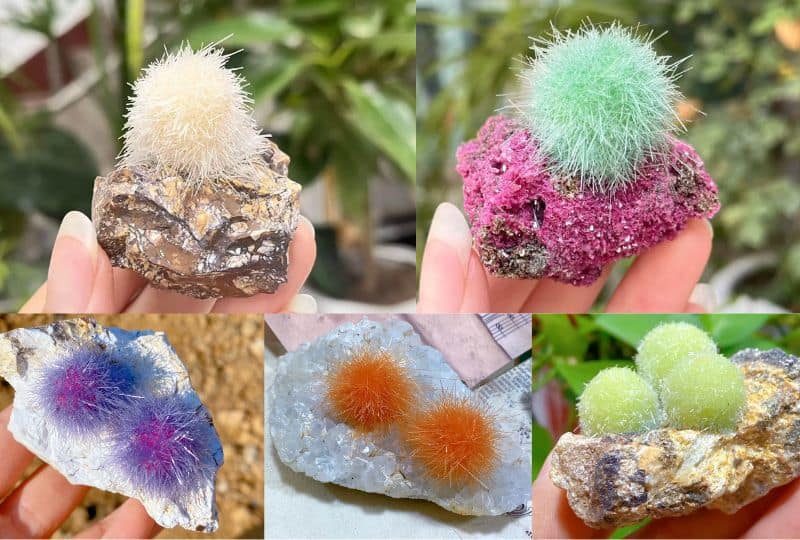
In addition to these natural specimens, counterfeits also circulate on the market. These are referred to, for example, as ‘Indian dandelion zeolite crystals’ and consist of orange spheres with messy white needles on a natural matrix. Sometimes they are also white (as an imitation of okenite) or colored blue (as a linarite imitation). The matrix and growth form do not correspond to natural pieces, and the crystal structure lacks the typical radial arrangement characteristic of natural mesolite.
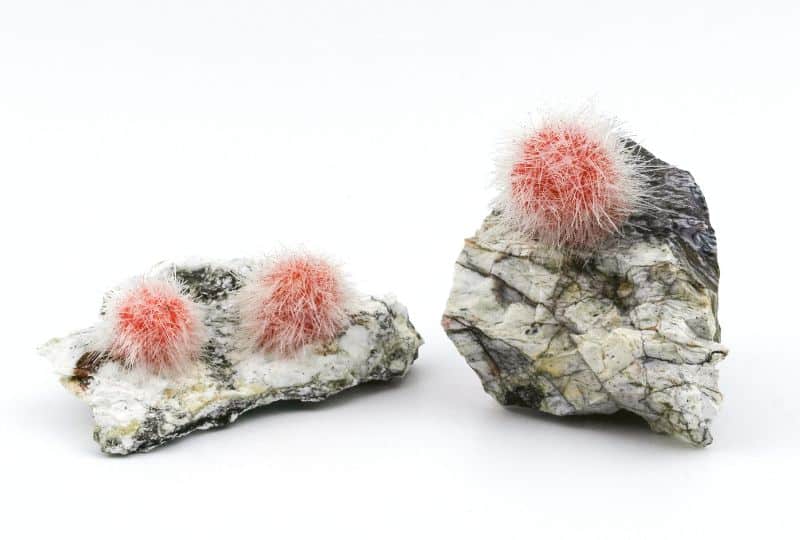
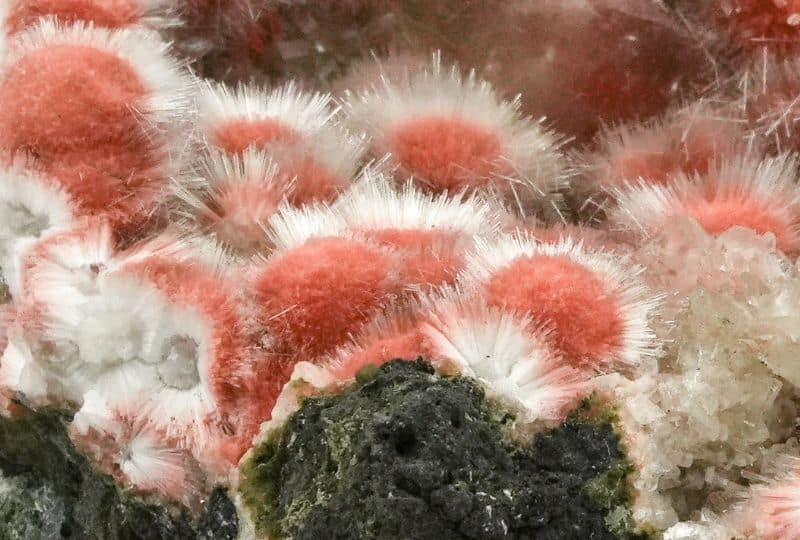
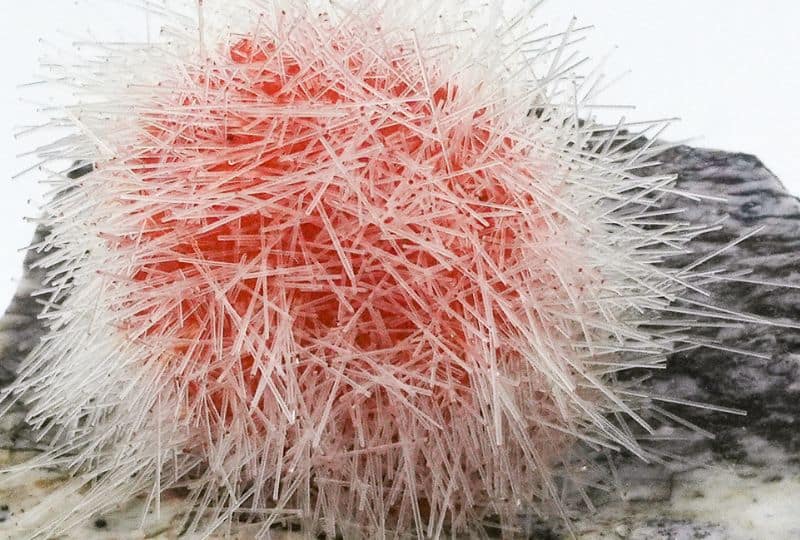
Left detail of natural mesolite crystals clearly arranged radially and right imitation mesolite fiberglass needles crisscrossing from the sphere
- Ottens, B. (2024). India, the secondary minerals from the Deccan Volcanic Province. Munich: Christian Weise Verlag. ↩︎


Responses