
Names of minerals and gemstones

In recent years, more and more “new” names have been popping up for existing or newly discovered stones. During the courses I give on minerals and on online platforms, I often get questions about stones with the most exotic names, such as Aqua Aura, Azeztulite, Super Seven, Shaman Dream Quartz and Lemurian crystals. These are just a few examples. When you then research in geologically-oriented books and reliable websites, you often find little or no information about the origin of these names. This is because they are not official mineral names, but commercial designations, trademarks or esoteric fantasy names.
For enthusiasts, it is often not clear whether a name is a recognised scientific name, a trademark or simply a fabrication. Some people are fine with that too, but there are several reasons why using a unified name is important. Which name is known or used often depends on the lens through which you look and which sources you use: books and websites with an esoteric slant use different names than publications from a geological or gemological approach. The introduction described that many of these commercial names and esoteric fantasy names can be misleading. Why they are or are not classified as Scammite will become clear in the descriptions in the library.
Reasons for proper naming
Proper and honest naming of gemstones and minerals is essential for several reasons. First, the plethora of fancy names and commercial trade names causes a lot of confusion. It frequently happens that the same mineral is sold under different names, making it difficult for buyers to figure out exactly what they are buying. A good example is amethyst with inclusions of iron minerals. For years, this material was seen as amethyst with “impurities” and was therefore less sought after than the pure purple amethyst. However, since these stones have been marketed under attractive names such as Agape Crystal®, Auralite 23®, Melody Stone, Sacred Seven, Super Seven or Purple Angeline, they have suddenly become hugely popular. That these exact same stones are offered by different sellers under different names illustrates how marketing and naming can drive consumer perception. Incidentally, you can read in the library that in none of these names was the presence of the claimed composition correct: they are all amethyst with impurities, or more nicely put inclusions, of the iron minerals haematite and/or goethite.
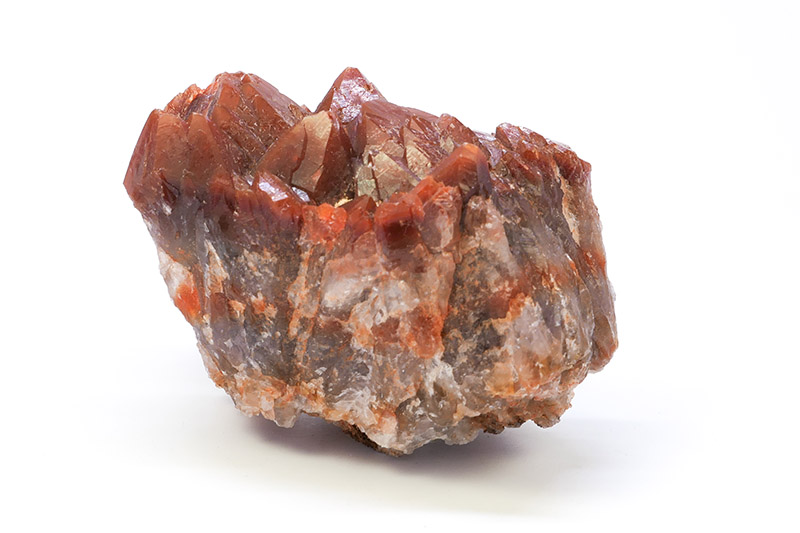
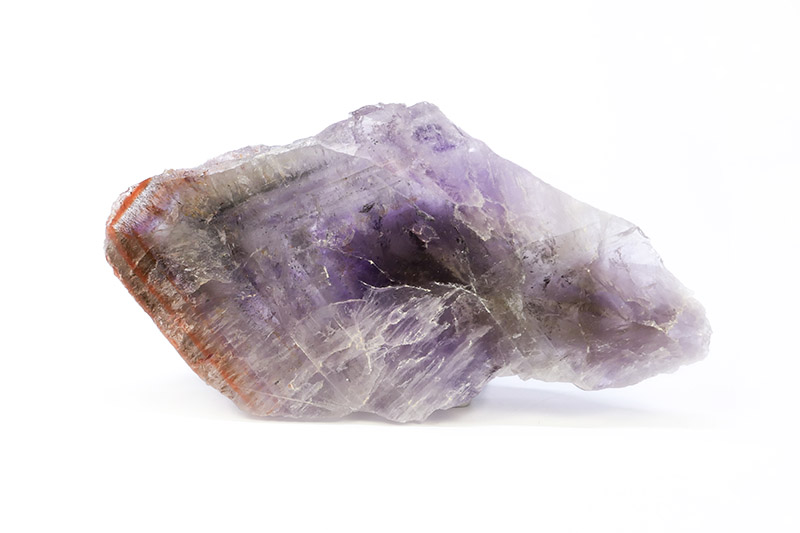
amethyst with inclusions of haematite, on the market under many different names, on the left a crystal group from Thunder Bay, Ontario, Canada and on the right a cut and polished crystal from Brazil
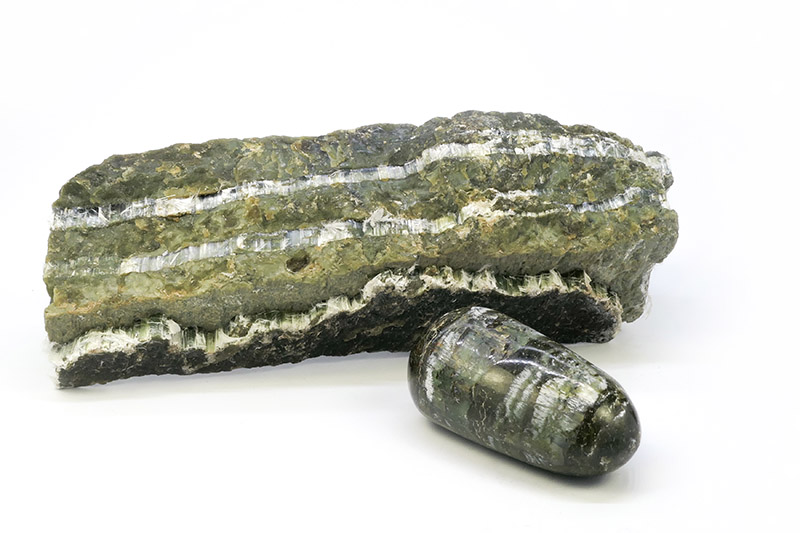
In addition, correct naming also has a legal dimension. With the entry into force of the General Product Safety Regulation (GPSR) in December 2024, it is mandatory for sellers to provide clear and honest product information, including origin, composition and potential risks. This means that using commercial names without clear indication of the actual composition or origin can not only be misleading, but also have legal consequences. So it is not only a matter of fair trade but also of compliance with legislation. A good example is “Bumblebee Jasper”, which is actually calcite with realgar and pyrite. While the commercial name sounds attractive, it does not give any insight into the composition of the stone and the health risk of the realgar, a toxic arsenic sulphide, present. Similarly, the name “Silver Eye Serpentine” conceals the presence of chrysotile, a fibrous asbestos mineral that is banned in the Netherlands (and most of Europe) because of the health risks if used improperly.
Besides safety issues, deception in marketing also plays a role. Some sellers give stones with a long-established but “boring” name a new made-up label to attract buyers’ interest. There are numerous examples where commercial names are used to create a hype around previously unpopular rocks. For example, “Pink Fire Azeztulite™” or “Red Healer” sounds more exciting than quartz with haematite, even though it is the exact same stone. Also, people often lift along on the popularity of rare stones by giving lookalikes similar names. For example, cheap Chinese and Indian lookalikes of the rare nuummite from Greenland. This allows poorly marketable or low-grade stones to still be sold, often at higher prices.
A common source of confusion is also that many of the “new” names are actually rocks and not minerals, even though they are presented as such. A rock consists of several minerals, which means that its properties do not correspond to those of a single mineral. For example Kiwi Jasper is not jasper, but a microgranite composed of albite, orthoclase, clay minerals, quartz and muscovite. Giving it the name “jasper” makes it appear to be one mineral, when it is actually a complex mixture. This leads to incorrect and misleading information about properties such as hardness, specific gravity and chemical composition, as well as possible spiritual properties.
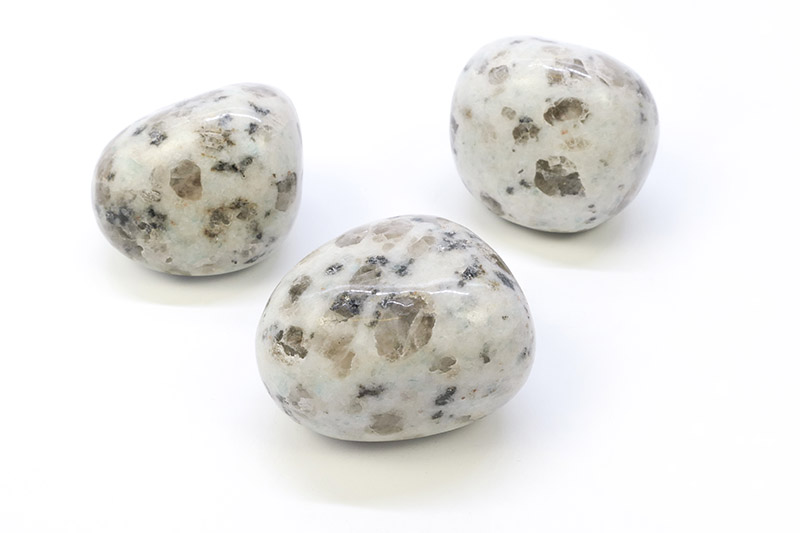
Kiwi “jasper”, so not jasper but a microgranite with albite, orthoclase, a clay mineral, quartz and muscovite from New Zealand
Alternative naming in the world of minerals and gemstones is completely out of control and far from the unambiguous naming as pursued by the International Mineralogical Society (IMA) or the Blue Books of the World Jewellery Confederation (CIBJO). This not only causes confusion, but can also be seen as misleading if the actual composition and origin of the stone are not mentioned. Therefore, when using commercial or fancy names, it is important to be transparent about what the stone actually is. Stapel van Stenen contributes to this by providing clear explanations and scientific information in the Gem or Scam Library and in courses, so that enthusiasts and sellers are better informed and can make informed choices.
International standard for mineral names
Mineral nomenclature is regulated worldwide by the IMA’s Commission on New Minerals, Nomenclature and Classification (CNMNC). A mineral name is officially recognised only after a careful process of scientific research and publication. This ensures that each name is scientifically substantiated and internationally accepted. The official IMA-CNMNC list contains as many as 6,118 recognised mineral names (as of January 2025) and covers almost 250 pages1. The most up-to-date version of this list is publicly available via the committee’s website.
Many recognised mineral names are derived from Greek, Latin or other ancient languages and translated into an international English name. However, spelling and pronunciation often differ from country to country. The ‘Encyclopedia of Mineral Names’ 2 describes various spelling and naming problems. For an extensive background on mineral naming, see the (dutch) book ‘Mineralogie voor verzamelaars’ (Mineralogy for collectors) 3 by Paul Tambuyser. In my book ‘Belazeriet of niet?’ the Dutch spelling has been used as much as possible, as suggested by Van Dennebroek and Moorer of Stichting GEA 4. In the English version of this library the IMA-CNMNC list is used and American-English spelling for the mineral names as used on the website Mindat.org.
In addition to scientific names, many minerals have traditionally had nicknames or synonyms. Some of these ancient names are still in use, such as bloodstone for the chalcedony variety heliotrope, while others have fallen into oblivion, such as heavy spar for baryte. These nicknames often originated in mining communities or local cultures and were based on the appearance, properties or traditional uses of the mineral. In addition, there are variety names that are often used as independent mineral names when this is factually incorrect. Examples include rock crystal and amethyst, both of which are varieties of quartz but are often presented as separate minerals.
The IMA-CNMNC standard ensures uniformity and clarity in the naming of minerals, preventing confusion and deception among scientists and collectors alike. This system provides the scientific basis for naming minerals worldwide and helps distinguish between official names, synonyms and commercial designations.
International standard for gemstone names: CIBJO Blue Books
In addition to the scientific nomenclature of minerals, as established by the IMA-CNMNC, the CIBJO ensures uniformity and standardisation in the naming of gemstones. This is done through the Blue Books, a set of international guidelines specifically for the definition, description and classification of gemstones, pearls, precious metals and diamonds. These digital books contain detailed rules and standards for correct naming, with commercially used terms strictly controlled to avoid misleading consumers.
The CIBJO Blue Books are designed to ensure transparency and consumer guarantee, by ensuring that gemstones are identified and described fairly and accurately. This includes rules for the listing of treatments and synthetic variants so that buyers know what they are buying. The guidelines are based on international agreement and are regularly updated to take into account new discoveries and market developments.
Adherence to the CIBJO Blue Books contributes to uniformity and clarity in gemstone naming and prevents misleading consumers with commercial or fancy names. As a result, these guidelines align seamlessly with the scientific standards of the IMA-CNMNC and ensure a transparent and fair gemstone trade worldwide.
Commercial names and trademarks
Trademarks are often used to give products exclusivity and authenticity, but their main purpose is marketing. By registering a trademark, sellers can distinguish their products (such as minerals or gemstones) from those of competitors and prevent others from selling the same material under the same name.
In the Netherlands, a trademark is protected only when the full registration process has been completed. Then the ® symbol may be used, which shows that it is a registered trademark. Although displaying this symbol is not compulsory in the Netherlands, the register is publicly accessible, putting others at risk if they use the same name. In the United States, on the other hand, it is compulsory to carry the ® symbol to claim legal protection and damages in case of infringement. A trademark registration is valid for a specific product, in a specific region and for a specific time.
In the Gem or Scam Library, such names are referred to as “registered trademarks”. During the compilation of the book in 2022, it turned out that only a few trademarks were actually registered, such as Auralite23® (without space) in France and Auralite 23® (with space) in the United States. See Auralite.
Besides registered trademarks, there are also unregistered trademarks in the United States. In this case, the trademark has been filed, but the registration process has not yet been completed. In this case, the ™ symbol is used. Filing a trademark does not give a monopoly on the use of the name. Only a full trademark registration confers the exclusive right of use. Therefore, such a “unregistered trademark” does not provide legal protection in the Netherlands and the Benelux, while in the US it can be used to claim the right of use.
In the online library, such names are referred to as ‘unregistered commercial names’. A notable user of this strategy is Robert Simmons, an esoteric author of, among other things, ‘The Wisdom of Stones’ 5 and owner of Heaven & Earth LLC Metaphysical Minerals and Jewelry6. The library contains more than 40 names that he has marked with the ™ symbol, although many of these names cannot be found in a trademark database. Examples include Azeztulite™, Creation Stone Agate™, Empowerite™, Guardianite™ and Synergite™. In the US, the ™ symbol is often chosen so that the full registration process can still be completed in the event of commercial success. In the Netherlands, however, it is unnecessary to use this symbol, as it offers no legal protection.
All other names that are not official mineral names but are used in trade are referred to in this library as ‘commercial names’ or ‘trade names’.
A good example of the complexity of trademarks is Yooperlites®, a registered name for a common rock, sodalite syenite. The name was registered in the US on 14 September 2018 by Erik Rintamaki, but has also been registered in Germany since 10 November 2021 by Markus Flinzner as ‘Yooperlite’. Despite these registrations, similar stones are appearing on the market worldwide, including Yooperlites from China. As long as these products are sold outside the US and Germany, no claim can be made to the exclusive use of the name. Furthermore, the success of Yooperlites® is being exploited by competitors who offer similar stones under other names such as ‘Yooperlight’, for which no trademark registration has yet been found. Of course, the original Yooperlites® will continue to come exclusively from Lake Superior, USA, but this shows that registering a trademark does offer protection in certain regions, but does not guarantee a global monopoly.
Nuances
But does the use of commercial or fantasy names always imply a scam? If it is not stated what it actually is, as in some of the examples I have given, then in my opinion that is certainly the case. However, there are some nuances.
From a mineralogical or geological point of view, it does not matter to me what type of agate I am looking at; to me, they are all the same variety of chalcedony, which is a microcrystalline variety of the mineral quartz. However, I understand that there is a real need in the trade for separate names for the different colours and structures of the various types of agate. For example, the name ‘moss agate’ also was introduced at some point and is now an established name for chalcedony with green mineral inclusions (e.g. chlorite, hornblende, etc.) or brown to black dendrites of iron or manganese oxides. The name moss agate can also be found as such as a variety in the Mindat database and in the CIBJO Blue Book. So I don’t think the introduction of new names such as flower agate or orca agate is such a problem in itself, but bear in mind that, from a mineralogical or gemmological point of view, it is not always possible to draw a strict line between all these different types of agate: they are all still varieties of chalcedony or quartz. Perhaps it is only a matter of time before species names such as flower agate are also included in international standards.
Similarly, many commonly used trade names have been accepted by industry organisations and have been standard practice in international trade for many years. Consider, for example, the use of the name selenite for the fibrous variety of gypsum, satin spar. Although, strictly speaking, the mineralogical designation ‘gypsum, variety satin spar’ is correct, this fibrous form is mainly known in trade and in books as selenite. This is a name that we in mineralogy reserve for a transparent variety of the mineral gypsum. Incidentally, the name selenite does not appear at all in the CIBJO Blue Book on Gemstones (the soft mineral is not widely used in jewellery) and satin spar is only mentioned as a variety of aragonite. Is this really misleading or Scammite? I don’t think so. Should we preferably call it gypsum, var. satin spar? As far as I’m concerned, yes, or at least use both names.
Furthermore, it seems that the perspective from which you look at naming matters. There is a difference in how naming is viewed from different disciplines, such as mineralogy, gemmology, esotericism or trade. I often use the well-known ‘ruby in zoisite’ as an example. In mineralogy, this should actually be called ‘corundum, variety ruby in chrome zoisite with pargasite’, which is quite a mouthful. In petrology, the science of rocks, this metamorphic rock is called ‘corundum-pargasite-zoisitite’. Gemologists and jewellers describe it as ruby in zoisite or Anyolite. In the CIBJO Blue Book, Anyolite is described as a variety of zoisite. Anyolite, the local name from Tanzania, which is named after the Masai word for green, is also used in esotericism and trade alongside Tanganyika artstone. So the name ruby in zoisite is not so strange after all and is actually quite clear. Is Anyolite misleading then? No, I don’t think so, but it is good to know that it is a trade name for ruby in zoisite, specifically from Tanzania.
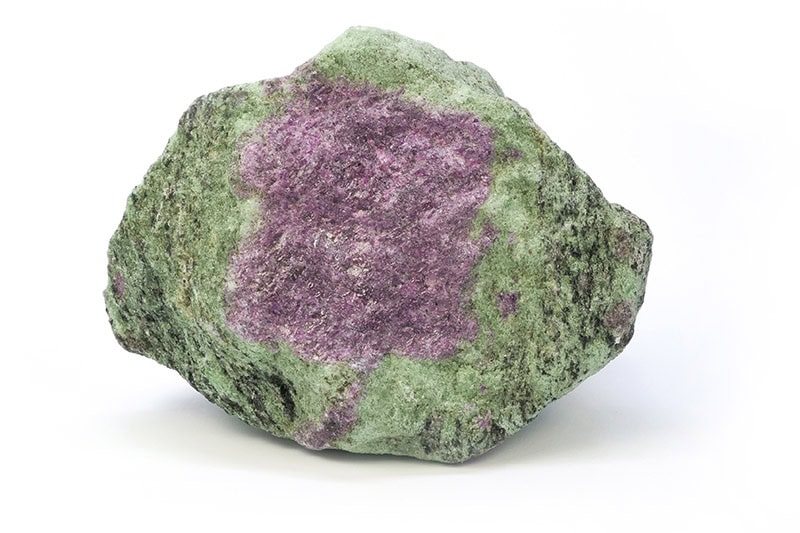
Anyolite or ruby in zoisite from Tanzania
- International Mineralogical Association. (2025). IMA Master List (2025-01). Commission on New Minerals, Nomenclature and Classification. Retrieved on 25 February 2025 from https://cnmnc.units.it/files/editor/IMA_Master_List_(2025-01).pdf ↩︎
- Blackburn, W.H. & Dennen, W.H. (1997). Encyclopedia of Mineral Names, The Canadian Mineralogist, Special Publication Ed.., Ottawa: Mineralogical Association of Canada. ↩︎
- Tambuyser, P. (2020). Mineralogie voor verzamelaars, Antwerp, Belgium: Paul Tambuyser. ↩︎
- Dennebroek, H. van & Moorer, W.(2021). Nederlandse spelling van mineraalnamen, Stichting Geologische Aktiviteiten GEA. ↩︎
- Simmons, R. & Ahsian, N. (2012). De wijsheid van stenen, Haarlem: Publisher Altamira. ↩︎
- Simmons, R. (2025) Heaven & Earth LLC Metaphysical Minerals and Jewelry, Heaven & Earth LLC, 2025. Accessed on 25 February 2025 from https://heavenandearthjewelry.com/. ↩︎



Responses