
Controversy surrounding purple fluorite on quartz from China

Since the publication of the first version of this article on Jan. 6, 2026, much new information has become available in a short period of time and the online discussion surrounding this find has continued to develop, sometimes in quite fierce terms. That is the reason for publishing this updated version of the article on Jan. 8 . A PDF of the original text can be downloaded at the bottom of this page for reference. With this article I explicitly do not intend to throw (more) oil on the fire, but rather to provide an independent, transparent and factual overview of the events and available information at this time. I am not being paid by any party to write or adapt this article and have no commercial interest in selling the specimens discussed. Stapel van Stenen (Stack of Stones) is an independent knowledge center that makes reliable information available to collectors, sellers and enthusiasts of gemstones and minerals. The text of this article was prepared with support from AI (ChatGPT) for the purpose of structure and readability; the content data, source selection and interpretation were compiled and checked by myself.
Did you find this article interesting? You can find many more in-depth articles on misleading trade names, imitations, synthetic and treated gems and minerals in the Gem or Scam Library via subscription.
Version 2 – January 8, 2026 (current version)
This updated version contains additional and new information, including:
- New insights and background based on multiple conversations with Chad (@Mineralholics_anonymous), including Chad’s role as a collector and content creator with no commercial interest in the specimens, supplemented by the raw Raman data he provided.
- Addition of a summary and interpretation of the raw Raman data, including mineralogical rationale.
- Comprehensive interpretation of commonly cited claims about possible treatment, with geological-scientific refutations.
- Additional context from independent experts in the minerals community.
The article will continue to be supplemented as new, verifiable information becomes available.
Spectacular new find from Huanggang
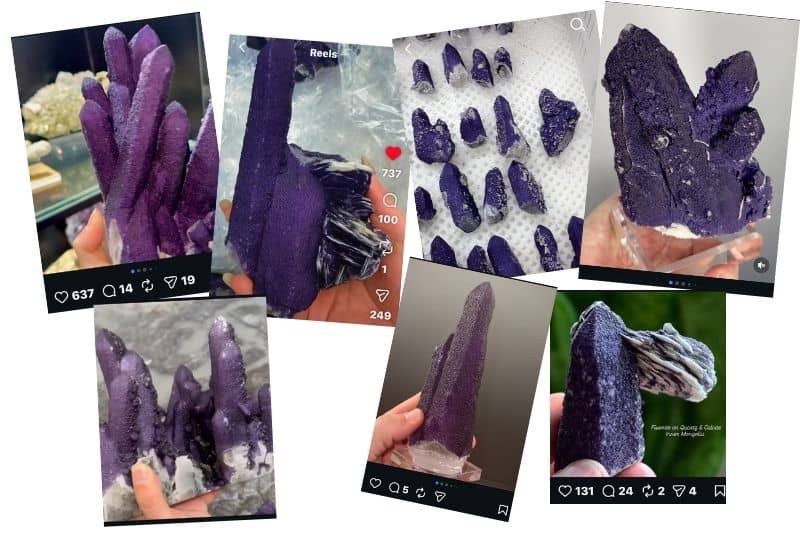
A striking new mineral discovery was announced in late 2025: purple fluorite on “candle quartz” from the Huanggang region in Inner Mongolia, China (location on Mindat). The specimens consist of white quartz crystals that appear to be completely covered with an irregular purple layer. No obvious fluorite crystals can be distinguished with the naked eye; the purple fluorite forms a crust or coating over the quartz. Sometimes bladed calcite crystals are also present, partially co-covered by the same purple layer. Such combinations from Huanggang are not in themselves unprecedented: previously, for example, the famous “blueberry” fluorites on white quartz came from there. That earlier find contained dark blue fluorite in spherical aggregates (“blueberries”) on quartz, something also initially received with skepticism but eventually recognized as natural.
When the purple variety emerged in late 2025, the initial reaction was enthusiasm. Several reputable mineral dealers worldwide, including big names in the US and Europe, obtained significant quantities of these new fluorite/quartz pieces and offered them for sale. On social media, dealers flaunted photos of intensely purple-tinged quartz clusters from Dongwu Qi/Huanggang. The timing was propitious: right before the big mineral shows in Tucson (January), there was a new “hot” item that created fear of missing out (FOMO) among collectors. Many enthusiasts want to get their hands on such a special piece for their collection.
Doubts and tests on social media
Soon, however, the mood turned from euphoria to distrust. In online forums and groups, collectors began to question the authenticity of the purple fluorite coating, for example on Jan. 3 and 4 in the Facebook group Scamologist (mineral specimen scams). Some notable concerns were: the color did seem very uniform across many specimens; all crystals seemed to have the same deep purple with no variation. Also notable was the consistent, somewhat matte appearance of the purple layer, as if each quartz crystal was covered in exactly the same way. So the first impression of some was that it was “too good to be true.”
On Instagram on Jan. 3, Ricky Fentiman (@carpecrystals) shared a now much-discussed video in which he uses simple home-and-home tests to show how immersion in dilute hydrochloric acid gave effervescent effects and, in a second video, even soaked off pieces of the purple coating. This fueled speculation that the purple layer could possibly consist of calcite (after all, calcite fizzes in acid) or – even worse – an artificial substance. Some commentators suggested that if the purple layer had been applied by humans (for example, with a chemical precipitation process or paint), it might dissolve in hydrochloric acid. In summary, the creator of the videos indicates that his examined specimen showed signs of treatment, but that there are actually natural specimens in circulation in addition to these treated (“enhanced”) pieces, and that it would be naive to assume that these treated variants do not exist.
On TikTok, Brandi (@crystal.lover0031), among others, posted a video on Jan. 5 in which she carefully discusses the controversy and doubts surrounding this find.
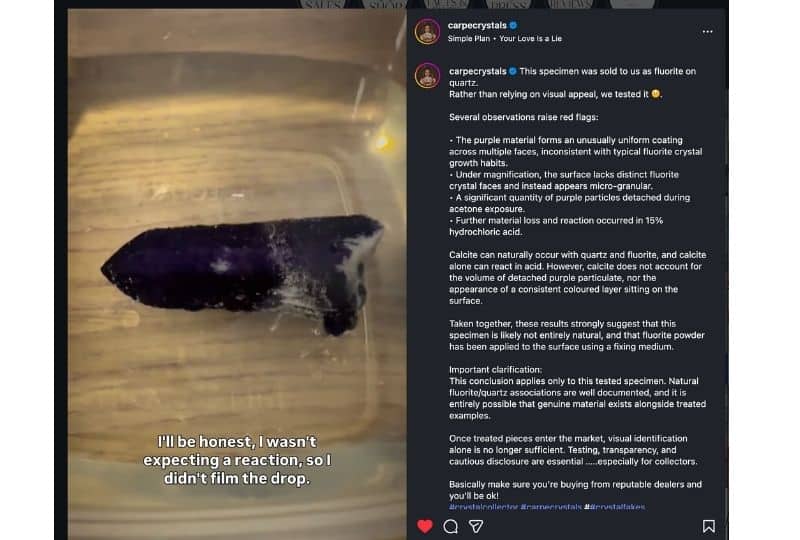
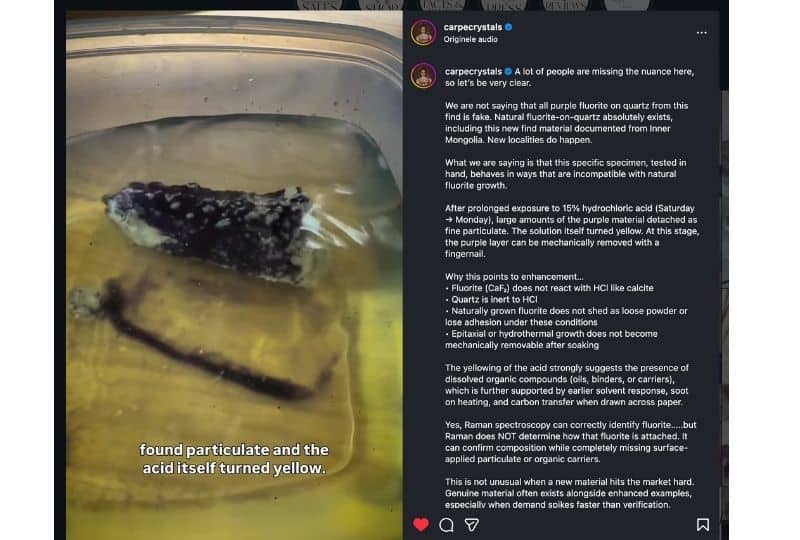
Screenshots of the two videos by Ricky Fentiman (@carpecrystals) on Instagram showing how purple material is released from the quartz crystal after immersion in dilute hydrochloric acid
Several social media posts urged caution. One collector wrote: “I was on the verge of acquiring some of these, but I second-guessed their authenticity and decided to pass. It was the too uniform color across the batches, the consistent coating, and the refusal of the supplier to show me up-close texture that helped me decide,” illustrating how the consistent color and lack of detail aroused distrust. Others noted that the alleged fluorite crystals did not show the usual shapes: “The fluorite crystals don’t look very tetrahedral like they should. The color is strange too, dark and not translucent under light. I’d worry about it being artificially irradiated because of how saturated the color is.” Another suspicious comment on Instagram was that the purple color would look exactly like that of lab-grown tetraammine copper sulfate (tetraamine copper), suggesting a chemical trick could be involved.
Several influencers in the mineral community jumped on the subject. For example, a “Fake Crystal Alert” message circulated warning that this purple fluorite was possibly synthetic or coated. Under a microscope, the purple layer looked microgranular with no recognizable fluorite surfaces, a possible sign that we are not dealing with naturally grown octahedrons or cubes, but with an amorphous precipitate. It was also highlighted that a suspicious amount of these purple pieces had appeared on the market in a short period of time; a red flag, since real finds are usually more scarce and more gradually distributed.
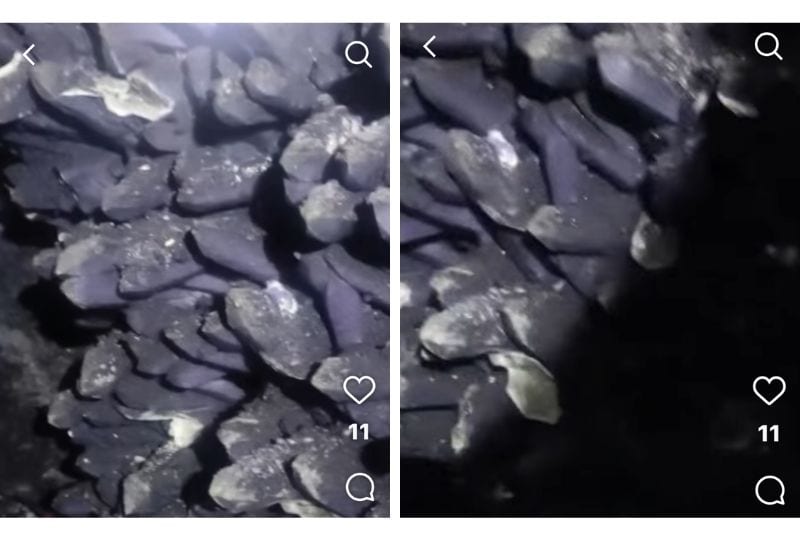
This skepticism resulted in fierce discussions in Facebook groups and among posts on Instagram and TikTok. Roughly two camps emerged: on the one hand, finders and sellers who swore it was a legitimate find (some Chinese dealers even shared photos and videos of entire mine walls full of purple crystals as proof); on the other, doubters, collectors, scientists and some competing dealers, who cried “fake!” and called for independent research.
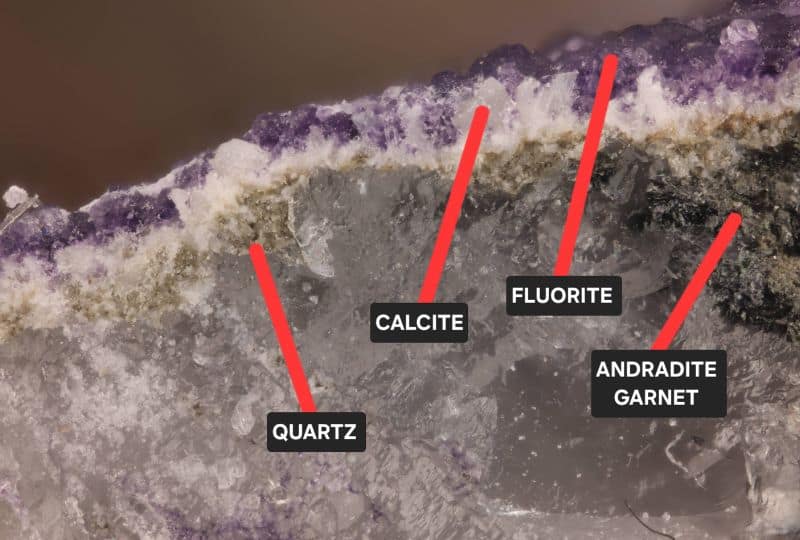
Then on Jan. 6, Chad of the instagram account @mineralholics_anonymous posted a video showing the first real laboratory analysis. Presented herein is that Raman spectroscopy was performed on a controversial purple fluorite/quartz sample in collaboration with China University of Geosciences (Wuhan). The results, summarized in flashy images and graphs in the video, would show that the purple layer is actually fluorite, and that no traces of glue, paint or resin were found: “No glue. No dye. No resins. Just 100% natural, world-class mineralogy from the Inner Mongolian skarn belt”. He also reports that, under the microscope, small amounts of calcite, pyrite and andradite (garnet) were also discovered on the quartz, minerals that fit into a natural skarn environment and immediately offer an explanation for the effervescence in hydrochloric acid (calcite) and the loosening of the purple layer thereafter (calcite dissolved between the quartz and the purple layer). These findings are brought as a refutation of the faking theory.
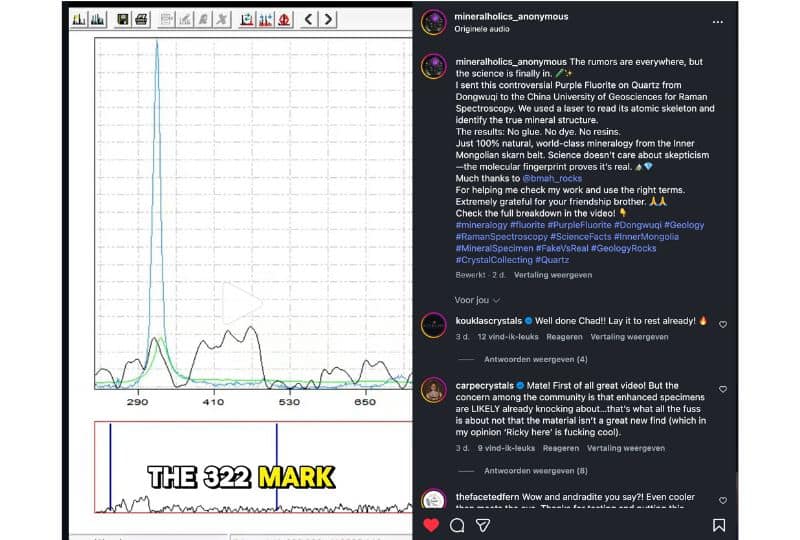
Summary timeline of the controversy (fall 2025 – January 2026)
- November 2025: The first reports and photos pop up online of a new fluorite discovery in the Dongwu QiHuanggang mines, Inner Mongolia. International specimens circulate on sales platforms and social media, praised for their striking purple color.
- December 2025: Major mineral dealers (including those in the US, Europe and China) offer dozens of specimens for sale. The pieces are promoted as “spectacularly new” and get a lot of attention. First doubts are expressed publicly.
- Jan. 3, 2026: On Instagram, a mineral seller posts videos in which they perform simple tests (such as with acetone and hydrochloric acid). These videos suggest possible manipulation, which is widely shared online.
- January 2026: Discussion escalates in Facebook groups, on Instagram and Tiktok and discussion forums. Collectors are asking for proof of authenticity. Some report that they have postponed or canceled purchase decisions until more is clear. There is “drama” and many rumors (“lab-grown fluorite,” “coated quartz,” etc.).
- Jan. 6, 2026: A video is posted on Instagram by an infotainment channel with results of an initial laboratory analysis. In the spectacular video, based on Raman analyses (conducted through the China University of Geosciences, Wuhan), specimens are claimed to consist of natural fluorite with calcite and andradite, with no evidence of glue, resin, paint or synthetic coatings.
- Jan. 6, 2026 and on: The community’s reaction to the results presented is divided. While some are relieved that “scientific proof” has been provided that the material would be natural, others remain suspicious. There has been criticism that the video was very slickly made (including AI-generated images and voice-overs), which actually does not inspire confidence among skeptics. There are calls for the full research report or raw data for peer review: a slick Instagram video is nice, but people want hard, verifiable numbers. Meanwhile, rumors are surfacing that, if the find is real, treated specimens (for example, artificially colored or irradiated quartz pieces) would still be mixed in among the real ones, perpetuating the confusion. The discussion continues, with the prospect of this being the hot topic of discussion at the upcoming mineral fairs (Tucson 2026).
Scientific research: evidence or insufficient?
The now-famous Instagram video by @Mineralholics_anonymous was intended as an attempt to calm the rising tempers surrounding this find using measurement data. The video shared results from Raman spectroscopy, an analytical technique that can identify the molecular and crystalline structure of materials via their spectral “fingerprint.” According to the results presented, the purple layer on the quartz crystals consists of fluorite and no evidence of glue, resin or paint pigments were found. In addition, calcite is demonstrated, which explains why some pieces fizz in acid and why the fluorite layer can detach locally.
However, this video did not end the discussion; quite the contrary. Several members of the international minerals community criticized the presentation and conclusions. They pointed out that demonstrating that a layer consists of fluorite does not automatically prove that it was formed naturally. After all, fluorite can also be grown synthetically, for example for optical applications. Others noted that the video does not show a complete technical laboratory report and that the graphs shown do not provide sufficient context to independently verify the analysis.
The criticism was sometimes sharply worded. The video was dismissed as “crap, easily faked” and “made by AI.” One scientist noted that “a few fancy instruments and half results” are no basis for a definitive conclusion about natural origins. At the same time, others pointed out that previous “kitchen experiments” and quick online conclusions were at least as problematic and had fueled the uproar.
Following these diverse responses, I had extensive contact with Chad, the creator behind @Mineralholics_anonymous, on January 7 and 8. In these conversations it became clear how the research came about and what data is actually available. By the way, Chad is not a salesman as I wrote earlier, but a collector and enthusiast of Chinese minerals, with particular interest in skarn deposits from Inner Mongolia. He creates mostly humorous and satirical “infotainment” content and was himself surprised by the ferocity of the reactions his video elicited. Although he is an artist/content creator and not a scientist, he makes sure his information is accurate. For example, he had the Chinese data checked by geologists before sharing it. He regrets that Chinese minerals sometimes have a bad reputation due to the abundance of counterfeit and synthetic specimens. Chad stresses that we should judge genuine Chinese minerals on their own beauty and value, and not write them off in advance out of skepticism. (He does not deny that some rogue sellers have fueled the doubt themselves with fakes, but wants to show that specimens from this find are not one of them.) This is precisely why he wanted to be more transparent about the underlying research and made the raw Raman data, graphs and additional photos available to better inform this discussion.
About the use of AI in the video, I can report the following: It was also suggested in the discussion that the video and voice-over would have been generated by AI, which raised additional suspicion from some viewers. In conversations with Chad, this was further clarified. He confirmed that some visual elements in the video were deliberately generated with AI, including the opening image of the crowd, the “Raman restaurant,” the so-called “smoking gun” and the image accompanying the statement “nature doesn’t give a shit.” These images are intended as artistic, satirical and visual reinforcement of the story. However, the voiceover was voiced by Chad himself and only technically cleaned up for sound quality. As such, the video is not an AI-generated presentation, but a self-produced infotainment video with limited artistic AI illustrations.
Performance of lab analysis
In mid-November 2025, shortly after the first specimens surfaced, Chad sent one of his pieces to a geologist friend at the China University of Geosciences in Wuhan for analysis. (The first version of this article incorrectly stated the university; it turned out to be Wuhan.) This geologist performed confocal micro-Raman spectroscopy on the purple fluorite-on-quartz. Chad’s main motivation was out of curiosity: he wanted to know if Rare Earth Elements (REE) were present in the fluorite (something that is common in fluorites from Inner Mongolia and can affect color and fluorescence).
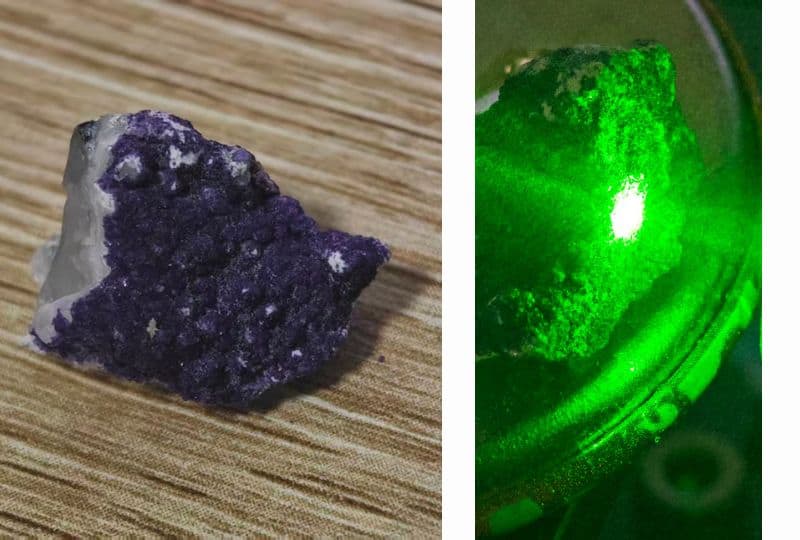
As more and more questions and rumors gradually surfaced about the authenticity of the pieces, Chad asked the geologist to pay extra close attention to any glue, dyes or synthetic resin, or indications that the pieces were composite or treated. The analysis took a total of about 3 to 4 weeks. Chad received the results via a WeChat message in Chinese, after which he translated them into English. He had his translation verified by two geologists in the U.S. to make sure the terminology and interpretation were correct. Only then did he present the findings in the video on Instagram. So Chad actually shared everything he found out via via, as transparently as possible, with the minerals community.
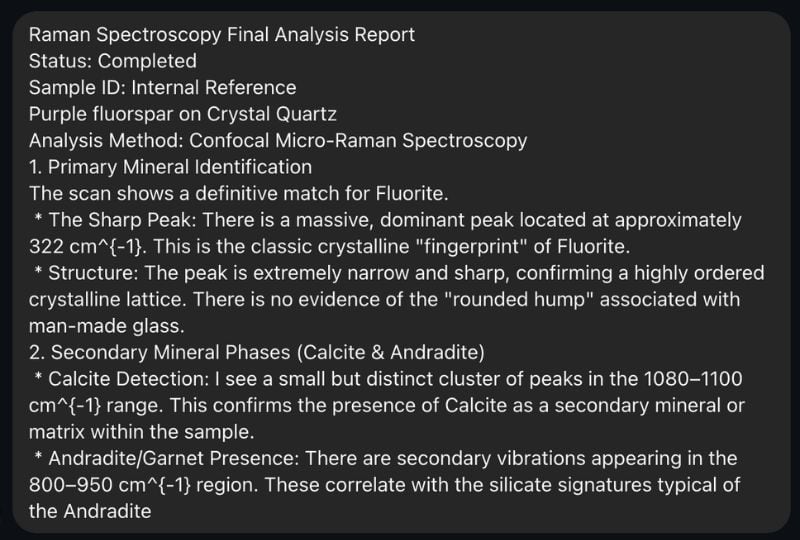
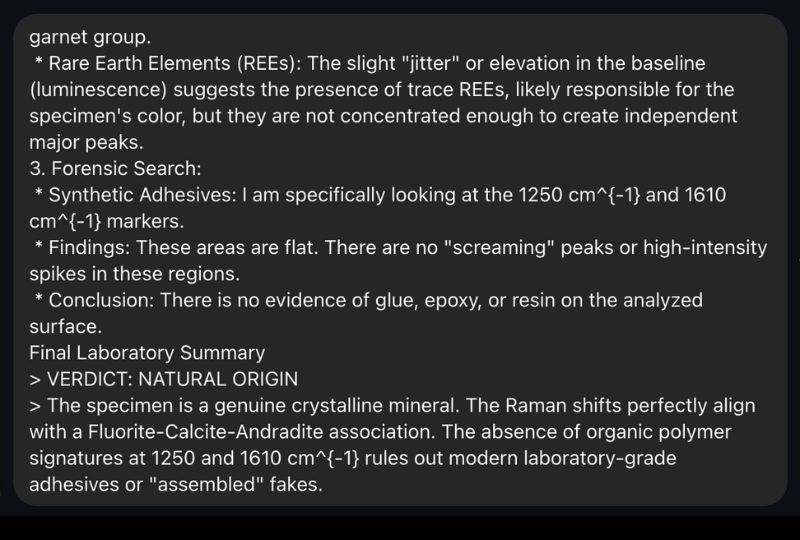
screenshots of the chat with the analysis results translated into English
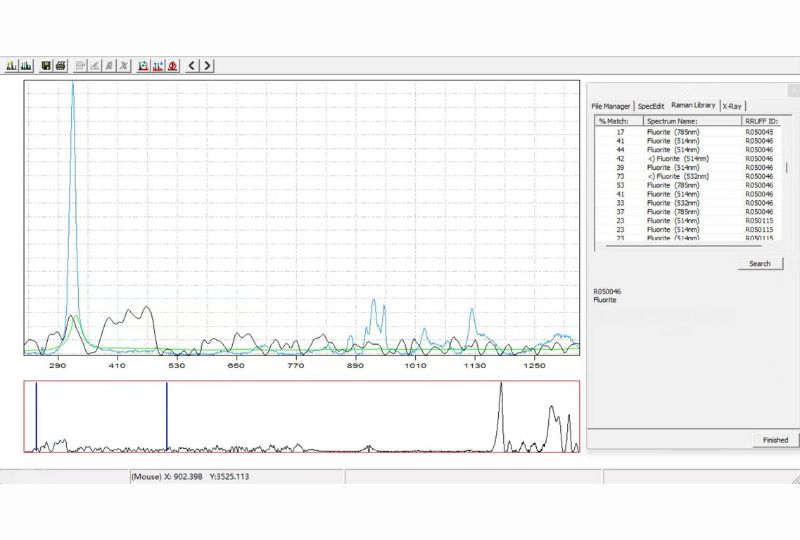
We should note, however, that this is not an official lab report; critics will argue that such an informal result is easy to question. And indeed, some skeptics online noted that the graphs he showed in the video “might as well have been from any fluorite,” since there is no date, lab name or sample ID on the screenshot. Chad also used reference graphs from the CrystalSleuth database (standard fluorite spectra) for his video to clarify his explanation for laymen. This may cause some to wonder exactly which graph was from his sample. Understandably, one would like to see a formal certificate with all the bells and whistles: lab name, apparatus, date, analyst, sample photos, etc. Such a report is not available as of yet because the analysis was done through an informal means and the results were shared via chat. However, this is now the information we have, and both Chad and other geologists who looked at it confirm that the data are correct and consistent with a natural fluorite-on-quartz. Meanwhile, I also received the raw data set and once again interpreted it with the analyst.
Interpretation of the raw Raman data
The raw Raman data shared by @Mineralholics_anonymous conclusively confirm that the purple layer at the measured spot contains fluorite (CaF₂). A dominant band is visible in the spectrum around 318-322 cm-¹, corresponding to the characteristic lattice vibration of fluorite. The remaining marked peaks around 279, 393, 433 and 468 cm-¹ should not be interpreted as Raman fingerprints of other minerals in this case: according to the analyst involved, these are mainly laser-induced emission/fluorescence signals that can appear in the same spectrum due to the measurement setup (green 532 nm laser) and mix with Raman signals. These emission peaks are attributed by the analyst to Tb³⁺ activation (trace element/impurity) and help explain why parts of the spectrum are saturated by strong fluorescence. Finally, the purple color is not associated with REE staining, but with calcium-related color centers in the fluorite.
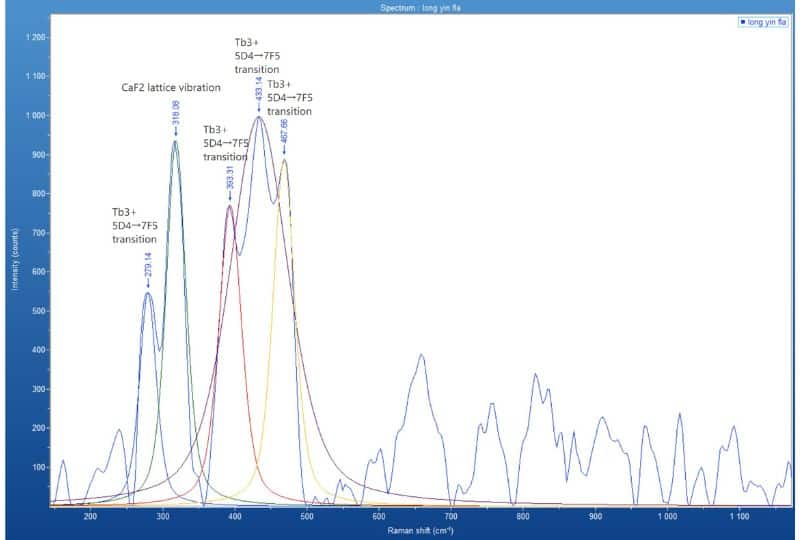
Raman spectrum with peak identification (532 nm laser). The dominant band around 318-322 cm-¹ is the characteristic Raman fingerprint of fluorite (CaF₂). The remaining highlighted peaks (279, 393, 433 and 468 cm-¹) are mainly laser-induced fluorescence emissions attributed to Tb³⁺ activation (trace elements), which can overlap the Raman signal when using a green 532 nm laser.
The raw Raman measurements discussed here were again studied specifically to verify the presence of natural fluorite (CaF₂) in the purple coating. The presence of other minerals, such as calcite and andradite, is based on additional observations and measurements at other measurement spots, whose raw Raman data have not been publicly shared. In addition, these minerals were visually determined by microscopy (see detail photos) and fit well with the known mineralogy and paragenesis of skarn deposits from Inner Mongolia. The interpretation of these additional minerals is therefore beyond the scope of the Raman peak analysis presented here.
The preliminary balance has thus shifted: where initially the word “fake” was widely used, it now seems plausible that at least part of this find consists of natural fluorite overgrowth on quartz. At the same time, it remains realistic to consider the existence of treated or manipulated pieces alongside natural specimens, something not denied by Chad himself. Without broader, independent follow-up research (e.g., SEM, extensive FTIR and trace element analyses), a definitive statement about all circulating pieces on the market remains impossible for the time being.
Claims of manipulation: myth or possibility?
The discussion surrounding this purple fluorite-on-quartz has raised all sorts of theories about possible manipulation. Below we discuss the most commonly heard claims point by point, provided with current insights that refute or nuance those claims:
- Synthetic/lab-grown: This claim implies that someone in a laboratory would have grown fluorite (crystals) on quartz. Although fluorite can be grown in the lab (e.g., for lens manufacture), all current data indicate natural formation. Controlled crystallization of fluorite on a quartz (possibly with a calcite interlayer) requires very specific conditions: high purity of raw materials, precise temperature and pressure control, and a lot of time. The cost and effort would be extremely high, much higher than what can be recouped by selling such pieces. The minerals such as calcite and andradite (garnet) found along with the fluorite are very typically appropriate for a hydrothermal skarn deposit (fluorite as a late hydrothermal phase after calcite). A simple acid test shows at most the presence of calcite (a natural constituent) rather than evidence of synthesis. So far, there is no concrete evidence that these fluorites grew synthetically. Indeed, the combined research data conclusively indicate natural fluorite overgrowth on quartz.
- Fluorite imitation (e.g., tetraammine copper sulfate or alum): This rumor is very unlikely. Tetraammine copper sulfate is a complex salt that can form beautiful deep blue crystals in the lab, but they are chemically completely different from fluorite. First, Raman has ruled out that the purple crystals are anything other than fluorite. Second, such salts are extremely unstable outside the lab: tetraammine copper disintegrates slowly in open air (ammonia evaporates, crystal loses color and shape). It is also water-soluble, just like alum; rinsing for a moment would make the crystals disappear. In addition, working with concentrated ammonia solutions and copper sulfate is dangerous (toxic fumes, danger of explosion if mishandled). All in all, this theory is practically out of the question.
- Coating/paint: Some thought the purple layer was an artificial coating or paint on the quartz. However, Raman spectroscopy of the specimen examined confirms that the purple layer consists of pure, crystallized fluorite. No traces of paint, resin or coatings were measured or observed under the microscope (see detail photos). The fact that there is an intermediate layer of real calcite beneath the fluorite also makes painting less plausible; that complex layering would be an odd choice if someone simply wanted to paint something. The intense purple color of this fluorite is due to trace elements in the mineral itself (visible as slight luminescence in the spectrum). There are reports that some specimens have been treated with oil, a practice more common in China to deepen colors and optically cover up minor damage, but this treatment involves a superficial presentation enhancement and is separate from the natural mineralogical composition established in the Raman analysis.
- Glue: There was speculation that the fluorite layer was glued to the quartz. The Raman analysis shows no evidence of polymers or glue components (for example, characteristic bands around ~1250 and ~1610 cm-¹ are missing). On the contrary, under the microscope, a thin natural calcite layer is visible between the quartz and fluorite, which explains the effervescence in acid; the acid dissolves that calcite, loosening the fluorite layer locally.
- Irradiation: Finally, there was the suggestion that the purple color was obtained artificially via irradiation. Fluorite can indeed discolor under irradiation; in a natural environment, purple fluorite is often associated with long-term exposure to natural radioactivity. Artificial gamma irradiation with, for example, cobalt-60 is also done, but that usually gives fluorite a blue tint, not an intense purple. It has been reported that other shades are sometimes achieved with cesium-137 sources, but this is specialized and not generally accessible. Moreover, if one were to irradiate all such large quartz clusters, the quartz would probably discolor (quartz often turns brown or gray). In this case, the quartz under the fluorite has remained bright white. In addition: if this material had been irradiated en masse, it would have been quite logistically and financially challenging, think access to nuclear facilities and costs. To date, there is no evidence that these purple fluorites have been treated with ionizing radiation.
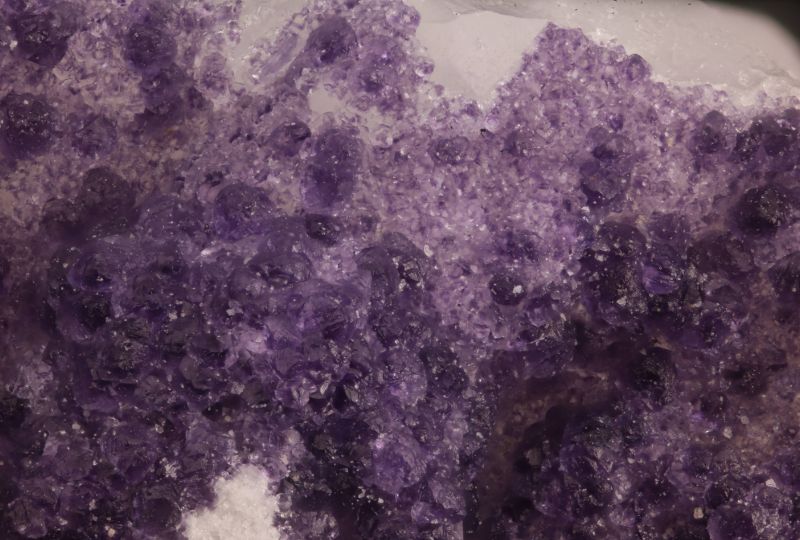
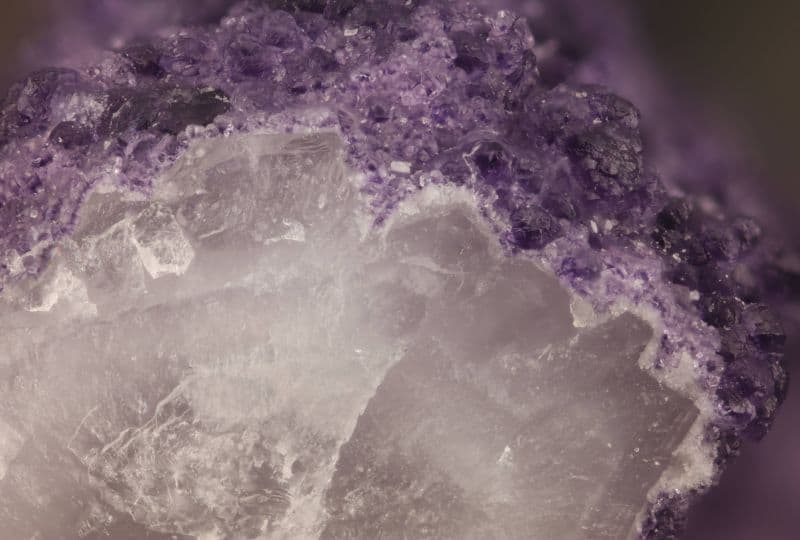
Surface detail shots: crystalline fluorite over a calcite layer on quartz (photos: @Mineralholic_anonymous)
“Surely there are ‘enhanced’ (treated) pieces between the lot.” This suggestion was voiced, among others, by the creator of the first critical videos (@CarpeCrystals). He suspects that in addition to genuine natural specimens, manipulated specimens may also be circulating, partly given the large quantities that appeared on the market in a short period of time. We can never completely rule this out.
To date, however, no specimen from this particular find has been unequivocally demonstrated as artificially engineered. The initial unease seems to have been fueled primarily by home-tests (such as acid tests) that have been misinterpreted. That some of the purple layers detach or effervesce in acid appears to be well explained by the presence of a natural calcite interlayer beneath the fluorite, which dissolves in acid. This indicates natural paragenesis, not adhesive or assembly. In the absence of a formal, independently published lab report, a small battle remains justified, but based on all current data, the most plausible explanation is that these specimens are true natural products.
Disrupted confidence and comparison with previous cases
This issue touches on a broader theme: reliance on minerals of certain provenances. Unfortunately, in recent years there has been a flood of manipulated or entirely synthetic minerals entering the collecting market, remarkably often from China. Think of the synthetic quartz clusters, coated quartz (titanium aura quartz etc.), dyed calcites, irradiated fluorite and tourmalines and even completely artificial combinations sold as mine finds. This has created a climate of distrust in which collectors sometimes view anything from China with suspicion in advance. In a way, this is understandable, as the saying goes, “One rotten apple spoils the basket.” Previous Huanggang finds (such as the aforementioned blue “blueberry” fluorite on quartz) were also previously viewed with suspicion, but did eventually prove to be natural. So it would be unfair to necessarily dismiss every new Chinese find as fake.
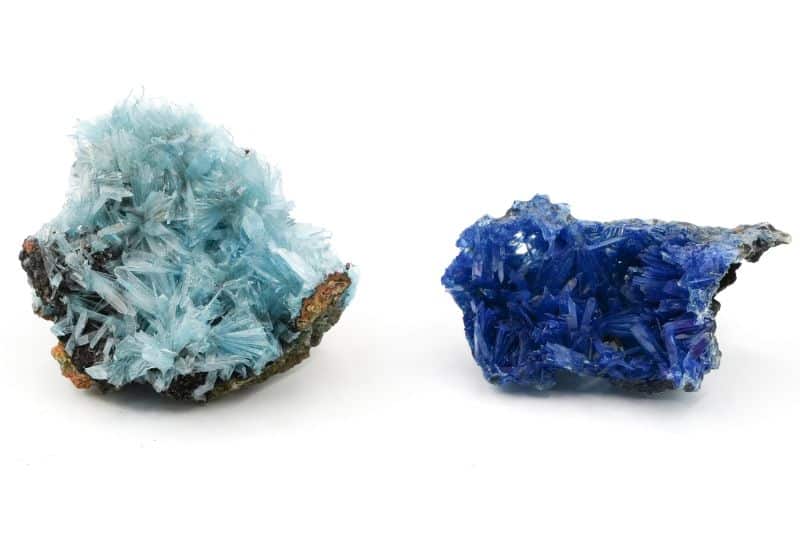
Still, there are plenty of examples of real scams. A recent infamous example is the case of the blue hemimorphite crystals from the Ojuela mine in Mexico around 2020. At the time, bright blue, transparent hemimorphites suddenly surfaced, a color never before seen in that mine. Many respected dealers initially fell for it; videos were even circulated of miners pulling blue crystals out of the wall to bolster the story. Only after months (in 2021) did analyses come out showing that the crystals had been treated with a virtually undetectable blue dye. The dye (Phthalocyanine Blue) was so persistent that ordinary tests showed nothing out of the ordinary, eventually Raman spectroscopy had to come into play to unmask it. By then, many had lost a lot of money and Ojuela’s reputation had been hurt. You can read the whole story about the blue hemimorphite in this extensive article in the Gem or Scam library. Cases like this make collectors extra alert today, sometimes perhaps too alert, but that is an understandable self-defense against disappointment and deception.
In the current fluorite-on-quartz issue, we see a similar dynamic: spectacular discovery, meteoric commercialization, followed by a backlash from skeptics who fear being fooled again. Without solid, independently verified data, there remains noise and distrust.
Red flags and learning points for the mineral community
Although the truth surrounding the purple fluorite coating has not yet been definitively settled, we can already draw lessons from this case. Collectors and dealers alike would do well to pay attention to the following red flags when making a new find:
- Too good to be true? When a new mineral emerges with an unprecedentedly spectacular color or shape, be cautious. Especially if it seems to be virtually limitlessly available in that quality. Of course, exceptional finds sometimes occur, but extreme claims deserve a healthy dose of skepticism.
- Uniformity and repetition: When dozens or hundreds of specimens have the exact same color, coating or texture, it may indicate artificial reproduction. In nature, variation is the norm; in synthetic or treated pieces, one often sees a serially similar appearance. In this case, all the quartz pieces have a similar purple coat, which set off alarm bells.
- Lack of detail: note the microscopic details. Real crystal growth shows facets, fractures, inclusions and irregularities. Although naturally smooth botryoidal fluorite is known, a “coating” that is grainy or amorphous under magnification (no crystal planes of fluorite recognizable) may indicate a precipitation or coating process. This was an explicit warning with the Huanggang fluorites but in the detail photos it appears to be natural crystallization.
- Simple tests fail: Although home-tests are limited, they can raise red flags. In this case, the purple layer reacted with acid and partially let go, a possible indication that a soluble coating had been applied or, as it now turns out, natural calcite is underneath. When in doubt, simple tests (hardness, streak color, solubility) can quickly reveal something odd, but also remember that clever forgers sometimes use agents that pass these tests (see the hemimorphite paint that did not dissolve).
- Sudden flood on the market: A new type of top mineral suddenly on sale everywhere at high or just relatively favorable prices, right before a big trade show, that smells like hype creation. Often hype is fueled to sell a lot quickly before questions are asked. This happened with both the blue hemimorphite and this purple fluorite. A gradual flow and some scarcity is more common with authentic finds.
- Source of information: Pay attention to who is disseminating the information. Is it mainly parties with a financial interest (sellers, companies from the country of origin)? Or independent experts? In this story, the initial “evidence” (such as mining videos) came from the Chinese dealers themselves, who will obviously benefit from credibility of the material. Neutral sources were lacking at the beginning. Don’t trust anecdotal evidence or flashy marketing alone.
- Time and peer review: Real confirmation of a finding often takes some time. Be patient and wait for independent analysis if necessary. Don’t prematurely declare something real or fake without solid data. And if data are presented (such as Raman results), ask to see reports or confirmation by other labs. In science, independent verifiability = credibility. Until then, some doubt is healthy.
Advice for sellers and collectors
These events have shown the importance of trust and transparency in the mineral world. A few recommendations for managing such situations:
- For sellers: Be reluctant to hype a new find until you have been able to verify its authenticity yourself. It is tempting to buy in and sell quickly when a “hot item” comes up, but your reputation is at stake. If necessary, do a few tests yourself or have a few pieces analyzed before offering them as 100% natural. Communicate honestly with customers about what is and isn’t certain. If there are doubts circulating in the community, don’t ignore them: address them. Customers appreciate honesty and caution more than fancy talk afterwards. As one collector noted, “Lots of discussion… I don’t understand there is no simple analysis made public on these yet. The insinuating and commenting without research is harmful for the industry.”. In other words, counter gossip and innuendo by offering facts as soon as they are available.
- For collectors: don’t get caught up in every trend right away. Healthy distrust is okay, ask around, wait for more info if something seems questionable. But keep it civilized: don’t immediately go on a “witch hunt” online. Realize that falsely calling something fake can also do damage (to legitimate miners and dealers). Try to remain objective and watch out for confirmation bias (both toward believing everything, and seeing deception everywhere). Follow various sources: both enthusiasts and skeptics, and especially what real experts say about it, if available.
- Community & Media: This case shows the value of cooperation between enthusiasts, dealers and scientists. In the end, most of us just want to know what we’re dealing with. It helps tremendously if, when new finds are made, sample material goes to an independent lab and the results are shared publicly (in trade journals or online reports). That would help quell speculation sooner. It would also help if large mineral fairs or organizations had some sort of panel of experts who could evaluate new finds like this and inform the public. Transparency is the key to trust.
In conclusion
The “purple fluorite on quartz” from Inner Mongolia has become an instructive case study of how the mineral market operates anno 2026: a spectacular new find spreads worldwide at lightning speed, but at the same time is critically questioned by a well-informed collector community. That critical attitude is healthy, especially at a time when both genuine top finds and treated or synthetic products are in circulation.
Based on currently available data, including Raman analysis, the geologic context of the skarn environment, the paragenesis (fluorite-calcite-andradite-quartz) encountered, and independent expert interpretation, the evidence accumulates that this find is predominantly of natural origin. No evidence of glue, resin, paint or other artificial assemblage was found, and the reactions observed in simple acid tests appear to be well explained by natural calcite interlayers.
This does not rule out the possibility that incidentally superficially presented (“enhanced”) pieces may circulate, for example through oil treatment, but as yet no specimen from this find has been convincingly demonstrated as artificially manipulated.
As long as a formal, independently published laboratory report is lacking, a degree of caution remains justified. At the same time, this case shows how important transparency, good documentation and verifiable analyses are for trust in our industry. Until additional studies appear, the following applies: enjoy beautiful minerals, but remain critical, ask about provenance and analyses, not out of distrust, but out of respect for good mineralogy.
Caveat Emptor: Buyer Beware
To be continued…
Did you find this article interesting? You can find many more in-depth articles on misleading trade names, imitations, synthetic and treated gems and minerals in the Gem or Scam Library via subscription.
You can download the text of the first version of the article for reference as a PDF here.




Responses