
Agni Manitite

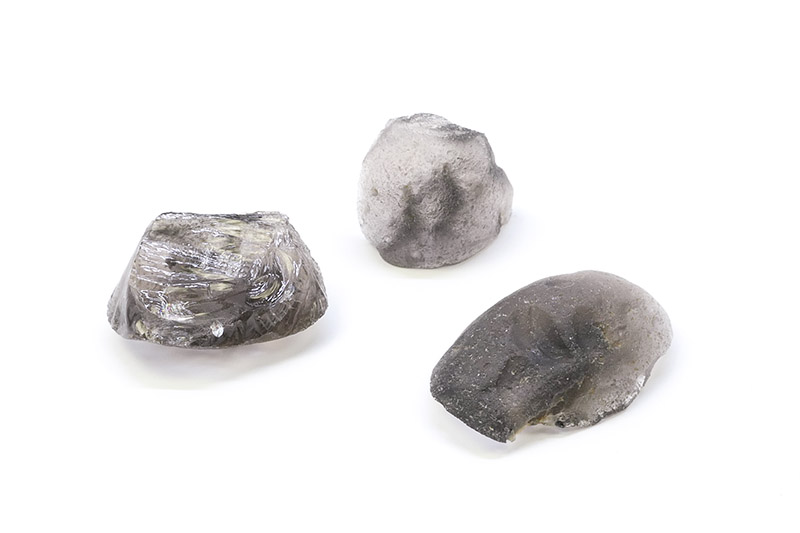
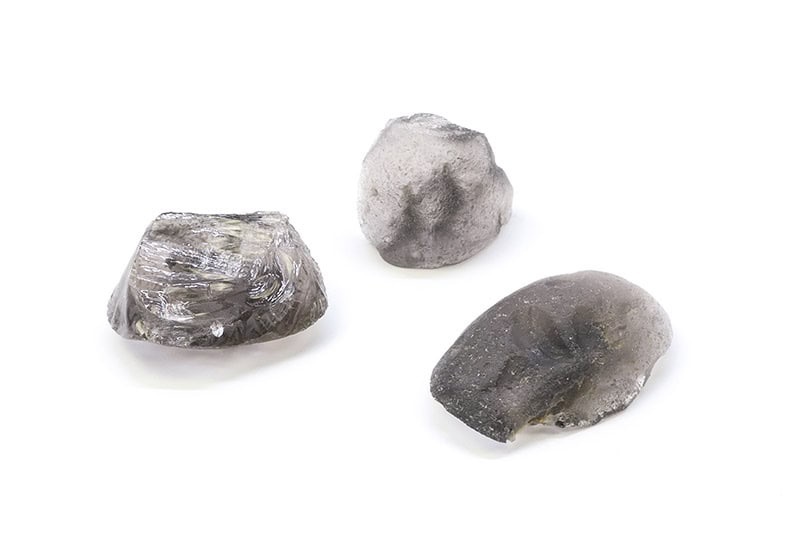
Commercial name for rounded pebbles of obsidian found in rivers around Malamingan, Sumatra, Indonesia. These water-rolled obsidian fragments are usually dark, almost black, but show a transluscent brown to gray glow with backlighting. Because of their rounded shape and weathered exterior, they are sometimes compared to tektites (impact glass created during a meteorite impact) and referred to as pseudo-tektites, contributing to misconceptions about their origin.
The name “Agni Mani” comes from Sanskrit and means “Pearl of Fire,” referring to the stone’s genesis. Hence, this stone is also called Pearl of Fire in the trade. In Hindu and Buddhist traditions, the term is associated with sacred or magical jewels, also known as Mani stones, mentioned in various scriptures. Some compare Agni Manitite to the Philosopher’s Stone of Western alchemy because of its symbolic meaning of transformation and purification through fire.
Geological origin and locality
Agni Manitite is a natural form of obsidian (volcanic glass), formed by rapid cooling of silica-rich magma after a volcanic eruption. The stones are found mainly in river beds in Sumatra, where erosion and transport over long periods of time have given them their characteristic rounded and weathered shape. The exact volcanic origin is not documented, but geologically it is very plausible that the material came from one of Sumatra’s many (historical) volcanic eruptions.
There was no known analysis of the material when my book came out in 2022, and scientific websites such as Mindat and Mineralienatlas do not describe this stone or similar material. There is only information on esoteric websites about Agni Manitite and other pseudo-tektites. In 2022, laboratory research with SEM-EDX and XRD analysis confirmed that material sold as Agni Manitite from Indonesia is indeed a natural form of obsidian. As such, it does not belong to the group of true tektites, such as Moldavite and Libyan desert glass. In the recently released book “Glassy Wonders” Agni Manitite is described by Jelinek and Adami (2024) 1.
Misconceptions and commercial confusion
Besides the name Agni Manitite, this material is also called Cintāmaṇi stone, leading to confusion with other pseudo-tektites such as saffordite and colombianite that are sometimes sold as such. Cintāmaṇi is also an ancient name from Sanskrit, also spelled Chintamani, for a wish-fulfilling gem within both Hindu and Buddhist traditions.
Some vendors suggest that Agni Manitite formed in a similar manner to tektites, others that it is molten lava that solidified in the air and rained down like glass. However, there is no scientific evidence that Agni Manitite formed this way. Even the name Agni Mani Moldavite is used. In any case, this is misleading since moldavite is a true tektite and this stone is not. But perhaps the sellers want to ride on the huge hype surrounding moldavite.
In addition, claims are made that the stone comes not only from Indonesia but also from the Philippines and Arizona (USA), most likely Agni Manitite-like material (such as Filipinite tektites or saffordite). In Indonesia a connection is sometimes made with the Kintamani region of Bali, there is an active volcano there (Gunung Batur) but it is not known if obsidian sold under this name occurs here.
Agni Manitite bears similarities to Apache tears, another translucent form of obsidian, but Apache tears are found directly in volcanic contexts and are less weathered.
- Jelinek, R. Adami, I. (2024). Glassy Wonders. Guide to volcanic and impact glass. . Der Konterfrei, Vienna 2024. ↩︎




Responses