
Analysis: Siberian blue quartz

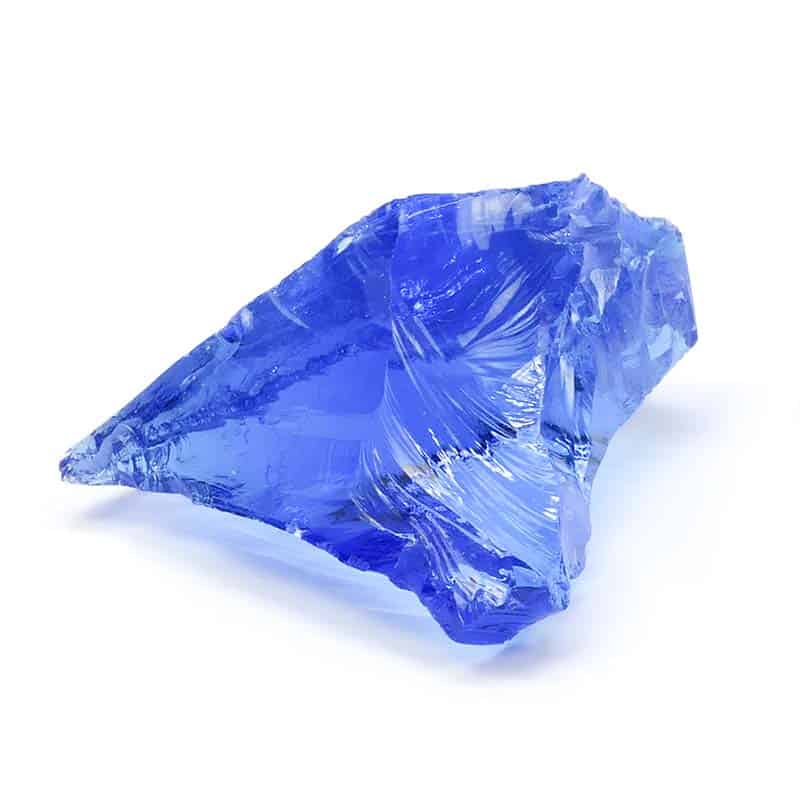
Siberian blue quartz turns out to be ordinary glass!
In July 2021, I had a piece of “Siberian blue quartz” analyzed in a laboratory to determine the true nature and origin of this material. The results of this analysis provided important insights that can help consumers and sellers recognize misleading commercial names and esoteric claims surrounding this material.
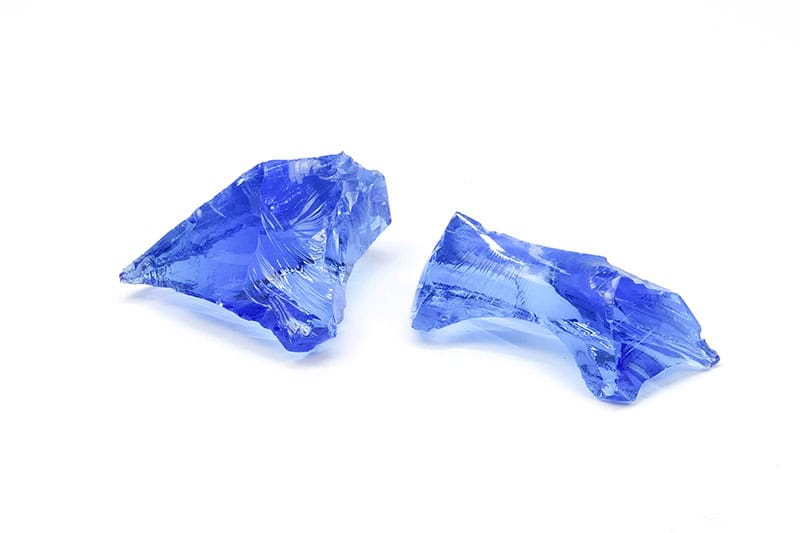
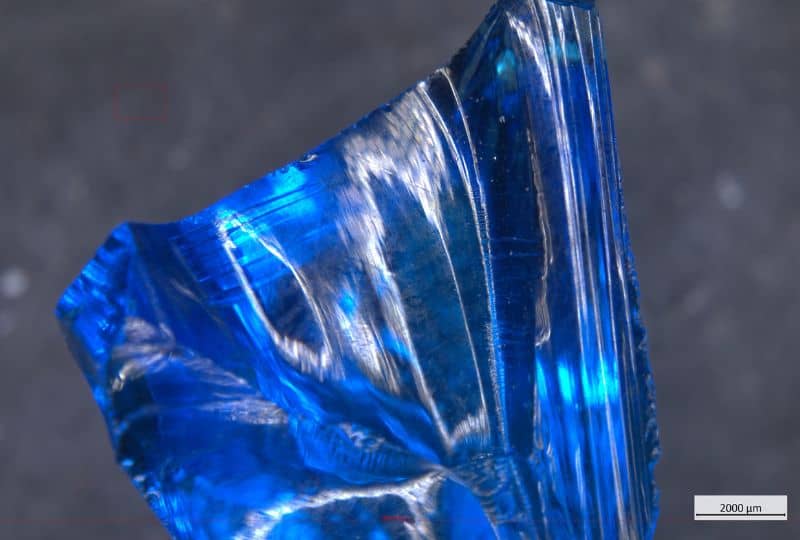
Analyzed sample of ‘Siberian blue quartz’
Background
‘Siberian Blue Quartz,’ also known as ‘Siberian Blue,’ is often offered as a rare gemstone with unique properties. Different stories circulate for different stones.
Quartz with dumortierite: Sometimes the term “Siberian blue quartz” is used for a rare quartz variety with a blue color caused by inclusions of the mineral dumortierite. This natural stone is said to be found mainly in the Siberian region of Russia, especially around Lake Baikal. We do know of natural occurrences of blue quartz with dumortierite, including Brazil, but no evidence of its occurrence in Siberia has been found in reliable sources such as mindat.org. Also, known specimens of quartz with dumortierite look completely different from the material on the market named “Siberian blue quartz”.
Synthetic quartz or glass: However, the name ‘Siberian Blue Quartz’ is also used for man-made hydrothermal quartz or glass with an intense blue color. Original ‘Siberian Blue’ is a synthetic crystal produced in the Soviet Union in the late 1980s through a hydrothermal process, using natural quartz as a seed crystal to create synthetic quartz, which was colored blue with cobalt. You can read the full story behind this here. It was used in military laser weapons, but also gained spiritual significance when Siberian shamans saw it as a powerful tool for intuitive perception. After the fall of the Soviet Union in 1991, businessman Stephan Schwartz managed to secure a supply and introduced it to the market as “Siberian Blue”. When the original production stopped, China took over mass production, flooding the market with cheaper imitations. Today, in fact, in most cases this material is no longer synthetic hydrothermal quartz from Russia but glass from China and also appears on the market as ‘Siberian Blue Andara’ or ‘Bleuberry quartz’. In particular, the latter designation is also used for glass with inclusions of blue swirls, a kind of blue variant of ‘Strawberry quartz’ or ‘Cherry quartz/opal’.
Quartz with blue aura coating: Unfortunately, we see that the name “Siberian blue quartz” is also used for natural quartz clusters with a blue aura coating, by some sellers therefore incorrectly used as a synonym for aqua aura quartz.
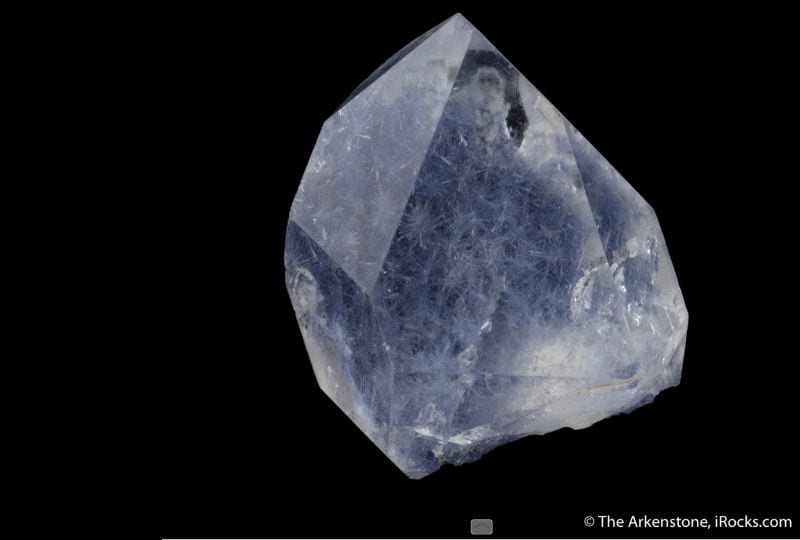
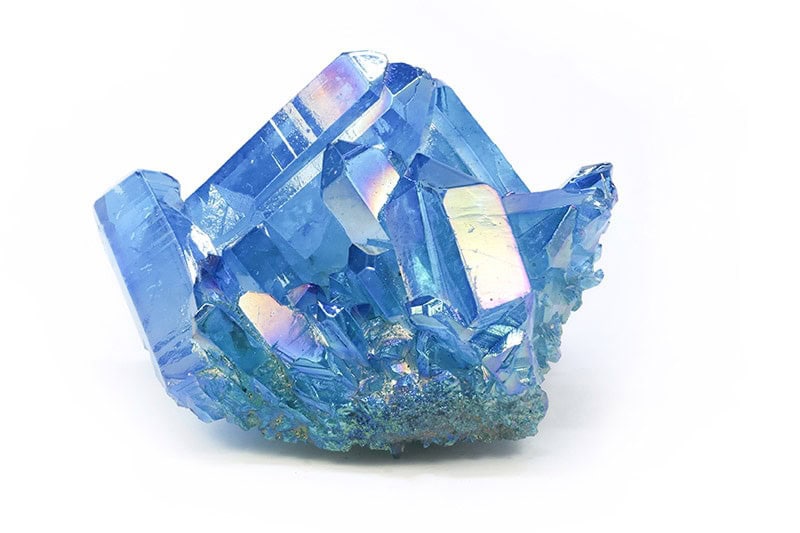
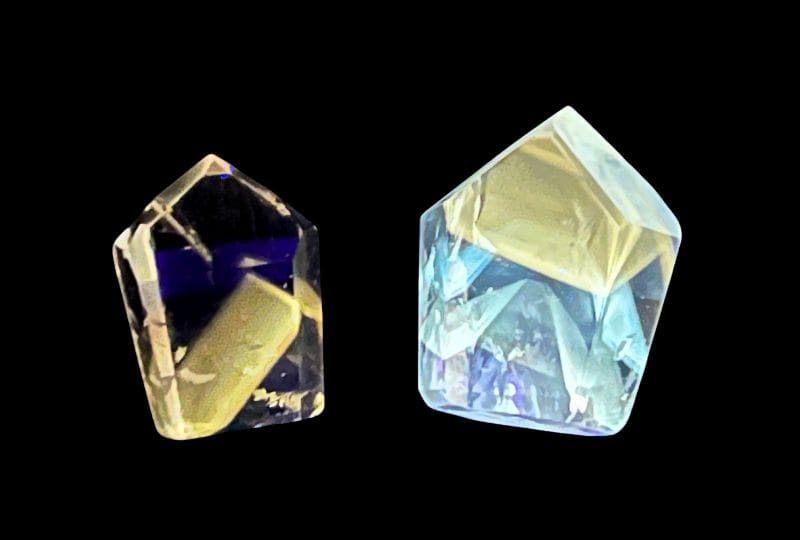
left: quartz with dumortierite inclusions, Bahia, Brazil (photo: Arkenstone via Mindat); right: aqua aura quartz, natural quartz with a vaporized aura coating
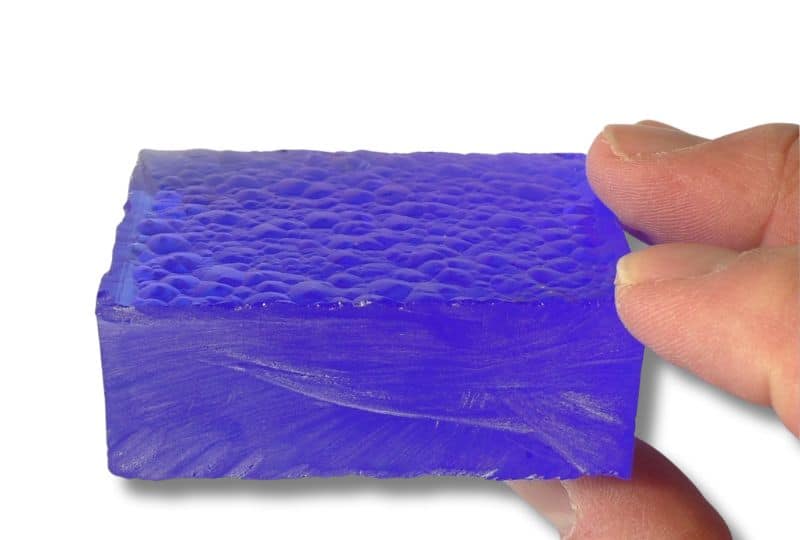
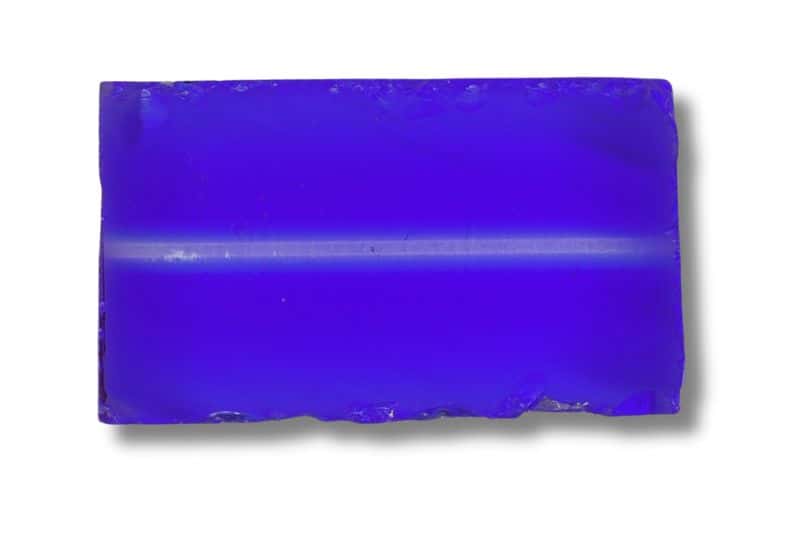
synthetic hydrothermal blue quartz from Russia, on the right the seed crystal of natural quartz can be seen in the middle (collection and photo: Henk Rijneveld FGA)
Analysis steps and results
The piece of “Siberian blue quartz” that has been analyzed looks like a piece of blue glass and not quartz with dumortierite or aura quartz, but we are looking at it step by step.
When viewing the sample under the microscope, some features immediately stand out. The stone has an even bright blue color, is clear without swirly inclusions and visible air bubbles. It has a Mohs hardness of about 5, it can be scratched with glass, but scratches glass itself with difficulty. It exhibits a typical conchoidal fracture, familiar from both glass and quartz. A density of 2.51 has been measured, matching glass (2.5) and lower than that of quartz (2.65). With long-wave UV (365 nm), the sample turns milky blue.
Although these characteristics all point to man-made glass, we had a sample analyzed to find out its exact composition, and also to determine what causes the blue color. It was shown in the lab that this is indeed man-made glass. However, the spectra that emerged from this analysis showed strong similarities to the mineral lazurite and/or afghanite. This suggests that the blue color may have come from a substance with a similar chemical structure.
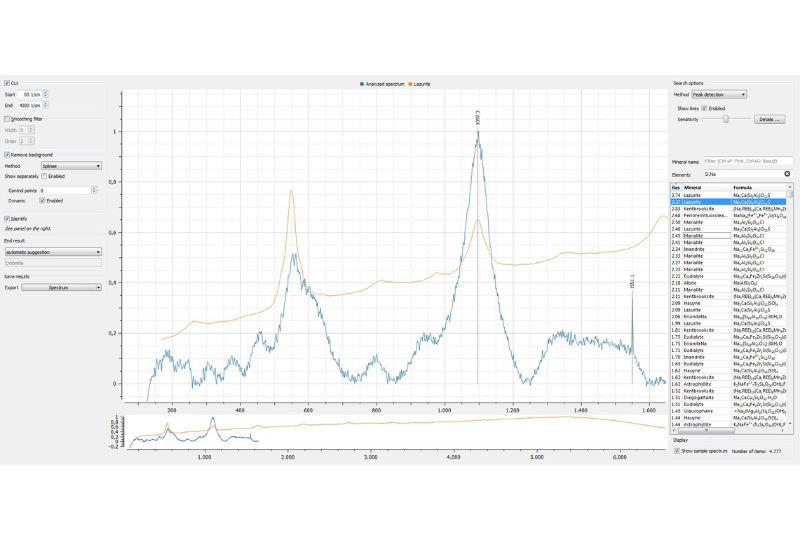
In addition, detailed EDX (Energy Dispersive X-ray Spectroscopy) analysis was performed to determine the chemical composition of the sample. The major elements found were sodium (24.06 percent by weight), magnesium (1.87 percent by weight), aluminum (2.01 percent by weight), silicon (64.56 percent by weight), potassium (0.55 percent by weight), calcium (6.72 percent by weight) and a very small amount of cobalt (0.22 percent by weight).
Revised interpretation of results (2025)
During the initial assessment in 2021, we adopted the laboratory conclusion that the blue color was possibly associated with lazurite/afghanite-like components. When digitizing the data for the Gem or Scam? library, we took another critical look at this and it turns out, however, that the EDX composition (sodium-rich aluminosilicate with calcium, and only ~0.22 percent cobalt by weight) exactly matches a common sodium-calcium-aluminosilicate glass. That small amount of cobalt is more than enough to color glass intensely blue; trace percentages are usually enough for cobalt blue. The use of natural pigments (lazurite/afghanite) is therefore unnecessary and also unlikely: such minerals should show sulfur, among other things, which was not demonstrated in the EDX. The Raman similarity with “lazurite-like” peaks could possibly be explained by color centers/Co²⁺ in the glass and/or measurement artifacts rather than true mineral inclusions.
Conclusion
Analysis confirms that this sample of “Siberian blue quartz” is not natural quartz, or a hydrothermally manufactured quartz, but a man-made glass. The blue color is caused by traces of cobalt and not by the addition of a substance with a structure and composition similar to afghanite or lazurite.
This post was published on social media and the previous Stack of Stones website in July 2021. A summary of it was included in the May 2022 book “Belazeriet of niet?’ This information was updated in August 2025 and is also available from then on through the online “Gem or Scam?” library.
If you also want to learn to better recognize minerals yourself based on their shape and characteristics follow a course with me and watch my videos.


Responses