
Podcast 002: Sulphur from the Ijen volcano

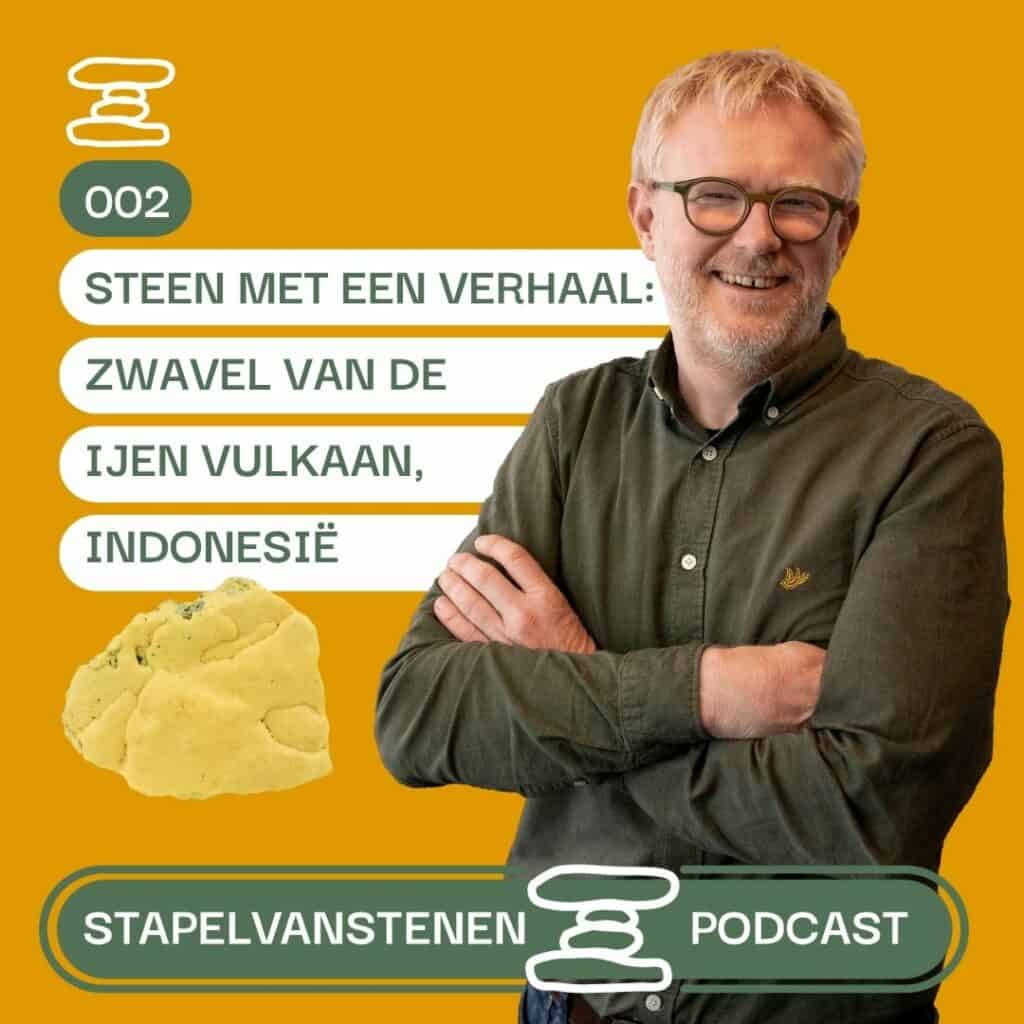
The podcast is in Dutch, but available via YouTube with English subtitles, so you can listen in – even if your Dutch is not perfect. You can also read the English text down below. Below you will also find the fully transcribed text and photos of the 1979 adventure and the sulphur piece can be found in this blog article.
In the second episode of the Stack of Stones community podcast, I like to tell the story behind a piece of sulfur from the Ijen volcano in Indonesia.
For many enthusiasts of gemstones, minerals and geology, the interest goes beyond simply collecting more stones. Above all, it is also about the stories behind the stones. Whether it is the origin of the stone itself, its properties or the fascinating story of how the stone was collected. These stories give the stones a deeper meaning and value. So we not only collect stones, but also the stories they tell.
I was reminded of this truth again recently when a friend surprised me with a beautiful piece of sulfur, complete with a fascinating story. I’d like to take you through his adventure about how he once collected this piece from a volcano in Indonesia. In addition, I tell a little more about the active Ijen volcano and the properties of the mineral sulfur itself. Photos of the 1979 adventure and the piece of sulfur can be found in a blog article on my website.
In this episode, I like to tell you the story behind a piece of sulfur from the Ijen volcano in Indonesia.
For many enthusiasts of gemstones, minerals and geology, the interest goes beyond simply collecting more stones. Above all, it is also about the stories behind the stones. Whether it is the origin of the stone itself, its properties or the fascinating story of how the stone was collected. These stories give the stones a deeper meaning and value. So we not only collect stones, but also the stories they tell.
I was reminded of this truth again recently when a friend surprised me with a beautiful piece of sulfur, complete with a fascinating story. I’d like to take you through his adventure on how he once collected this piece. In addition, I tell a little more about the active Ijen volcano and the mineral sulfur itself. Photos of the adventure and the piece of sulfur in question can be found in a blog article on my website.
When I was visiting friends a while ago I got my hands on a beautiful piece of sulfur, he asked me if I knew where it came from, “Indonesia” I said, “Yes!” he said surprised, how I could tell then… The “reading” of stones is something I have been doing for over 40 years and I recognized in this piece the typical structure of the sulfur chunks of Java as I had seen before. He asked me if I already had such a piece in my collection? “No,” I said and upon that I was allowed to keep it. He then promised to look up the old photos of the trip to the volcano where he had picked up this piece.
A few days later I get a whatsapp message from Theo, with an extensive text and a link to a folder with more than 40 scanned photos from 1979. An actually very ordinary piece of sulfur suddenly comes to life much more.
Replacement military service
During the years 1977-1980, Theo did substitute military service in Surabaya, Indonesia. He had just graduated from the Technical University Eindhoven and did not feel like going into military service at all. He was able to work for a NUFFIC project at the Instituto Teknologiko Sepuluh (ITS) in Surabaya. There he would study the behavior of microwaves, which are radio frequencies used for telephone telecommunications. Satellite communications were then on the rise, and influences of weather and reflections on the sea surface were of interest.
Working with the students and teachers at ITS, the culture and climate of Java, the nature and people…. he couldn’t imagine a more beautiful replacement for military service.
Free weekend to the volcano
In 1979, during a free weekend, Theo and two others went with the institute’s Toyota Landcruiser to the volcano Kawah Ijen. Driving through the coffee plantations, the volcano was clearly visible in the distance. But soon they had to abandon the car because a bridge was broken. They arranged horses on the spot to continue towards the crater, but after some time it was no longer possible for the animals to continue either. Then they continued on foot for several hours…. Along the way they regularly encountered men, descending into the valley, often carrying more than their own weight in sulfur chunks.
Smell of sulfur
Near the edge of the crater, around 2,000 meters above sea level, was a hut, Pondok Kawah Idjen. Sulfur smell all around, that could not be a healthy environment. I don’t know if you’ve been near a volcano before, but you never forget that sulfur smell!
Yet there were plenty of men there extracting sulfur. In the vapor and the smell of rotten eggs, one basket after another was filled only to be carried out of the crater toward the valley where it was weighed and sold.
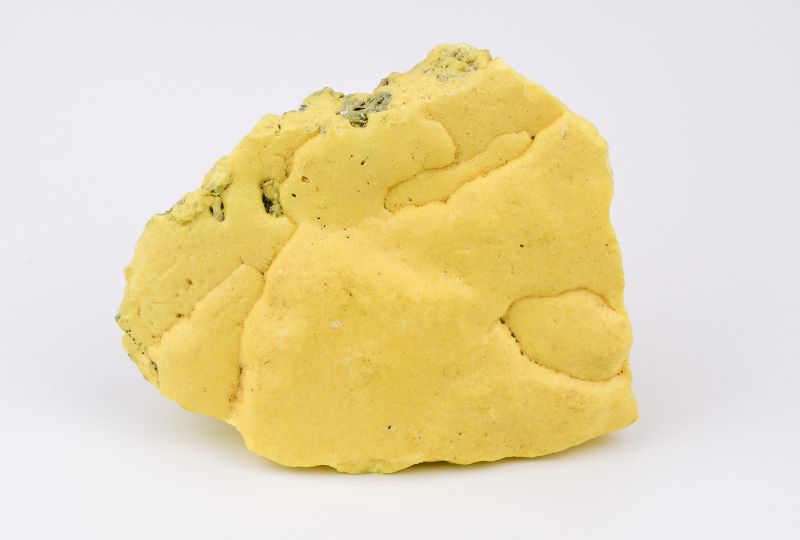
This is also where Theo picked up the piece of sulfur and took it back down the mountain and then kept it at home for years. Thanks in part to scanning the photos taken in 1979, many memories of that time came up he said. Clearly, this was a wonderful trip for Theo and now you too can get a little taste of the journey this chunk of sulfur made. At this moment, 45 years later, the piece of about 10 cm and almost 300 grams is in my showcase with my other pieces of sulfur. Thank you Theo, for the piece but especially for sharing your story.
Active volcano
The Kawah Ijen has an altitude of about 2250 meters and is part of a larger volcano complex. Together with several other well-known volcanoes, such as the Merapi (2800 meters) and the Raung (3332 meters), it lies in a caldera over 20 kilometers wide. A caldera is a large bowl-shaped crater created when the upper part of a volcano explodes or the ceiling of a volcano’s magma chamber collapses. The volcanic complex is still very active. In 2013, for example, the Ijen was closed to visitors for six months due to the volcano’s activity.
Ijen volcano has a one-kilometer-wide turquoise colored acidic crater lake. This lake is one of the most acidic lakes on earth and is even said to have a pH of 0.5 according to measurements. The crater lake is also a source for the Banyupahit River, resulting in highly acidic and metal-enriched river water that has a significant detrimental effect on the downstream river ecosystem. Labor-intensive sulfur mining still takes place along the crater lake, where sulfur-laden baskets are carried by hand from the crater floor. So more than 45 years after my sulfur chunk was picked up there, conditions have hardly changed.
The sulfur is melted, already melting at 119 degrees Celsius, and led out through ceramic pipes. There it solidifies again and forms a yellow mass that is chopped into pieces. The melt structure is also visible on the surface of my piece. So that possibly means that my piece was not formed entirely naturally either.
Although it looks like yellow Styrofoam, the two baskets the men carry together weigh an average of 90 kilograms. It is a walk of about two and a half hours. The men walk this trip an average of 2 times a day and get paid per kilogram which amounts to about €5 per catch. So the total salary for 1 day is about €10.
As a tourist, you can also still climb the Ijen. However, you must do this under the supervision of a guide. The hike has five rest stops and at the top an opportunity to rent gas masks. This is not an unnecessary luxury, besides the unbearable smell of rotten eggs, prolonged stay in the sulfur vapor is not good for your health.
Mineral sulfur
Finally, in this podcast I want to tell you about the mineral sulfur itself.
Sulfur belongs to the class of elements, as it consists only of the element sulfur. Its color is actually always yellow, but can also be somewhat brownish or greenish yellow. It has a hardness of 1 ½ – 2 ½ on the Mohs scale, so it is quite soft, and is also often brittle. Sulfur has a specific gravity of 2.07, somewhat lighter than, say, calcite or quartz. In addition to granular masses, powdery layers and crusts, sulfur can also form beautiful crystals. Crystals according to the orthorhombic system are usually block-shaped with a point on two sides, but thick flat crystals or more elongated double pyramids also occur. The element sulfur naturally also occurs in association with other elements in various minerals such as pyrite, galenite, sphalerite, and so on.
Although sulfur is perhaps best known from volcanic areas, most sulfur is found in sedimentary rocks. Large deposits of sulfur are formed by reduction of sulfates, often of biogenic origin. Sulfur is then found for example in combination with gypsum or anhydrite, such as the sulfur in gypsum from Weenzen, Germany or the known deposits from Poland together with celestine, also a sulfate.
But sulfur is thus also a common deposition product of volcanic gases in combination with realgar, cinnabar and other minerals. This is also how the sulfur at the Ijen volcano was formed. I have seen crystals of sulfur in several places around the world at volcanic areas, at so-called solfatars or hot sulfur springs. Those crystals, by the way, are very fragile and you almost never get to take them home whole, moreover, you run the risk of burnt fingers when collecting them, so take a nice picture and leave them there.
By the way, the most beautiful sulfur crystals, in my opinion, come from around Agrigento in Sicily, often in combination with a base of beautifully fluorescent aragonite. Be careful because man-made crystals of this are also in circulation. Although, most synthetic sulfur crystals come from China. Typical are the elongated points, grown on a substrate of fluorite. Examples are in my book “Belazeriet of niet?” and in the Gem or Scam Library.
Sulfur is widely used as a raw material in the chemical industry. For example, for the production of sulfuric acid and for vulcanization in the rubber industry. Other uses of sulfur include: fertilizer, fireworks, matches, pesticide in horticulture and fumigation of wasp nests. Sulfur was also formerly used extensively in the production of gunpowder.
Risks
Since I regularly get questions about the safety of sulfur in your collection briefly a word about risks. Elemental sulfur in the form of crystals or solid lumps is not particularly risky. This is because sulfur is insoluble in water and it is of little toxicity to humans. Ingestion of too much sulfur, however, can cause burning sensations or diarrhea. Inhaling sulfur dust can irritate the respiratory tract or cause coughing. It can also be irritating to the skin and eyes. So some caution, especially with powdery pieces, is desirable, and washing hands after handling pieces of sulfur is always a good thing to do.
Certain compounds containing sulfur and the sulfur dioxide gas (SO2(g)) are toxic, however, and can trigger violent asthmatic attacks in some people. Therefore, do not heat sulfur and watch out at hot sulfur springs near a volcano. Many volatile sulfur compounds have an unpleasant odor of rotten eggs. In any case, it is not recommended to stay in them for a long time.
I find reading about stones and their stories extraordinarily fascinating, I hope you now also look differently at that “ordinary” piece of sulfur in your collection.
Stay curious, keep collecting, and above all, keep enjoying the stories behind the stones. I’m already looking forward to telling you another story in a new podcast episode.


Responses