
Podcast 005: The versatile mineral jasper

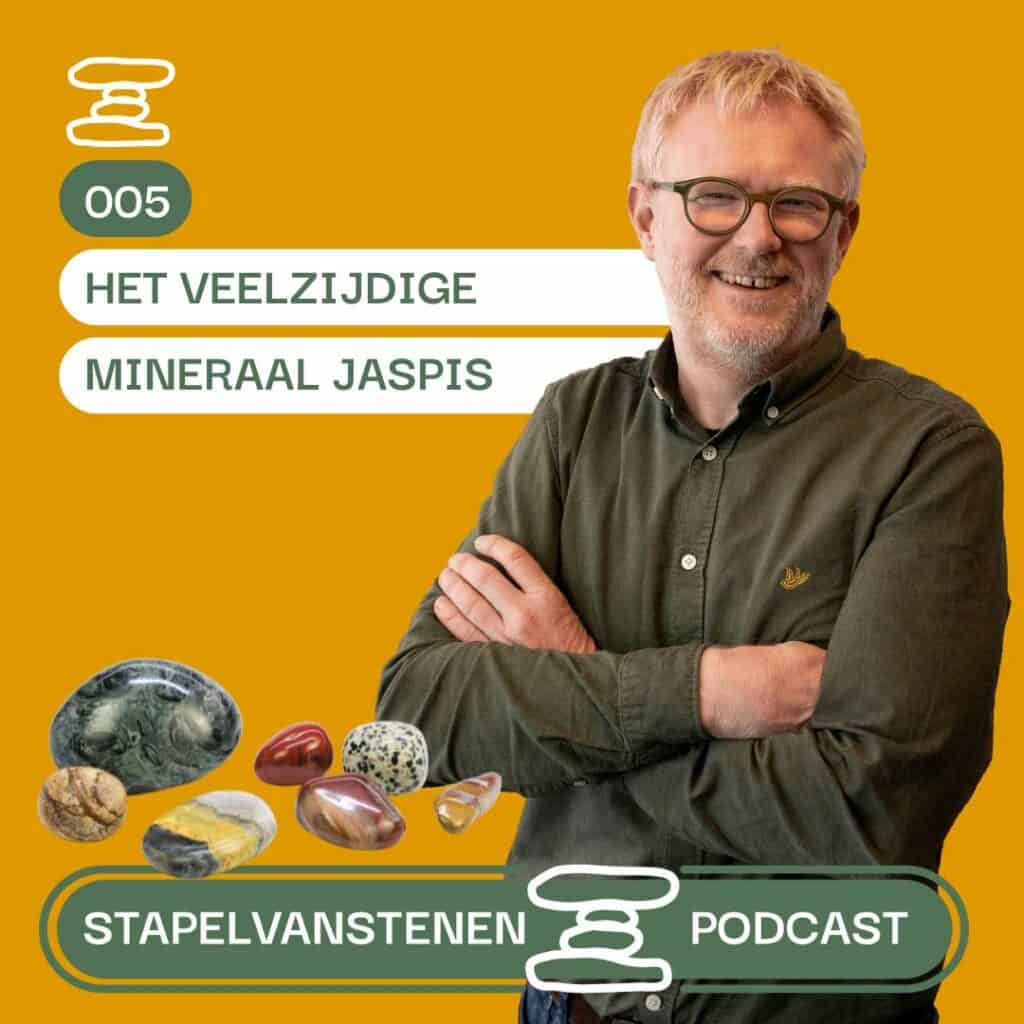
The podcast is in Dutch, but also available via YouTube with English subtitles, so you can listen in – even if your Dutch is not perfect. Below you will also find the fully transcribed text.
In this episode of the Stack of Stones community podcast, I like to talk about the mineral jasper. A very famous stone that has been collected and used by humans since ancient times. And many enthusiasts, I think, have a rough piece or polished form of jasper in their homes.
But the name jasper might also be the most misused name for lots of different variegated rocks or minerals that are not jasper at all. In this podcast I talk a little about the history of jasper, what we mean by jasper, what properties it has and how it is formed. I will also discuss some common types of jasper and explain stones that are called jasper but actually are not.
A little history about the mineral jasper
Jasper has been valued as a “gemstone” since ancient times, including for jewelry, for tool production and seal stones for trade to mark goods and transportation. In Minoan Crete, for example, jasper was carved around 1800 B.C. to produce seals, as evidenced by archaeological finds at the Palace of Knossos. Jasper was also used in prehistoric times – like flint – to make tools such as scrapers and arrowheads. Prehistoric men already understood that jasper has a fine structure and composition and they took advantage of these properties to make razor-sharp tools from a jasper stone. For example, green jasper was used to make arch drills in Mehrgarh in Pakistan, between the 4th and 5th centuries BC. Today, jasper is especially popular as jewelry and for ornamental objects.
What is jasper?
This is a question that is actually not at all easy to answer. Historically, the name jasper has long been used for an opaque chalcedony or a microcrystalline hornfels. Because of the many fine inclusions, the stone we classically call a jasper often has a red, brown or green color, but jasper can have many different colors. This is also reflected when we look at the origin of the name.
Indeed, the name jasper literally means “spotted or speckled stone” and is initially derived from ancient Semitic languages: from Yashpeh in Hebrew and Yashupu in Akkadian, for example. Via Greek iaspis, Latin iaspidem and Old French jaspre to jaspis in the Dutch language area and jasper in English. It is good to realize that throughout history, these were not always the same stones, but stones with different colors and transparency. At some point even diamond was referred to as a transparent form of jasper. Even in the present time we see that the name jasper is used for different stones all the time. All sorts of variegated, opaque stones, whose composition is not always known, are given the name jasper in order to sell the material. More on that later.
By the way, jasper is not an official mineral name, as registered by the International Mineralogical Association (the IMA), but is usually referred to by mineralogists as a microcrystalline, fine-grained, opaque variety of the mineral quartz with about up to 20% admixture of “impurities.” And those impurities can be fine inclusions of hematite, iron hydroxides and other minerals. Jasper is closely related to chalcedony, the “fibrous” translucent quartz variety. Its designation as a variety of the mineral quartz is based, as is common in mineralogy, on its chemical composition (SiO2) and internal crystal structure (microcrystalline trigonal).
Because of jasper’s enormous variety of external appearances, there is an understandable need among enthusiasts and sellers to give all these forms their own names. Moreover, this is a way to make a common stone more special and thus more marketable. So when you google “jasper,” an infinite number of names and types come up. A selection of names I came across: flower jasper, Bruneau jasper, kaleidoscope jasper, cappuccino jasper, dalmatian jasper, fancy jasper, K2 jasper, Kambaba jasper, kiwi jasper, landscape jasper, leopard jasper, ocean jasper, Picasso jasper, polychrome jasper, porcelain jasper, rainforest jasper, volcano jasper, and so on. I will explain some of these names later in this podcast.
Classifying and naming jasper varieties is challenging, definitions vary and there are many local names. As with many other stones in commerce, the naming of jasper has become quite a chaos. I also briefly discussed the problem of out-of-control naming in the previous episode on Scammite.
But when you look at all these jasper names, we do see a certain pattern. This is because most of the jaspers are given a name based on appearance, such as color or texture, for example leopard jasper and landscape jasper. There are also jaspers that are given a name linked to the geographic location where they are found, for example Bruneau jasper after Bruneau Canyon, a canyon in Idaho, in America. And finally, there are jaspers that are given fantasy or esoteric names, such as fancy jasper or imperial jasper.
Unfortunately, outside of the IMA, which deals with the official naming of minerals, there is nobody that oversees the commercial naming of stones such as jasper. There are industry guidelines, for example from the CIBJO and a number of gemological institutes, such as the GIA in America and GEM-A in Britain, but these also do not contain clear definitions of the various jaspers. Even the widely used databases such as Mindat and Mineralienatlas do not provide definitive answers. By the way, on Mineralienatlas there is an extensive article with background information on jasper.
There are proponents of a system that bases the naming and classification of jasper on its mode of origin, but this has never actually been widely implemented. While there is certainly something to be said for this, the mode of genesis, like chemical composition and crystal structure, cannot always be identified by appearance. In contemporary mineralogical and gemological literature, use of the term jasper is suggested only in the case of “true jasper” (consisting mainly of microcrystalline quartz) in combination with a so-called metasomatic or metamorphic mode of genesis. I will return to that mode of jasper’s genesis later.
From a day-to-day perspective, however, a description of the appearance and properties that can be tested seems most logical. Therefore, let’s look at the properties of jasper that you can observe and possibly test to determine if you are indeed dealing with a jasper.
Properties of the mineral jasper
For something to be called jasper, it must consist mostly of silica (SiO2). But jasper is rarely found in pure form. Admixtures with quartz, chalcedony, agate and opal are not uncommon. But admixtures up to 20%, of alumina, iron oxide, iron hydroxide and manganese hydroxide are also common. This unfortunately makes the chemical and physical properties highly variable.
Based on its mineralogical designation, it is a microcrystalline, fine-grained variety of the mineral quartz. So that means that there can never be crystals of jasper visible to the naked eye, and even the fine grains you won’t be able to see in most cases without an electron microscope. Jasper is found only in massive, compact masses. Jasper is always opaque and has a greasy, silky or matte to waxy luster on the fracture surfaces. It shows no cleavage but an irregular to shell-like (conchoidal) fracture.
The color is usually red, yellow, brown or green in color, rarely blue. But the amount and distribution of admixtures help determine the appearance, so the variation in color and patterns of jasper is extremely wide. The common red color is due to inclusions of the mineral hematite (an iron oxide). Red jasper is therefore also called ironstone. The streak color of quartz is white, but due to the inclusions present in jasper, it can be variable and therefore cannot be used for determination.
The hardness of most jasper is like that of quartz, 6½ to 7 on the Mohs scale. But so is the hardness of other quartz varieties that may resemble jasper or with which it is fused, such as chalcedony and agate, so the hardness is not always conclusive either.
The specific gravity of jasper is described as between 2.5 and 2.9, but the question is to what extent that is useful to identify a stone as jasper. As indicated, jasper consists mostly of quartz, with a specific gravity of about 2.65, but contains up to about 20% of various, sometimes unknown admixtures with unknown influence on the specific gravity.
For a gemologist there is still the possibility to measure a refractive index (RI) with a refractometer. To make a good measurement, a flat surface is preferably needed; in the case of a cabochon cut stone, a so-called “spot measurement” can possibly be made. Since silica is the main ingredient, expect an RI of about 1.54. But we can also measure that value in chalcedony or quartz which also consist of silica, and thus is only meaningful in combination with other characteristics.
So, in summary, identification of “true jasper” with the naked eye is quite difficult. The main properties we can observe, however, are: 1. jasper occurs in massive, compact masses, with no visible crystals or grains; 2. jasper is always opaque and can have a variety of colors and patterns; and 3. its hardness is about 6½ – 7, like that of quartz.
The rest of the characteristics cannot be easily determined by most enthusiasts. And for a precise identification, microscopic, X-ray and in some cases additional chemical and spectroscopic examination methods are therefore recommended.
Having such costly analyses performed is not realistic for a jewel of jasper or a simple tumble stone or object. The question is also whether exact identification is relevant to most enthusiasts. In the end, stones or objects of them are collected mainly because someone likes them and the name is adopted as given by the seller. Enthusiasts also look for specific species or names based on examples in books or on the Internet.
However, in the two episodes on Scammite, I have already explained why I do consider correct naming of gems and minerals important and thus also with jasper. Further on I will therefore also give some examples of the incorrect use of the name ‘jasper’ for a number of well-known stones. But first I will explain how jasper is formed.
How is jasper formed?
The mineral jasper occurs mainly in fissures or cavities in volcanic rocks, in a number of different ways:
First, through volcanic processes: Jasper can be formed when volcanic gases and liquids react with the volcanic rocks and sediments, both at the surface and deep within the earth. Jasper can also form hydrothermally, when hot water, which contains a lot of silica (SiO2), flows through volcanic rock and reacts with it.
But surely quartz can hardly dissolve in water I hear you thinking, so how can jasper be created in this way? Well, the silicon stored in other minerals in the magmatic rocks, such as in feldspars or micas, can dissolve in hot water. Then silica is formed. The water flows through cracks and passages in the rock. When the silica can no longer remain dissolved, because the temperature becomes too low or the concentration of silica becomes too high, water-rich quartz starts to precipitate. Usually a kind of gel is formed at first. As more water evaporates, jasper is formed from this. The many colors and patterns form during the hardening process due to flow and deposition patterns in the original silica-rich sediment or volcanic ash.
Second, jasper may be formed by metamorphosis: jasper may then be formed when rocks are altered by heat and/or pressure, for example near a magma chamber or lava flow, or by subsequent changes in volcanic ash layers or other existing rocks. Even fossil tree trunks covered by volcanic ash can eventually be transformed by metamorphosis into jasper, chalcedony, opal or combinations thereof. Another well-known form created by metamorphism are the red silica-rich parts of thick layers of iron ore, called Banded Iron Formations (BIFs). This occurs as a sedimentary rock in ancient oceans, where the iron-rich mud is converted into a type of hornfels and eventually a mineral related to jasper. Strictly speaking, this is not considered “true jasper” by some, so it is usually referred to as “jaspilite.”
I will now describe some well-known types of “true jasper.”
Different types of jasper
As has become clear, classifying and naming jasper varieties is a huge challenge, I will therefore limit myself here to a few common varieties.
The best known and the most common jasper is the red, red due to inclusions of hematite. We also see a lot of yellow and brown jasper, with the color usually caused by goethite. Sometimes this type of material from a particular locality is given the geographical name, for example, red African jasper or brown Egyptian jasper.
A well-known dark green jasper with red spots is also called heliotrope or bloodstone. Unfortunately, lately I regularly see the incorrect use of the name bloodstone or heliotrope for a variety of other green or gray rocks with fragments of red jasper, including African Bloodstone or African heliotrope, which is partly composed of other minerals as well.
Polychrome jasper, is a variegated jasper with gray-green-blue hues containing reddish-brown spots and bands. The name is derived from the Greek, poly=many and chromos=color. It is mainly marketed from Madagascar.
Landscape jasper or also called Picture jasper shows vivid patterns on its surface, which with little imagination can be interpreted as stylized landscapes or plants. The brown color is caused by admixtures of goethite (i.e., iron). The lines are probably caused by circulation of hot liquids through the stones creating different concentrations of iron particles. An example of a landscape jasper that has received a local name is the Bruneau jasper from the Bruneau River Canyon in Idaho in the US.
Of course, there are many more jaspers to describe, but for now I will leave it here and would like to give some more examples of incorrect use of the name jasper.
Scammite jasper?
The name jasper, as mentioned above, is nowadays used indiscriminately for all sorts of opaque, variegated rocks. Many of these stones do not even contain any quartz at all, nor do they have the same properties as jasper, but these properties are mentioned with it (such as hardness or chemical composition). Examples include K2 jasper, Kabamba jasper, Dalmatian jasper and kiwi jasper.
So many of the types of jasper ‘gems’ on the market today are not real jasper. And in some cases it is not even a natural material at all, but colored clay or epoxy with fancy names like ‘sea sediment jasper’ or ‘imperial jasper’. In my book “Belazeriet of niet?” and in the online Gem or Scam Library I describe over 40 types of “jasper” what it is mineralogically/geologically. A few examples I will share with you in this podcast.
Bumblebee “jasper,” for example, is a trade name for colorful calcite found on a volcano in Indonesia. It is named for its resemblance to the black and yellow stripes of a bumblebee. The material consists of fibrous calcite with yellow, orange and black stripes. The orange and yellow colors are mainly caused by finely divided realgar. The black color is caused by the presence of pyrite. By calling this calcite-containing rock a jasper, the stone appears to be as hard as quartz or jasper, but the opposite is true. The volcanic rock is quite soft and brittle, and it also contains the toxic arsenic sulfide realgar. By using the name jasper, without mentioning the actual components, buyers cannot properly inform themselves about the properties and risks of this stone. I made an extensive video about this that you can watch back on my YouTube channel.
Dalmatian “jasper” is a trade name for a rock (a microgranite) consisting of dark flecks of arfvedsonite in a light matrix of feldspar. Named for its resemblance to the Dalmatian dog. The material is often incorrectly referred to as a “jasper” and the black flecks are often incorrectly identified as tourmaline. Dalmatian stone would be an excellent designation as far as I am concerned. Another example of a granite marketed as jasper is kiwi jasper (consists of albite and orthoclase, quartz, mica and a clay mineral from the smectite group). It contains no amazonite and no tourmaline as still claimed by some sellers and is therefore definitely not jasper. Also K2 jasper is not jasper but granite with blue flecks of azurite.
Finally, Kabamba or Kambaba “jasper,” also a misnomer. In this case, it is a gray-green to blue-green volcanic rock with dark “eyes,” native to Madagascar. Thus, it is also not a type of jasper, but a rhyolite. Incidentally, this rock is offered under many other names: eldarite, nebula stone, nebula jade, crocodile stone and crocodile jasper. Sometimes the stone is also incorrectly referred to as a stromatolite or other fossil. It was determined by X-ray diffraction that the green part of the rhyolite rock consists of the minerals quartz, pyroxene (aegirine), albite and a potassium feldspar. The characteristic dark round structures consist of needles of amphibole minerals (composition from riebeckite to pargasite).
So you can read more such examples back in the Gem or Scam Library.
Although it will be difficult to part with long-established trade names, we also know from history that naming is subject to change over time. After all, a name exists as long as it is used in commerce. While that means that new names for jasper will likely continue to be added, it also provides opportunities to stop using incorrect names which will hopefully eventually make them disappear.
With the information in this podcast, I hope to have at least given you more clarity about the versatile mineral jasper and contribute to a more uniform naming in the world of gems and minerals.
Stay curious, keep collecting, and above all, keep enjoying the stories behind the stones. I look forward to telling you another story in a new episode.
Be sure to watch the following video about jasper in which you can see all kinds of examples from my collection:



Responses