
Agate

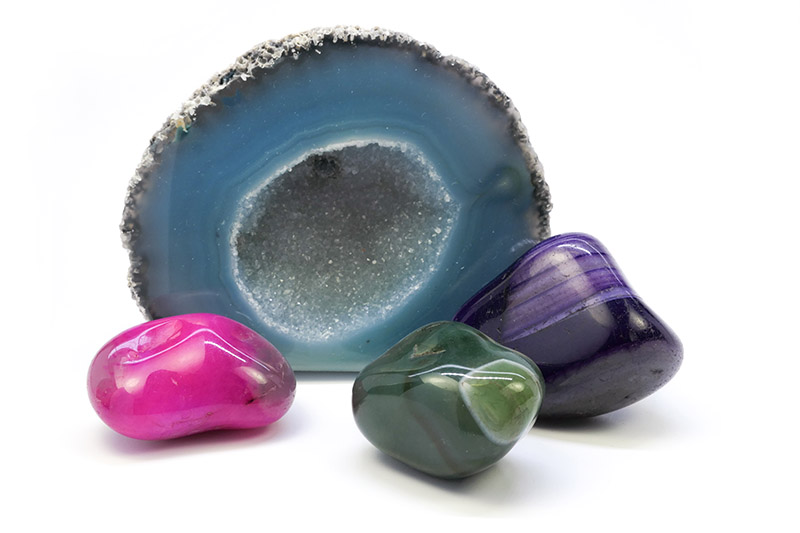
Name for a distinctly striped or banded chalcedony. Originally found in the river Dirillo (formerly Achates) in Sicily, Italy, from which the name is derived. Most agate in commerce is natural, but a lot of colored or treated material is also sold where this is not always disclosed.
The bands in agate are visible because of natural differences in translucency. Layers appear darker when more translucent (this may appear reversed in transmitted light). This effect may be accompanied and enhanced by changes in the color of adjacent layers due to inclusions of other minerals. In old agates that have been subject to weathering and chemical alteration, the differences in translucency may disappear; such specimens may become almost opaque.
Agate, by the way, is not simply “chalcedony with bands”. There are other varieties of chalcedony that have bands that do not fit the above description, for example flint with bands. In addition, there are a number of varieties of chalcedony called ‘agate’ that also do not fit the definition given above. A good example is ‘fire agate’. This is not a variety of agate, but of chalcedony, with inclusions of goethite or limonite, creating an iridescent effect or ‘fire’.
Because the colors and patterns found in agates are so varied and often characteristic of a particular locality, for example, there is a confusingly large number of ever-changing varieties and trade names. In Roger Pabian’s “Agate Lexicon” on the University of Nebraska-Lincoln website1 you will find descriptions of thousands of names of agate varieties.
Agate consists of so-called fibrous chalcedony. In thin slices, the fibers are sometimes visible in transmitted light and can produce interesting optical effects (see iris agate). Because the individual crystals in the fibers are not tightly interlocked, agate is slightly porous and can be easily dyed.
Many of the agates from South America are generally gray and brown by nature and not very attractive. After artificially coloring them, however, they find eager appeal. Fortunately, most enthusiasts know by now that bright blue, green, purple, pink and yellow agate slabs are often dyed. Unfortunately, this is still not always disclosed.
By the way, the art of dyeing agates has been known for a very long time and in Idar-Oberstein, Germany, among other places, it has been done since the 1920s. A very detailed article on this can be read on the Mindat website2. Dyeability depends on the porosity and opal and water content of the individual bands. White bands consisting of dense quartz aggregates take on little or no color. Dyed agates are sometimes difficult to distinguish from real ones with the naked eye, except when a particular color does not occur in nature, such as fuchsia purple or bright blue. However, that means that many of the orange (“carnelian“), brown (“sardonyx“) and black agates (“onyx“) from South America are also often treated or colored. For a long time, people did not find it necessary to mention this treatment when selling dyed agates. But today there is a trend toward more honest information when selling minerals and gemstones, especially also because the market is flooded with man-made or treated stones.
Recently (2021), large polished stones of reddish-brown agate appeared on the market under the name bandagate, carnelian or sardonyx. Most of these stones are treated which enhances the color and banded texture. The stones then first go into a sugar solution after which they go into hot sulfuric acid which carbonizes the sugar and darkens the stone. When cutting or sawing through these stones, a clear difference can be seen between the superficial treated exterior and the paler interior. See also band agate and sardonyx.
Also beware of so-called “enhydro” or “water agate”: agate with enclosed water. There are both tumbled stones and polished half geodes on the market that contain visible water. Although it is quite possible that ‘primordial water’ is enclosed during the formation of certain minerals, the question with water agates is whether this is always entirely natural and how old the water is then. Indeed, most of the enhydro agates sold are placed in water so that water is drawn into the cavity through the porous exterior. See also enhydro agate.
In the following video, Dr. George Rossman (Professor of Mineralogy, California Institute of Technology, Pasadena, CA, USA) gives a clear explanation of the natural causes of color in agate and chalcedony.
Also check out my video below on agate, a recording of an educational live session for mineral and gemstone enthusiasts from my community. I give a brief theoretical introduction about the origins and properties of agate after which I show a variety of examples (in Dutch).
- University of Nebraska-Lincoln, School of natural resources, “Agates Lexicon,” University of Nebraska-Lincoln, 2021. [Online]. Available: http://snr.unl.edu/data/geologysoils/agates/agateslexicon.aspx.[Accessed 2024]. ↩︎
- D. Russell, “Historic Methods of Artificially Coloring Agates,” Jan. 13, 2008. [Online]. Available: https://www.mindat.org/article.php/170/Historic+Methods+of+Artificially+Coloring+Agates. [Accessed 2024]. ↩︎




Responses